
FOMO Trading: How to Stop Chasing and Start Profiting
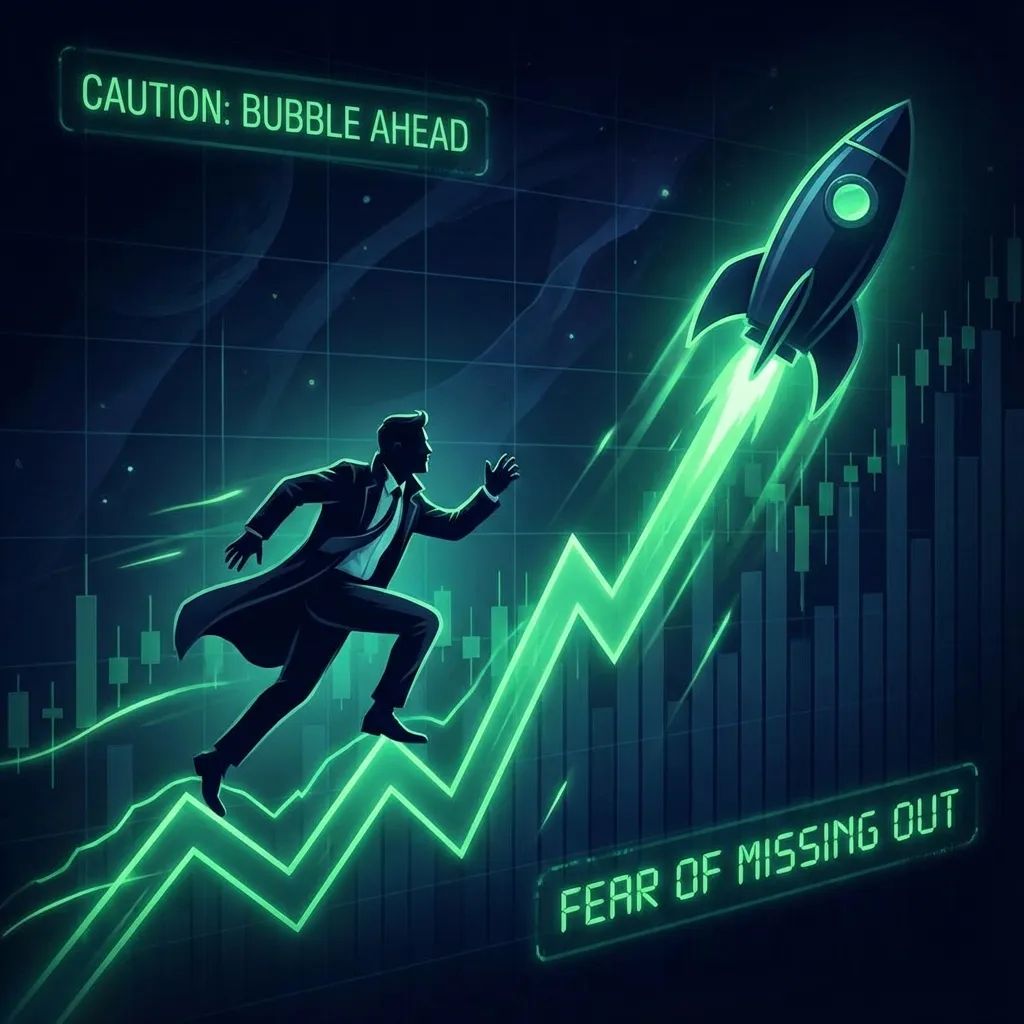
It usually starts innocently enough. You check your phone in the morning and see a tweet about a random stock or cryptocurrency that has surged 30% overnight. You shrug it off. An hour later, it's up 50%. You start paying attention. By lunch, it's up 100%, and your group chat is blowing up with screenshots of massive gains. Your friend texts you, "Are you in this? I just made a month's salary in two hours." That is the moment the virus takes hold. Your logic center shuts down, your pulse quickens, and you scramble to buy a vertical green candle at the exact top. FOMO (Fear Of Missing Out) is the most destructive, capital-eroding force in trading, capable of wiping out years of discipline in a single afternoon. It is the predator that eats inexperienced capital. It is not a strategy; it is a psychological breakdown.
Key Takeaways
5 points- 1The Trigger: FOMO is biological, not logical. Watching others get rich triggers the same pain centers in the brain as physical injury or social accumulation.
- 2The Setup: FOMO usually strikes after a missed opportunity. You vow not to miss the 'next one', leading to impulsive, revenge-based entries.
- 3The Trap: Late entrants provide 'Exit Liquidity' for the smart money and algorithms who bought weeks ago. You are buying their sales.
- 4The Check: If you feel urgency, anxiousness, or envy, DO NOT TRADE. Real opportunities are boring, repetitive, and planned.
- 5The Cure: Process over outcome. If the trade wasn't in your plan yesterday, you can't take it today.
Who This Is For
Beginner LevelPerfect if you:
- You bought a stock because 'everyone on Twitter' was talking about it and you felt left out
- You chased a pump, got wrecked, sold the bottom, and then watched it rally again
- You feel physical anxiety or tightness in your chest when you see a coin up 50% that you don't own
- You trade size that is too large to 'make up for lost time' or previous losses
You'll learn:
- The deep psychology of the 'Social Feedback Loop' and Validation seeking
- The 4 distinct types of FOMO limiting your returns (Social, Financial, News, Regret)
- How to differentiate between a legitimate Breakout and a FOMO Trap
- The '3-Day Rule' and 'Dopamine Detox' protocols to reset your brain
- How to use 'Limit Orders' to force discipline and kill impulse
- Why 'JOMO' (Joy Of Missing Out) is the ultimate trader superpower that separates pros from amateurs
Part 1: The Anatomy of a FOMO Trade
FOMO doesn't happen in a vacuum. It follows a predictable, 4-stage lifecycle that repeats in every market cycle, from Tulip Mania in the 1600s to the Dot Com Bubble in 1999 to Crypto in 2021. The asset changes, but human nature remains exactly the same. Learning how to overcome FOMO in stock trading starts with understanding this cycle—it is your vaccination against it.
The asset is boring. Price is flat or slowly grinding higher. Technicals show a base forming. Professional traders and institutions accumulate quietly. No one is talking about it on Social Media. The news is silent. This is where the wealth is generated—in the silence.
The breakout happens. Price moves up 20-30%. Early trend followers and breakout traders jump in. The first tweets appear. You see it, but think "I'll wait for a pullback," or "It's too extended right now." You are still acting rationally and adhering to your rules.
Price goes vertical. It's up 100% in a week. Your friend brags about his gains. Mainstream news outlets (CNBC, Bloomberg) cover it. You feel stupid for waiting. You feel envy. You abandon your logic mechanisms. You panic buy at the market price just to "be in" and stop the pain of missing out. You have just bought the top.
Smart money sells into your buy order (Exit Liquidity). Momentum stalls. The price crashes 30% in an hour. You freeze, thinking "It will come back, it's a good asset." It drops another 50%. You are now a "bagholder" for years, praying to break even. This is the graveyard of capital.
Part 2: The Biology of Panic
What is FOMO in trading, and why is it physically painful to watch a stock go up without you? Why do you feel a tightness in your chest or a pit in your stomach when you see a position you don't own running higher?
Anthropologists trace this back to tribal survival. In a tribe of 50 people, if everyone else found a new food source and you didn't, you starved. If everyone else moved to a new cave and you didn't, you were eaten by a tiger. Social exclusion was a death sentence. Our brains have not evolved for the stock market; they are still optimized for the savannah.
The Amygdala Hijack
Your brain treats "Missing a 10% gain on NVDA" as an existential threat to your survival. It activates the Amygdala (the lizard brain, responsible for fear and fight-or-flight).
- Cortisol Floods: The stress hormone increases, significantly reducing your ability to think long-term or assess probability.
- Prefrontal Cortex Shuts Down: The part of your brain responsible for logic, math, impulse control, and risk assessment literally goes offline. You become functionally dumber.
- Adrenaline Spikes: You feel a physical urge to click "Buy" to relieve the tension. The act of buying is not about profit; it is about stopping the anxiety.
In this state, you are not an investor making a calculated bet. You are a cornered animal reacting to a threat. The market is designed to exploit this specific biological flaw.
Part 3: The 4 Types of FOMO
Not all FOMO is the same. Identifying which specific type you suffer from is the key to how to stop FOMO trading for beginners. Most traders suffer from a combination of these.
"Everyone on Twitter is getting rich except me." This is driven by envy and social comparison. You see curated highlight reels of other people's wins and feel inferior.
"If I miss this trade, I won't be able to pay off my debt." This is driven by desperation and financial need. You view the market as a lottery ticket to solve your real-life problems.
"The CEO just tweeted! The upgrade just came out!" This is driven by urgency and breaking news. You feel you must react instantly to new information, not realizing the algorithms already reacted in milliseconds.
"I sold too early and now it's up another 50%." This is driven by the pain of a previous mistake. You re-enter a trade you already closed just because it kept going, usually right at the top.
Part 4: The Social Feedback Loop
Social media has weaponized FOMO. In the past, you only knew if your neighbor got rich. Now, you open Twitter/X and see a 20-year-old turn $500 into $50,000. This creates a psychological pressure cooker.
For every screenshot of a 1,000% gain, there are 99 traders who blew up their accounts. But the losers don't post screenshots of their liquidation emails. You are looking at a fundamentally distorted reality. You are comparing your "Behind the Scenes" (struggles, losses) to everyone else's "Highlight Reel" (wins only). It is statistically impossible for everyone to be winning all the time.
Algorithms feed you what you click on. If you click one bullish post about crypto, your entire feed becomes "Crypto to the Moon," silencing any bearish arguments. It creates a false consensus that "everyone is winning except me," which amplifies the panic to buy. You stop seeing risks because your feed has filtered them out.
Part 5: The Addiction Mechanics (Variable Rewards)
Behavioral psychologist B.F. Skinner discovered that the most addictive way to reward a rat was not every time it pressed a lever, but randomly. This is known as a "Variable Reward Schedule."
Trading is the ultimate variable reward machine. Sometimes you buy and win instantly (Reward). Sometimes you buy and lose (Punishment). This randomness creates a chemical addiction stronger than guaranteed rewards. FOMO is often the withdrawal symptom of that addiction. You crave the action, not the profit. You want the dopamine hit of "being in the game," regardless of the outcome.
Case Study: The GameStop (GME) Saga
Educational ExampleHow Retail Traders became Exit Liquidity
Deep Fucking Value (Roaring Kitty) identifies a short squeeze based on fundamental analysis. He enters early. Smart money joins. This is the "Stealth Phase."
Hedge funds cover their shorts. Volatility explodes. Early retail traders join. This was the "easy money" phase where legitimate profits were made.
Mainstream news covers it. Grandmas are asking how to buy it. People take out loans. "It's going to $1,000!" This is late-stage mania. Buying here is not investing; it is charity for the people selling.
Price crashes to $40. Those who bought at the top lost 90% of their savings. They bought excitement, not value. They were the liquidity for the professionals to sell. The cycle is complete.
This is a hypothetical scenario using historical market data for educational purposes only. Past performance does not guarantee future results.
Part 6: The Antidote - JOMO
The opposite of FOMO is JOMO: The Joy Of Missing Out.
JOMO is the quiet confidence of knowing your strategy is sound. It is looking at a stock rallying 20% and saying: "That doesn't match my setup. Good for them, but I don't care." It is the distinct pleasure of being on the sidelines when a bubble eventually pops, knowing your capital is safe.
How to Cultivate JOMO (The Checklist)
- Do I have a Plan? Did I plan this trade yesterday in my journal, or am I reacting to a green candle right now? Reacting is always wrong. Planning is allowed.
- Is it Extended? Is price far above the 20-day Moving Average (Rubber Band stretched)? If yes, Wait. The reversion to the mean is inevitable.
- Where is my Stop? If I buy here, where is my technical stop loss? If it's 20% away, the Risk/Reward is broken. Pass. Never enter a trade with undefined risk.
Part 7: Historical Bubbles
FOMO is not new. It has famously destroyed wealth for centuries. Humans never change, only the ticker symbols do.
In Holland, FOMO drove the price of a single tulip bulb to the price of a luxury house. People sold land to buy flowers. They believed prices could never go down. When it popped, the economy collapsed, and wealth evaporated overnight.
Even Sir Isaac Newton (one of the smartest men in history) lost £20,000 (millions today) chasing this stock. He famously said: "I can calculate the motion of heavenly bodies, but not the madness of people." FOMO affects geniuses too.
A group of 50 "can't miss" blue-chip stocks (Polaroid, Xerox). Investors bought at any price (PEs of 80+). They crashed 80% in the bear market of 1974. Valuation always matters. A good company can be a terrible investment if the price is driven by FOMO.
Any stock with ".com" in the name doubled daily. Taxi drivers gave stock tips. The NASDAQ crashed 80% in 2000-2002. Many companies (Pets.com) went to zero. The internet succeeded, but the FOMO investors failed.
Part 8: Tactics to Stop Impulsive Buying
The "Delete App" Rule
If you catch yourself checking prices every 5 minutes, delete the app. Reinstall it only after the market closes. This breaks the dopamine loop. Distance gives you clarity.
The 3-Day Rule
When a stock drops huge (e.g. -20% on bad earnings), NEVER buy on day 1. Wait 3 days. Usually, margin calls happen on Day 2 and 3. Buying the dip too early is just FOMO in reverse.
Limit Orders Only
Ban yourself from using "Market Orders." Force yourself to set a Limit Order at a support level below the current price. If it hits, great. If it runs without you, great (JOMO). Never chase. A pre-planned entry also lets you size the position properly—run the numbers through a break-even calculator before you commit capital.
The "Play Money" Account
Keep 90% of your money in index funds. Keep 10% in a separate "Casino" account for scratching the itch. When the 10% is gone, it's gone. This protects your life savings from your impulses. Automating that core 90% with a steady SIP plan removes the emotion entirely—you keep buying on schedule whether the market is euphoric or terrified.
The Social Media Detox
If Twitter/X is making you anxious, curate your feed to remove the noise:
- Unfollow anyone who posts "🚀" emojis without detailed analysis.
- Unfollow anyone who posts PnL screenshots (they are usually fake, cherry-picked, or demo accounts).
- Follow data aggregators and official news sources only.
- Turn off all push notifications. Your phone should not buzz when a stock moves.
FOMO vs. a Legitimate Buy Signal: How to Tell the Difference
The single most useful skill for a retail investor is knowing how to tell the difference between FOMO and a real trading signal. The test is brutally simple: timing and structure. A real signal exists before the crowd arrives—you identified the level, the catalyst, and the risk in your journal while the asset was still boring. FOMO is the opposite; it is born from the price action itself, after the move is already obvious to everyone with a phone.
A genuine setup always has a defined exit. You know exactly where you are wrong, so your downside is capped and measurable. FOMO has no plan and no stop, which is why the losses are so catastrophic. Before chasing any rally, define your target and your invalidation level—a quick pass through a target price calculator forces you to ask whether the remaining upside even justifies the risk. If you cannot answer "where do I sell if I'm wrong?" in one sentence, it is FOMO, not a signal.
FOMO vs. Revenge Trading: Two Sides of the Same Coin
People often lump these together, but they are triggered by opposite events. FOMO is driven by a missed profit—you watch something run without you and rush in late. Revenge trading is driven by a realized loss—you just got stopped out and immediately size up to "get it back." Both share the same fatal ingredient: the decision is motivated by a past outcome, not by the current setup in front of you. And in practice they feed each other. A FOMO entry at the top produces a loss, the loss triggers revenge trading, and revenge trading almost always spirals into over-trading with degraded standards.
| Attribute | FOMO Trading | Revenge Trading |
|---|---|---|
| Trigger | Someone else's gain / a missed move | Your own recent loss |
| Core emotion | Envy, urgency, greed | Anger, shame, need to be "right" |
| Typical action | Chasing an extended vertical candle | Doubling size right after a stop-out |
| Position size | Too big "to catch up" | Too big "to win it back" |
| The cure | Watchlist + limit orders + a wait rule | A hard cooling-off period after any loss |
The two-loss circuit breaker
The simplest rule that kills the FOMO→revenge spiral: after any losing trade, your next position must be equal size or smaller—never larger. After two losses in a row, you are done for the session. Walk away for the day. The urge to "make it back right now" is the exact feeling that empties accounts. Proper position sizing and a written risk plan make this automatic instead of a battle of willpower.
How to Measure Whether FOMO Is Actually Costing You Money
Most traders feel like FOMO hurts them but never prove it. The fix is boring and devastatingly effective: tag every impulsive trade in your journal. When you enter a position that was not on your watchlist the night before, mark it "FOMO" before you even know the outcome. After 30 to 60 trades, filter your journal by that tag. The pattern is almost always the same—your planned setups carry the account, and your FOMO trades quietly bleed it. Once you can see the number, the emotion loses its grip.
The 4-Step Anti-FOMO System
- 1. The 5-minute rule. For any trade that is NOT on your pre-market watchlist, set a 5-minute timer before you can click buy. Most FOMO urges evaporate inside that window because the move is already reverting by the time the timer ends.
- 2. Tag and count. Label every unplanned entry "FOMO" in your journal, then review the tagged trades monthly. Seeing their real win rate on paper is the single most powerful behaviour changer.
- 3. Use a "watch, don't trade" list. Redirect the urge. When you spot a hot name, add it to a parking-lot watchlist instead of buying. You still capture the idea for a proper planned entry later, without the impulse.
- 4. Reframe the miss. Instead of "I missed a huge profit," say "I successfully avoided an unplanned, low-probability trade." The market prints a new opportunity every week; missing one is a rounding error over a career.
Why the "most active" traders lose
Classic studies of retail brokerage accounts have found that the most frequent traders—typically the ones acting on impulse and FOMO—tend to underperform patient, passive investors by a meaningful margin each year (illustratively, several percentage points annually) once fees and bad entries are counted. Activity feels like progress, but in investing it is usually a cost. Automating a boring, rules-based plan through a SIP calculator or dividend estimator sidesteps the whole problem: the schedule decides, not your emotions.
FAQ: Dealing with FOMO
What if I miss the trade of a lifetime?
How do I recover after a FOMO loss?
What triggers FOMO most?
Is buying a breakout always FOMO?
Questions about FOMO and impulse trades
What is FOMO in trading?
FOMO (Fear Of Missing Out) in trading is the anxiety-driven urge to jump into a position because you see the price moving fast and don't want to miss the profit. Unlike slow-building emotions, it hijacks your decision in seconds—the move looks obvious, momentum is building, and your brain releases dopamine in anticipation before any real analysis happens. The result is almost always a late, oversized entry at a poor price.
How do I stop FOMO trading as a beginner?
Build a written entry checklist and refuse any trade that doesn't tick every box. Add a hard 5-minute wait rule for anything not already on your watchlist, keep a 'watch but don't trade' list to redirect the urge, and tag every impulsive trade in your journal so you can see its real (usually poor) win rate. Discipline comes from rules and structure, not willpower in the moment.
What is the difference between FOMO and revenge trading?
FOMO is triggered by a missed profit—you chase something that ran without you. Revenge trading is triggered by a realized loss—you size up to win back money you just lost. Both are driven by a past outcome rather than the current setup, and they feed each other: a FOMO loss sparks revenge trading, which spirals into over-trading with lower standards.
What triggers FOMO the most?
Fast volatility and social proof. Sharp price moves feel like a limited-time offer, and seeing peers or social-media accounts post big gains amplifies the scarcity signal. Ironically, high volatility creates worse entries, not better ones, because it raises the odds of being stopped out on noise. Curating your feed and muting hype accounts removes most of the trigger.
Is buying a breakout always FOMO?
No. A breakout you planned in advance—bought near a defined level with a known stop and a favourable risk/reward—is a legitimate strategy. It becomes FOMO only when you chase an already-extended vertical move with no plan and no exit. The test is timing and structure: if you identified the setup yesterday it's a trade; if you noticed it five minutes ago it's an impulse.
How do I recover after a FOMO loss?
Stop trading immediately and take a fixed break—at least the rest of the session, ideally a week—so stress hormones can clear and the rational part of your brain comes back online. Journal the trade honestly and label the real cause ('I bought because I felt left out'). When you return, restart at smaller size; you cannot revenge-trade your way back to breakeven.
The Joy of Missing Out
The best traders in the world miss 90% of the moves. They don't care. They only swing at the pitches that are right in their sweet spot. Be the sniper, not the machine gunner. Your capital is your ammunition; don't waste it firing into the air.
Unfollow all hype accounts on Twitter/X immediately.
Write down your "Setup Criteria" on a physical post-it note.
Stick it to your monitor. No match? No trade. Walk away.
Investment Risk Disclaimer
This content is for educational purposes only and should not be considered financial advice. All investments carry risk, including the potential loss of principal. Past performance does not guarantee future results. Before making any investment decisions, please consult with a qualified financial advisor who understands your personal financial situation, risk tolerance, and investment goals.
Stock Averager provides tools and educational content but does not provide personalized investment advice or recommendations.
Explore this topic in depth
Risk Management & Position Sizing
Deciding in advance how much you can lose — the part of investing that determines whether you survive.
- Risk Management 101: The 1% Rule That Saves Portfolios (main guide)Capital preservation and the asymmetric maths of recovering a loss.
- Position Sizing: How Much to Invest in Each StockDeciding how much before deciding whether — the highest-leverage habit.
- Stop-Loss Orders: Your Insurance Against Catastrophic LossesDefining the exit in advance, and the order types that fail in fast markets.
- Diversification: The Only Free Lunch in InvestingWhat genuinely diversifies, and what only appears to.
- Portfolio Rebalancing: The Art of Selling WinnersKeeping risk where you set it, and the tax cost of doing so.
- International Diversification: How Much Should You Hold?How much to hold abroad, and why the answer isn't market weight.
- When NOT to Average Down: 7 Red Flags to WatchSeven red flags, with a real bankruptcy as the worked example.
- Hedging with Options: Protect Your Portfolio from CrashesProtective puts, collars and portfolio-level crash protection.
- Market Orders vs Limit Orders: Which Should You Use?Control over price versus certainty of fill.
Investor Psychology
Why disciplined rules get abandoned exactly when they matter most, and how to design around it.
- Behavioral Finance: Why Smart People Lose Money (main guide)The biases that override good rules, and how to design against them.
- When NOT to Average Down: 7 Red Flags to WatchSeven red flags, with a real bankruptcy as the worked example.
- Stop-Loss Orders: Your Insurance Against Catastrophic LossesDefining the exit in advance, and the order types that fail in fast markets.
- DCA Out: How to Sell Without Timing the MarketSelling systematically, so the exit isn't a single timing bet.
- Lump Sum vs DCA: When to Invest All at OnceWhat the evidence says about deploying a windfall gradually or at once.
About Stock Averager Team
Expert financial analysts dedicated to simplifying complex investment strategies for everyone. We build tools that help you make better money decisions.
Recommended Tools
Related Articles
Behavioral Finance: Why Smart People Lose Money
When NOT to Average Down: 7 Red Flags to Watch
Portfolio Rebalancing: The Art of Selling Winners
Hedging with Options: Protect Your Portfolio from Crashes
Options Greeks Explained Simply: The Secret Language of Pricing
Risk Management 101: The 1% Rule That Saves Portfolios