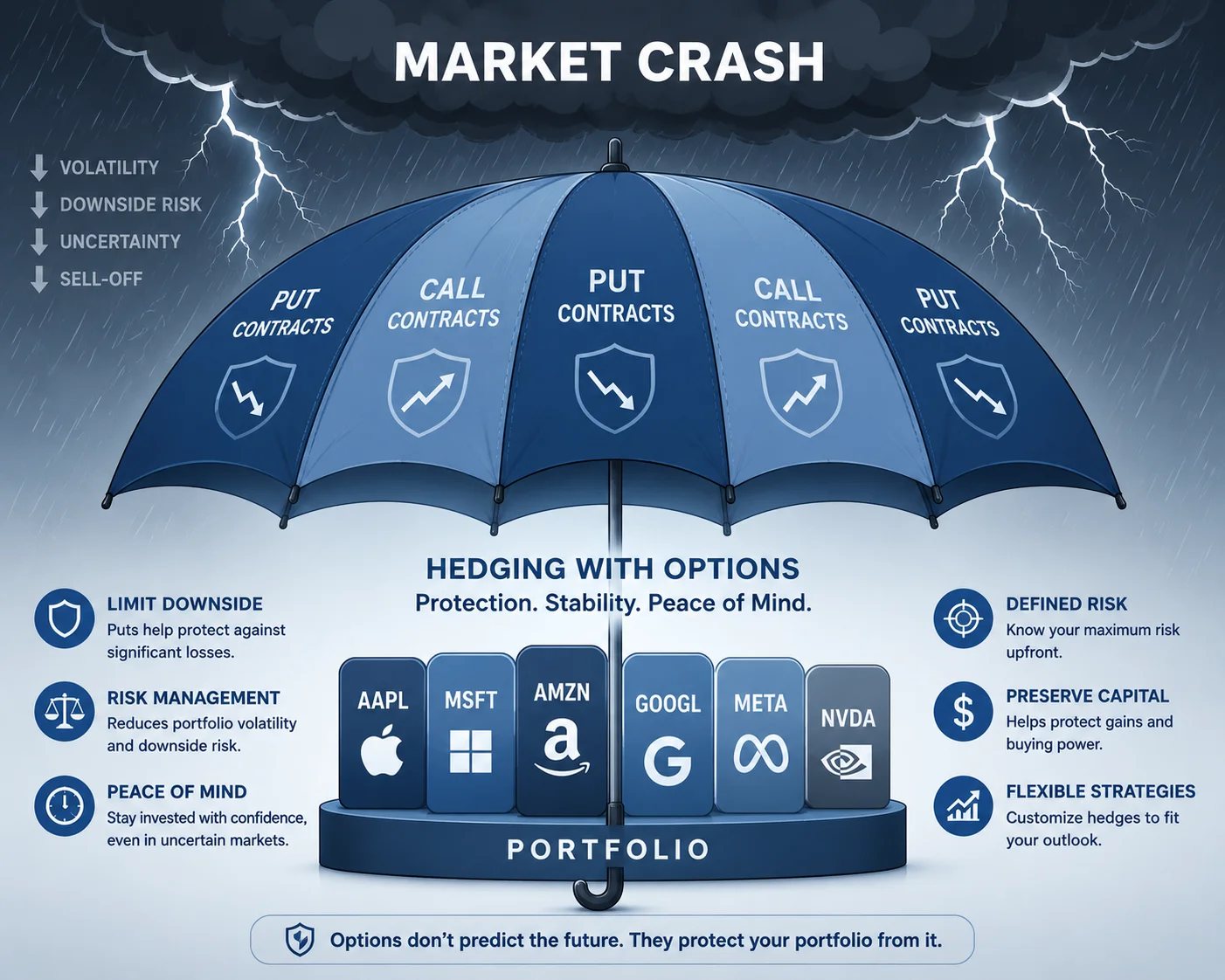
Hedging with Options: Protect Your Portfolio from Crashes
Options are the most powerful portfolio insurance available. Learn protective puts, collars, and portfolio hedges — and the right time to buy them (hint: not during a crash).
Essential strategies for protecting your portfolio, managing emotions, and controlling risk.
Almost everything written for retail investors is about picking winners. Risk management is the much smaller body of work about what happens when you are wrong — and since you will be wrong regularly, it is the part that determines whether you are still investing in ten years.
The through-line in these guides is that risk is a decision you make before the trade, not a reaction you have during it. How large the position is, where the exit sits, and how much of your portfolio rides on any single outcome are all set in advance, in a calm moment. A rule invented while staring at a loss is not a rule; it is a rationalisation.
One theme recurs often enough to state plainly: the mathematics of recovery are asymmetric and brutally unforgiving. A 20% loss needs a 25% gain to break even. A 50% loss needs 100%. An 80% loss needs 400%. This is the whole argument for caring about drawdowns rather than only returns, and it is why position sizing does more for most portfolios than any amount of stock selection.
Pair this reading with the Stock Averager and Break-Even Calculator to model a position's size and recovery threshold before committing capital — which is the only point at which the numbers can still change your mind.

Options are the most powerful portfolio insurance available. Learn protective puts, collars, and portfolio hedges — and the right time to buy them (hint: not during a crash).

Averaging down works brilliantly on high-quality stocks in temporary downturns. But it can destroy your portfolio on stocks that are falling for the right reasons. Here's how to tell the difference.

It feels wrong to sell your best performers, but it's essential for risk control. Learn the when, why, and how of portfolio rebalancing.

Fear Of Missing Out is the #1 portfolio killer. Learn to control your emotions, ignore the hype, and stick to your strategy.

Your brain is hardwired to fail at investing. Learn about loss aversion, confirmation bias, and the psychology that sabotages portfolios.