
Moving Averages: The Trend Trader's Best Friend
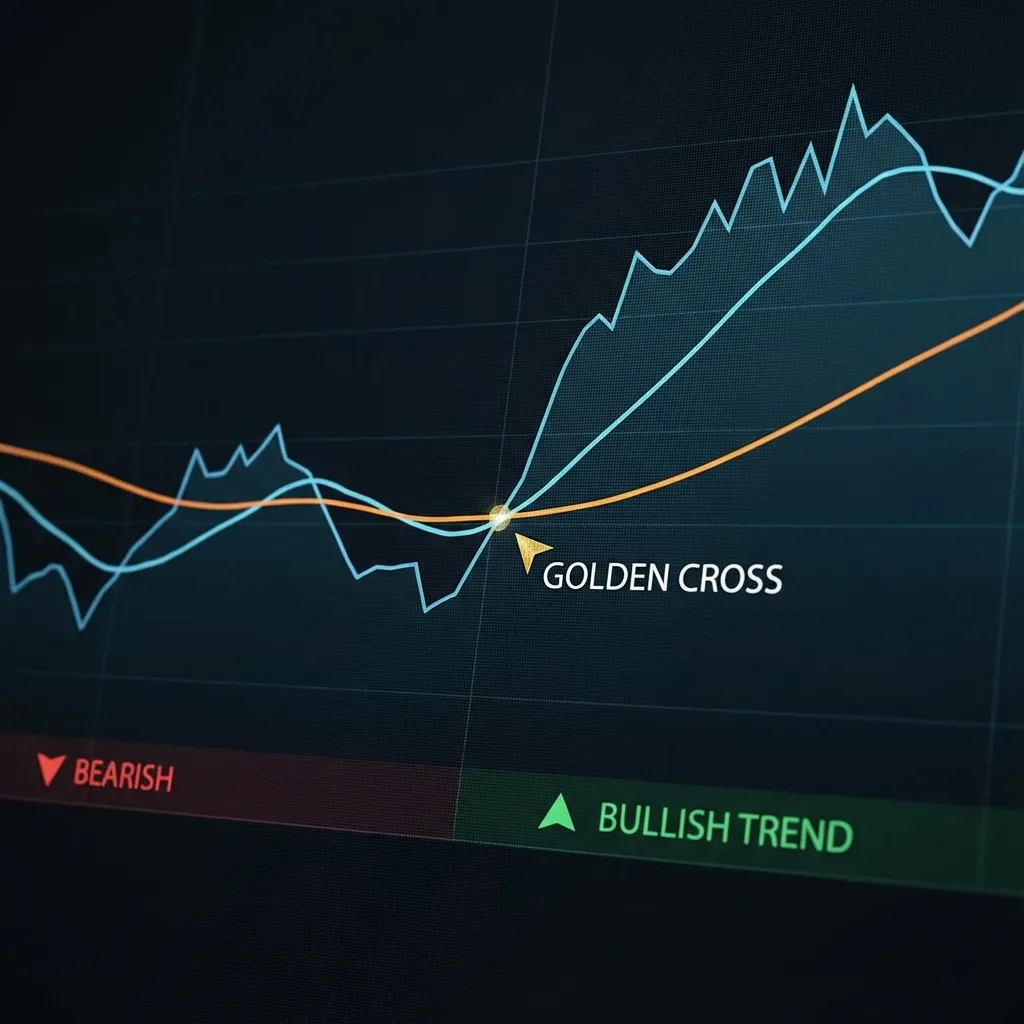
Price action is noisy. It whipsaws, spikes, and crashes, often trapping emotional traders on the wrong side of the move. Moving averages act as a noise filter, slicing through the daily chaos to reveal the true underlying trend. Whether you are a day trader or a long-term investor, master this tool, and you master the trend.
Key Takeaways
6 points- 1The Smoother: Moving averages (MA) smooth out price data to identify the direction of the trend.
- 2SMA vs. EMA: Simple Moving Averages are slow and steady; Exponential Moving Averages react faster to recent price changes.
- 3The 200-Day King: The 200-day simple moving average is the single most watched line on Wall Street. Above is bullish; below is bearish.
- 4Crossovers, honestly: only ~33 golden/death cross signals occurred in ~66 years, and forward 12-month returns after a death cross have often been positive. Treat them as regime filters, not crash alarms.
- 5Dynamic Support: Prices often bounce off key moving averages during trends, providing low-risk entry points.
- 6Lag Factor: MAs are lagging indicators. They confirm trends but do not predict tops or bottoms.
Who This Is For
Beginner LevelPerfect if you:
- You struggle to determine if a stock is in an uptrend or downtrend
- You enter trades too early and get stopped out by volatility
- You want a systematic way to exit losing positions
- You need objective rules to remove emotion from trading
You'll learn:
- The mathematical difference between SMA and EMA
- Which timeframes (9, 21, 50, 200) professional traders actually use
- How to trade the 'Golden Cross' and 'Death Cross' effectively
- The 'Rubber Band' strategy for mean reversion
- How to construct a 'Moving Average Ribbon' for visual trend strength
- Multi-Timeframe Analysis techniques (Triple Screen)
Part 1: What Exactly is a Moving Average?
If you have ever wondered what is a moving average in stock trading, here is the simple answer: a Moving Average (MA) is a technical indicator that calculates the average price of an asset over a specific period. It is called "moving" because as a new price bar is added to the chart, the oldest price bar drops off the calculation, causing the line to move along with the price. This makes moving averages for beginners one of the easiest indicators to learn first.
The primary goal of any moving average is to smooth out short-term fluctuations and highlight longer-term trends or cycles. Because it is based on past data, it is inherently a "lagging" indicator—it tells you what has happened, not necessarily what will happen. However, because millions of algorithms and traders watch these same lines, they often become self-fulfilling prophecies where price reacts simply because it "should."
The "Noise" Filter Analogy
Imagine walking a dog on a leash. The dog (Price) runs left and right, sniffs bushes, and chases squirrels. The walker (Moving Average) moves in a relatively straight line down the sidewalk.
If you watch the dog, you might get dizzy. If you watch the walker, you know exactly where the pair is heading. Successful traders watch the walker, not the dog.
SMA vs. EMA: The Battle of the Averages
Not all averages are created equal. The two heavyweights you need to know are the Simple Moving Average (SMA) and the Exponential Moving Average (EMA). The classic SMA vs EMA difference for swing trading comes down to speed: choosing the wrong one can lead to late entries or false stops.
1. Simple Moving Average (SMA)
Calculation:
(P1 + P2 + P3 ... + Pn) / n
Adds up the closing prices of the last 'n' days and divides by 'n'. Every day gets equal weight. The price from 50 days ago is just as important as yesterday's price. This makes the SMA slow to turn.
Best For: Long-term trends, Support/Resistance levels (e.g., 200-day SMA). It provides a smooth view that isn't easily tricked by a one-day spike.
2. Exponential Moving Average (EMA)
Calculation:
Weighted multiplier applied to recent prices.
Gives more weight to recent data. Yesterday's price impacts the line much more than the price from month ago. It turns faster and hugs price tighter.
Best For: Swing trading, Momentum entries, Crossovers (e.g., 9-day EMA). It gets you into the trade sooner, but also generates more false signals.
Part 2: The Critical Timeframes
Traders use specific timeframes as self-fulfilling prophecies. Because everyone watches these lines, markets tend to react at them, and understanding what the 200-day moving average means for investors is essential before you trust any signal. Using a "random" number like a 37-day moving average is useless because nobody else is looking at it. Stick to the standards.
| Period | Type | Who Uses It? | Purpose |
|---|---|---|---|
| 9 or 10 | EMA | Day Traders / Scalpers | Short-term momentum. "Riding the 9". Stocks in strong moves won't even touch the 20EMA, they'll bounce off the 9EMA. |
| 20 or 21 | EMA | Swing Traders | Pullback entries in a strong trend. The "Reversion to Mean" target for healthy trends. |
| 50 | SMA | Institutions | Intermediate trend. "The Line in the Sand". Mutual funds often buy when price tests the 50-day. |
| 200 | SMA | Everyone | Long-term trend filter. Major support/resistance. The difference between a Bull Market and Bear Market. |
Part 3: The Golden Cross & Death Cross
These are the two most famous signals in technical analysis, often cited by financial news networks to predict bull runs or recessions. If you want to know how to trade the golden cross and death cross, the key is the interaction between the "Fast" average (50-day) and the "Slow" average (200-day).
The Golden Cross
Signal: The 50-day SMA crosses above the 200-day SMA.
Meaning: Momentum has shifted to the upside. The short-term trend is now stronger than the long-term averages. Historically, this often precedes multi-year bull markets.
*Tip: Don't buy blindly on the exact day of the cross. Wait for a pullback to the 50-day line to enter to minimize risk.
The Death Cross
Signal: The 50-day SMA crosses below the 200-day SMA.
Meaning: Momentum has deteriorated and the market is "rolling over." This signal did appear before the Dot-Com crash (2000) and the Financial Crisis (2008) — which is exactly why it is so badly misunderstood. See the section below before you act on one.
*Tip: Treat it as a prompt to review position sizing and stops — not as a signal to liquidate.
⚠️ Warning: Crossovers are lagging indicators. In choppy, sideways markets, they can generate "whipsaws"—simultaneous buy and sell signals that lose money. They work best in trending markets.
The Death Cross Is Not a Crash Signal (What 65 Years of Data Actually Show)
This is the single most over-hyped indicator in financial media, and the reporting on it is usually backwards. When a death cross prints on a major index, the headlines write themselves — and they almost always imply a crash is coming. The historical record does not support that reading.
Two facts do most of the work here. First, crossover signals are rare: backtests spanning roughly 66 years of index data find only about 33 signals in total, with the average trade lasting around 350 days. A sample of 33 events is far too small to support the confident predictions you hear on TV. Second, and more awkwardly for the doom narrative, the S&P 500 has historically averaged positive returns in the 12 months following many death crosses. The signal has marked the bottom of an ordinary correction nearly as often as it has marked the start of a genuine bear market.
The reason is mechanical. A death cross requires the 50-day average to fall below the 200-day average, and that takes months of weakness to occur. By the time the lines actually cross, a large part of the decline has already happened. You are not being warned about a fall — you are being informed about one that is already well underway. In 2000 and 2008 the market kept falling afterwards, and those two cases anchor everyone's memory. The many occasions when the cross printed near a bottom are quietly forgotten.
What the crossover record actually supports
| Common claim | What the backtests show |
|---|---|
| "A death cross means a crash is coming" | Forward 12-month returns after a death cross have often been positive; it has marked correction lows about as often as bear-market starts. |
| "A golden cross is a reliable buy signal" | It captured the major recoveries after 2009 and 2020, but it lags the bottom badly and whipsaws in range-bound markets. |
| "Crossovers beat buy-and-hold" | Exiting on the death cross and re-entering on the golden cross has produced returns broadly comparable to buy-and-hold — with meaningfully smaller drawdowns. |
| "There are plenty of signals to trade" | Roughly 33 signals across ~66 years, averaging ~350 days per trade. This is a regime filter, not a trading strategy. |
That third row is the genuinely useful finding, and it reframes what these signals are for. The crossover system does not reliably make you more money than simply holding. What it has historically done is deliver similar returns with shallower drawdowns — which matters enormously if a 50% paper loss would cause you to capitulate at the worst possible moment. Judge it as a volatility-management tool, not a return-enhancement tool. If drawdown control is your real goal, pair this with position sizing and a written risk framework, which do the same job with far less guesswork.
Case Study: Apple (AAPL) Swing Trade
Educational ExampleUsing MAs for Entry and Exit
Let's look at a classic "Pullback to Value" trade using the 21-day EMA and 50-day SMA.
AAPL is in a strong uptrend. Price is making higher highs. The 20-day EMA is above the 50-day SMA (Bullish alignment).
The overall market dips. AAPL price falls 5% over 3 days. It touches the 50-day SMA line at $150. Volume dries up (selling exhaustion).
Instead of panicking, the trader sees the 50-day SMA holding as support. They buy at $150 with a Stop Loss at $148 (just below the line).
Buyers step in at the 50-day line and the stock recovers to $170.
Risk: $2/share. Reward: $20/share.
A 1:10 outcome is what this setup looks like when it works, not what it averages. A $2 stop sitting two dollars under a widely-watched line gets hit routinely on noise alone — expect to be stopped out of several of these for every one that runs. The setup earns its keep through the size of the winners, not the frequency of them.
This is a hypothetical scenario using historical market data for educational purposes only. Past performance does not guarantee future results.
Part 4: Expert Strategy - "The Moving Average Ribbon"
Advanced traders don't look at just one line; they look at the relationship between multiple lines. This is often visualized as a "Ribbon."
How to Trade the Ribbon
Put the 10, 20, 30, 40, and 50 EMAs on your chart.
- Expansion (Trend Strength): When the lines fan out and separate (lots of white space between them), the trend is accelerating. This is a "strong buy" signal.
- Contraction (Consolidation): When the lines squeeze together into a tight knot, volatility is dropping. A big move is imminent. Breakouts from a squeeze are explosive.
- Inversion (Reversal): When the 10 EMA crosses below the 50 EMA, the ribbon "twists" from Green (Bullish) to Red (Bearish). This visual cue is often faster than a generic Golden Cross.
Part 5: Multi-Timeframe Analysis (Triple Screen)
A common mistake is looking only at the daily chart. To really filter noise, you must align the "Tide" (Weekly) with the "Wave" (Daily).
Is price above the 30-week EMA? If yes, the long-term trend is UP. You are ONLY allowed to look for Buy signals.
Is price pulling back to the 20-day EMA? This is your "value" zone. Wait for the pullback against the Weekly trend.
Use this for timing. Enter when price crosses back above the 10-period EMA on the 4H chart.
How to Calculate a Moving Average (Worked Example)
The fastest way to trust an indicator is to build it once by hand. A common Google search is simply how do you calculate a moving average, so here is a 5-day SMA worked out step by step using six days of imaginary closing prices.
| Day | Close | Last 5 Closes Used | 5-Day SMA |
|---|---|---|---|
| Day 5 | $104 | 100, 102, 101, 103, 104 | $102.00 |
| Day 6 | $108 | 102, 101, 103, 104, 108 | $103.60 |
Notice how the average "moved" from $102.00 to $103.60: the oldest price ($100) dropped out and the newest price ($108) was added, dragging the line upward. That is the entire mechanic. An EMA follows the same idea but multiplies the newest close by a weighting factor (for a 5-day EMA, roughly 2 ÷ (5 + 1) = 0.33), so a single strong day like the jump to $108 nudges the line faster than the equal-weight SMA does. This is exactly why an EMA turns sooner and an SMA stays smoother.
Tie It Back to Your Cost Basis
A moving average is just a rolling average of price. The same math powers your own average purchase price when you buy a stock in multiple lots. If you want to see how a new buy near the 50-day line changes your blended entry, run the numbers through our cost basis calculator before you click buy.
How Reliable Is the Golden Cross? (And How to Filter It)
Because financial headlines love the phrase, many beginners ask does the golden cross actually work. The honest answer: it is a decent regime filter, not a precise timing tool. Because both the 50-day and 200-day lines are lagging, the cross often prints well after a bottom has formed, so you give up some of the early rally. In choppy, range-bound markets it also fires false signals and whipsaws you in and out. Treat it as one input, not a standalone system.
| Market Condition | Crossover Reliability | What to Do |
|---|---|---|
| Strong trend (clear slope) | High | Trust the signal; buy pullbacks to the fast line. |
| Sideways / range-bound | Low (whipsaws) | Ignore crossovers; trade the range edges instead. |
| High volatility / news gaps | Medium | Require a confirming close and a volume expansion. |
Confirm the Cross With a Second Indicator
The single biggest upgrade to any moving-average system is confirmation. Because MAs are lagging, pair them with a leading momentum gauge so you avoid buying into an exhausted move:
- Momentum check (RSI): A golden cross while RSI is rising above 50 is far stronger than one where RSI is already overbought and rolling over.
- Trend acceleration (MACD): The MACD line crossing its signal line in the same direction adds conviction that the shift is real, not noise.
- Structure (S/R): A cross that lines up with a break of horizontal support or resistance is the highest-probability setup of all.
Common Mistakes to Avoid
How to Use Moving Averages to Set a Buy Price
One of the most practical questions beginners ask is how to use a moving average to set a buy price instead of chasing a stock higher. The simplest method is to wait for price to pull back toward a key line, such as the 50-day SMA in an uptrend, and treat that level as your "value zone" entry rather than buying at the highs. Combine the line with a target on the upside and a stop just below it so your risk is clearly defined before you commit capital. You can model how a planned entry blends with your existing position using our stock averager calculator, or sanity-check the reward-to-risk on a level with the target price calculator. This turns a fuzzy chart line into a concrete, rules-based decision.
FAQ: Moving Averages Explained
What is the best time frame for moving averages?
- Day Traders: 9 EMA and 20 EMA (minutes).
- Swing Traders: 21 EMA and 50 SMA (daily).
- Investors: 50 SMA and 200 SMA (weekly/daily).
Does a Golden Cross guarantee a profit?
Can I use moving averages for Crypto?
What is a 'Trailing Stop' using MAs?
Do Moving Average Crossovers Actually Work?
The golden cross and death cross get enormous media coverage, which makes the honest answer worth stating plainly: moving average crossovers work, but not in the way most people assume. They are trend-following signals with a low win rate and a positive expectancy — the opposite profile to what a beginner expects from something described as a "buy signal."
They lose more often than they win
A typical crossover system is right roughly 30-40% of the time. Most signals in a choppy market produce small losses as price oscillates across the averages. The system makes money because the minority of signals that catch a sustained trend produce gains several times larger than the many small losses. If you cannot tolerate a long run of losing signals, this is the wrong tool regardless of its long-term record.
They are lagging by construction, and that is the point
A crossover confirms a trend that has already begun — you will never buy the bottom or sell the top with one. Traders who try to fix the lag by shortening the averages get more signals, more whipsaws, and worse results. The lag is what filters noise; removing it removes the edge.
Performance depends entirely on the market regime
In trending markets crossovers do well; in range-bound markets they bleed steadily through repeated false signals. Since you cannot know in advance which regime you are in, any honest expectation must include long stretches of underperformance. Most backtests that show spectacular crossover returns are fitted to a period that happened to trend.
The parameters are less important than the discipline
The 50/200 pair is famous, not optimal. Testing dozens of combinations to find the best-performing pair on past data is textbook curve-fitting, and the winner rarely holds up going forward. Any reasonable pair applied consistently beats the best historical pair applied inconsistently.
Where moving averages genuinely earn their place
Their most reliable use is not as an entry trigger but as a regime filter and a trailing exit. Using a long moving average to decide whether to be in the market at all — long above it, in cash or defensive below it — has historically reduced drawdowns substantially even when it slightly lowers total return. That is a genuinely valuable property for anyone who abandons a strategy after a deep loss. Similarly, trailing a stop along a moving average is a clean, unemotional way to let a winning position run without deciding daily whether to sell.
People Also Ask
Is SMA or EMA better for day trading?
For fast intraday timing, most active day traders prefer the EMA because it weights recent prices and reacts quicker to a turn, which times pullbacks more tightly. The trade-off is that it also produces more false signals in choppy conditions. A common compromise is a fast EMA (like the 9) for entries with a 200-day SMA as a slower 'only trade in this direction' filter.
How do you calculate a simple moving average?
Add up the closing prices for the chosen number of periods and divide by that number. For a 5-day SMA, you sum the last five daily closes and divide by five. Each new day you drop the oldest close and add the newest one, which is why the average 'moves' along with price.
What does it mean when a stock crosses its 200-day moving average?
The 200-day SMA is Wall Street's most-watched line for separating a long-term uptrend from a downtrend. Price crossing above it is broadly read as bullish, and crossing below as bearish. Because so many funds and algorithms watch it, the level often acts as major support or resistance even before any 'signal' is confirmed.
How reliable is the golden cross signal?
The golden cross is a reasonable regime filter but a poor precision-timing tool. It lags the actual bottom, so you usually miss the first leg of a rally, and it whipsaws badly in sideways markets. It works best in clearly trending conditions and improves a lot when confirmed by momentum indicators or a volume expansion.
Can I combine moving averages with RSI or MACD?
Yes, and it is one of the most reliable ways to reduce false signals. Moving averages tell you the trend's direction while RSI and MACD gauge momentum, so a crossover that agrees with a rising RSI or a fresh MACD cross is far higher probability. Traders typically use the MA for context and the momentum oscillator for the entry trigger.
Do moving averages work for long-term investors and SIPs?
They can act as a big-picture health check even if you never day trade. Many long-term investors simply hold while price stays above the 200-day line and get more defensive when it drops below. If you invest through regular contributions, moving averages are a filter, not a reason to stop your plan, since consistent buying is what builds the position over time.
The Trend is Your Friend
Moving Averages are the bedrock of technical analysis. They don't predict the future, but they give you a statistical edge by keeping you on the right side of the major trend.
Open your charting software (TradingView)
Add the 50-day and 200-day SMA
Only buy when price is above the 200-day
Investment Risk Disclaimer
This content is for educational purposes only and should not be considered financial advice. All investments carry risk, including the potential loss of principal. Past performance does not guarantee future results. Before making any investment decisions, please consult with a qualified financial advisor who understands your personal financial situation, risk tolerance, and investment goals.
Stock Averager provides tools and educational content but does not provide personalized investment advice or recommendations.
Explore this topic in depth
Technical Analysis
Reading price and volume — what indicators genuinely measure, and where the popular claims break down.
- How to Read Stock Charts: Beginner's Guide to Chart Analysis (2025) (main guide)Timeframes, structure and volume — the groundwork before indicators.
- RSI Indicator: How to Spot Overbought StocksWhy 'oversold' isn't a buy signal in a strong trend.
- Understanding MACD Indicator: Trading Signals That Work (2026)Momentum and divergence, and the lag built into the signal.
- Candlestick Patterns: Complete Guide for Traders (2026)The patterns worth knowing and the context that makes them work.
- Support and Resistance: How to Identify and Trade Key Price LevelsThe most durable idea in technical analysis, because it describes behaviour.
- Fibonacci Retracement: How to Use the Golden Ratio in TradingRetracement levels as a confluence layer rather than a trigger.
- Market Orders vs Limit Orders: Which Should You Use?Control over price versus certainty of fill.
Related topics
- Risk Management & Position SizingDeciding in advance how much you can lose — the part of investing that determines whether you survive.
- Fundamentals & ValuationWorking out what a business is worth before deciding what its shares are worth paying.
- Investor PsychologyWhy disciplined rules get abandoned exactly when they matter most, and how to design around it.
Sources & Further Reading
Figures and rules cited in this article are drawn from the primary sources below. Tax and regulatory details change — always confirm against the current official guidance for your jurisdiction.
- 1Does the Death Cross Actually Work? Backtesting 65 Years of Trading Data — Quantified StrategiesSignal frequency (~33 crossovers in ~66 years) and forward return distribution after death cross events.
- 2Testing the Golden Cross and Death Cross on the SPY — Cabot Wealth NetworkComparison of crossover switching versus buy-and-hold, including drawdown behaviour.
- 3Moving averages: A stock signal worth watching — Fidelity InvestmentsInstitutional context for the 50-day and 200-day averages.
About Stock Averager Team
Expert financial analysts dedicated to simplifying complex investment strategies for everyone. We build tools that help you make better money decisions.