
Averaging Down vs Dollar-Cost Averaging: Which Strategy Wins?
Two Strategies, One Costly Confusion
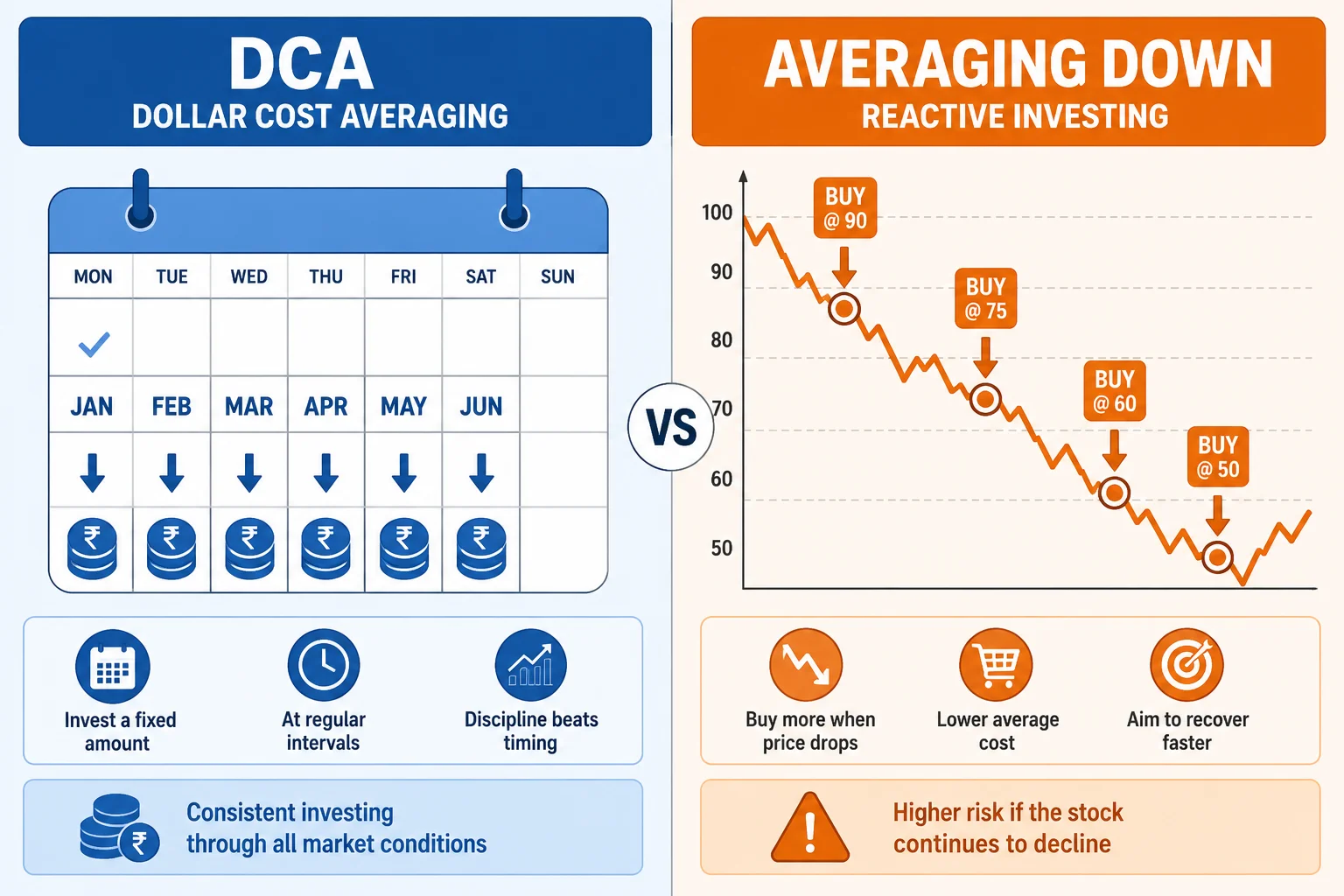
On the surface they look identical: both averaging down and dollar-cost averaging have you buying more shares as prices fall. But one is triggered by a price drop and demands you re-analyze the business every time, while the other is triggered by the calendar and demands nothing but consistency.
Confuse the two and you will apply the wrong tool to the wrong asset — mechanically averaging down on a collapsing company, or agonizing over timing when a simple monthly plan would have done the work for you. This guide draws the line clearly, with a side-by-side table and worked examples of each.
TL;DR — Quick Summary
30-sec read- 1Dollar-cost averaging (DCA) invests a fixed amount at fixed intervals regardless of price. Averaging down buys more specifically because the price dropped below your cost.
- 2DCA works best for diversified index funds; averaging down works for individual stocks — but only with fundamental conviction.
- 3DCA is emotion-free and automated. Averaging down requires analysis every single time.
- 4Averaging down amplifies losses if the business is declining. DCA's diversification protects you from any single company failing.
- 5The hybrid most investors use: DCA the core index holdings, selectively average down high-conviction individual positions.
Continue reading for the full guide with examples and strategies.
Who This Is For
Intermediate LevelPerfect if you:
- You've heard both terms used interchangeably and want the real difference
- You're deciding how to deploy cash into a falling market
- You hold index funds and individual stocks and want a rule for each
- You want to combine both approaches without contradicting yourself
You'll learn:
- The single distinction that separates the two strategies: trigger
- Which asset types each approach is built for
- When DCA clearly wins and when averaging down is the better tool
- A worked example of each, side by side
- The hybrid framework experienced investors actually use
Not for you if:
Key Takeaways
6 points- 1DCA = a fixed amount invested at fixed intervals, regardless of price. Averaging down = buying more because the price dropped below your cost.
- 2DCA works best with index funds. Averaging down works on individual stocks — but only with fundamental conviction.
- 3The trigger is the whole difference: a calendar date for DCA, a price drop for averaging down.
- 4Averaging down amplifies losses if the business is declining. Never average down without a fundamental check.
- 5Hybrid approach: use DCA for index funds, selective averaging down for individual high-conviction positions.
- 6Use the Stock Averager Calculator for averaging down and the SIP Calculator to project a DCA plan.
The Core Difference: Reactive vs Systematic
If you are trying to understand the difference between averaging down and dollar-cost averaging for the first time, start with the trigger. Dollar-cost averaging (DCA) is a time-based strategy. You invest a fixed amount — say $500 — on the same date every month, whether the market is up, down, or sideways. The discipline lives in the calendar, not in the price.
Averaging down is a price-based reaction. When a stock you already own falls below your purchase price, you buy more to lower your average cost. The trigger is the price drop, not the calendar, and it obliges you to re-examine the business before every purchase. In short: DCA asks "is it the first of the month?" while averaging down asks "is this still a good company at a better price?"
| Factor | Dollar-Cost Averaging | Averaging Down |
|---|---|---|
| Trigger | Calendar date | Price drop below cost |
| Asset type | Best for index funds & ETFs | Individual stocks |
| Emotion required | None (automated) | Conviction & analysis |
| Decision frequency | Set once, then hands-off | Every purchase re-evaluated |
| Risk of failure | Low (diversified) | High if business is failing |
| Frequency | Regular (monthly / weekly) | Occasional (price-triggered) |
| Cash needed | Steady, predictable | Lumpy, held in reserve for dips |
| Best for | Passive, long-term investors | Active, fundamental investors |
When Dollar-Cost Averaging Wins
For most beginners deciding whether dollar-cost averaging is better than averaging down, DCA is the right default. It is the correct strategy when:
DCA Is the Better Tool When…
- • You are investing in diversified index funds (S&P 500, total market ETFs)
- • You lack the time or interest to analyze individual companies
- • You want to eliminate market-timing decisions entirely
- • You have a regular income and invest monthly from your paycheck
- • Your investment horizon is 10+ years
The quiet magic of DCA is mechanical: in a falling market, your fixed $500 buys more shares because each one is cheaper. In a rising market it buys fewer. Over time your average cost naturally settles below the average price, with zero active decision-making. That is why DCA is the backbone of most retirement plans — it converts market volatility from a threat into an advantage. We cover the full compounding case in Dollar-Cost Averaging for Wealth Building, and you can project a monthly plan with our SIP Calculator.
When Averaging Down Works
Knowing when to average down on a stock comes down to four conditions — averaging down is the right move when:
- Fundamentals are unchanged: the business is still growing and the drop is market noise, not deterioration.
- You have high conviction: you have analyzed the company and would be happy to own more at current prices.
- Position size allows it: after averaging down, the stock is still 10-15% or less of your portfolio.
- The drop is sector-wide: if the whole sector is down, not just your stock, it is often a cleaner signal.
⚠️ When Averaging Down Destroys Portfolios
Averaging down on a company with deteriorating earnings, rising debt, fleeing customers, or an industry facing disruption is called "catching a falling knife." The falling price is reflecting a real problem. More shares of a failing business simply means bigger losses. Before adding, run the checklist in When NOT to Average Down.
DCA vs Averaging Down, Side by Side
Educational ExampleThe same $12,000 deployed two different ways in a falling market.
The DCA Approach
You invest $1,000 per month into a broad index fund for 12 months. In month 3 the market falls 20%, then recovers over the rest of the year. Because your fixed $1,000 bought extra shares during the dip, your average cost across the year ends up lower than if you had invested the full $12,000 on day one. You made zero timing decisions — the schedule did the work.
The Averaging-Down Approach
You buy 100 shares of a single quality company at $120 ($12,000 invested). A market correction drags it to $96, though earnings are strong and guidance is intact. You analyze the business, conclude nothing has broken, and buy 25 more shares at $96 ($2,400 more).
- • Lot 1: 100 shares × $120 = $12,000
- • Lot 2: 25 shares × $96 = $2,400
- • Total: 125 shares, $14,400 invested
- • New average: $14,400 ÷ 125 = $115.20 per share
Your break-even fell from $120 to $115.20, so you now need only a 20% recovery from $96 instead of a 25% recovery. But note the difference in effort: DCA required none, while averaging down required a real analysis of one company's fundamentals.
This is a hypothetical scenario using historical market data for educational purposes only. Past performance does not guarantee future results.
The Hybrid Approach Most Investors Use
The two strategies are not rivals — they are tools for different jobs, and experienced investors run both at once:
70-80%: The DCA Core
Index funds bought via automatic monthly contributions. This is the stable, diversified foundation that grows without any decisions and cannot be sunk by one company's failure.
20-30%: The Conviction Satellite
Individual stocks you have researched, selectively averaged down when conviction is high and the price has fallen on noise rather than deterioration.
This structure gives you the safety and discipline of DCA while letting you exploit mispricings in the individual companies you actually understand. It also keeps you honest: if a position is in the satellite bucket, you are forced to justify each add on fundamentals, not just because the number is red. Deciding how much to deploy at once versus over time is its own question — our guide on SIP vs lump sum compares staggered and one-shot deployment.
The Psychology That Separates the Two
The real reason these strategies get confused is not technical — it is emotional. DCA is deliberately designed to remove emotion. You automate the contribution, delete the decision, and never again have to ask whether "now" is a good time to buy. Averaging down does the opposite: it hands you a decision at the worst possible moment, when a position is red and your instinct is screaming.
Behavioral finance research consistently finds that the pain of a loss feels roughly twice as powerful as the pleasure of an equivalent gain. That asymmetry — loss aversion — is exactly what makes averaging down dangerous. When you add shares purely to "get back to even," you are not acting on a thesis; you are trying to erase the discomfort of an unrealized loss. That is an ego decision dressed up as a strategy.
The One Question That Keeps You Honest
Before averaging down, ask: "If I didn't already own this stock, would I buy it today at this price?" If the honest answer is yes, you are adding on conviction. If the answer is "no, but I want to lower my average," you are adding on ego — and that is a value trap in the making. DCA sidesteps this trap entirely because the calendar, not your feelings, pulls the trigger. For more on the biases that sabotage investors, see our guide on behavioral finance and investing psychology.
Common Mistakes With Each Strategy
Both approaches fail in predictable ways. The mistakes are almost mirror images: DCA usually fails from over-tinkering, while averaging down fails from too little discipline.
How Investors Break DCA
- • Pausing contributions during a crash — exactly when the cheap shares appear
- • "Improving" the plan by trying to time the monthly buy
- • DCA-ing into a single concentrated stock instead of a diversified fund
- • Cashing out at the first sign of a drawdown, locking in the loss
How Investors Break Averaging Down
- • Adding with no fundamental check — "it's cheaper, so I'll buy"
- • Letting a small position balloon past a sane portfolio weight
- • Refusing to set a maximum number of times they will average down
- • Ignoring a broken thesis to avoid admitting the first buy was wrong
A Simple Rule for Each
DCA: once you set the amount and schedule, never touch it based on the news cycle. Averaging down: before you start, write down the maximum number of times you will add and the thesis that would make you stop. Both rules exist for the same reason — to keep a future, more emotional version of you from wrecking the plan. Size every add sensibly using our position sizing guide.
How to Calculate Your New Average After Averaging Down
The math is simpler than most beginners expect. Add the total dollars you invested across all purchases, then divide by the total number of shares you now own. In the example above, $14,400 invested across 125 shares gives a new average cost of $115.20. Lowering your cost basis this way reduces the percentage recovery you need to break even — but it only helps if the underlying business is still sound.
Run the exact numbers with the Stock Averager Calculator and confirm your break-even target with the Break-Even Calculator. For a DCA plan, our SIP Calculator projects how fixed monthly contributions compound over your chosen horizon.
Model Both Strategies for Free
Whether you are averaging down a single conviction stock or building a steady DCA plan, our calculators remove the guesswork so you can compare outcomes before committing cash.
Decide the asset: index fund or individual stock
DCA the core, average down the conviction picks
Project the outcome with the right calculator
Averaging down or DCA? Reader questions
Is averaging down the same as dollar-cost averaging?
No. DCA is systematic — you invest fixed amounts at fixed calendar intervals regardless of price. Averaging down is reactive — you buy more specifically because the price fell below your cost. DCA is emotion-free and needs no analysis; averaging down requires conviction and a fundamental check of the business every time.
Which is better: averaging down or DCA?
It depends on the asset. For diversified index funds, DCA is better because no analysis is needed and diversification prevents any single stock from sinking you. For individual stocks, selective averaging down with fundamental conviction is appropriate — but only when the business is intact. Most investors use both: DCA for the core, averaging down for high-conviction positions.
Can you dollar-cost average into a single stock?
You can, but it carries more risk than DCA into a diversified fund. Mechanically buying a fixed dollar amount of one company every month without checking its fundamentals blends the automation of DCA with the concentration risk of a single stock. If that company deteriorates, your schedule keeps buying a declining asset. For single stocks, conviction-based averaging down is usually the more deliberate approach.
Does averaging down or DCA guarantee a profit?
Neither guarantees a profit. Both lower your average cost over time, which improves your odds if the asset eventually recovers, but they cannot rescue a permanently declining investment. DCA's diversification protects you from single-company failure; averaging down offers no such protection, which is why it demands a fundamental thesis.
When should you stop averaging down?
Stop when the reason you bought the stock no longer holds — falling earnings, rising debt, lost customers, or a broken industry. You should also stop if the position has grown past a sensible portfolio weight (many investors cap a single stock at 10-15%). A useful discipline is to decide, before your first add, the maximum number of times you will average down and the specific news that would make you sell instead.
Is averaging down a good strategy for beginners?
For most beginners, no. Averaging down requires you to confidently judge whether a price drop is temporary noise or a sign of real deterioration, and that skill takes time to build. Beginners are usually better served by dollar-cost averaging into diversified index funds, where no single company's failure can sink the plan and no analysis is needed. Averaging down individual stocks can come later, once your fundamental research is solid.
Frequently Asked Questions
What is the main difference between averaging down and DCA?
The trigger. Dollar-cost averaging is triggered by the calendar — you invest a fixed amount on a fixed schedule no matter what the price is doing. Averaging down is triggered by a price drop — you buy more because the stock fell below your cost. That single distinction cascades into everything else: the asset type each suits, the emotion required, and the risk profile.
Should beginners use averaging down or dollar-cost averaging?
Most beginners should start with dollar-cost averaging into diversified index funds. It removes market-timing decisions, requires no company analysis, and its diversification means no single failure can wipe you out. Averaging down is a more advanced tool that should only be used on individual stocks after you can confidently assess a company's fundamentals.
Can I combine DCA and averaging down?
Yes, and many experienced investors do. A common structure is to DCA 70-80% of your portfolio into index funds on autopilot, while reserving 20-30% for individual stocks you selectively average down when conviction is high and the price has fallen on noise. This blends the discipline of DCA with the upside of exploiting mispriced individual companies.
Why does DCA work without any analysis but averaging down doesn't?
Because DCA is applied to diversified funds that hold hundreds of companies, so no single business failing can derail the plan — the index self-corrects as weak companies are replaced. Averaging down is applied to a single stock, which offers no such safety net. If that one company is genuinely deteriorating, buying more just concentrates the loss, which is why the fundamental check is mandatory.
Related Articles
Investment Risk Disclaimer
This content is for educational purposes only and should not be considered financial advice. All investments carry risk, including the potential loss of principal. Past performance does not guarantee future results. Before making any investment decisions, please consult with a qualified financial advisor who understands your personal financial situation, risk tolerance, and investment goals.
Stock Averager provides tools and educational content but does not provide personalized investment advice or recommendations.
Explore this topic in depth
Cost Averaging & Averaging Down
Lowering your average cost deliberately — when it compounds returns, and when it compounds a mistake.
- What Is Averaging Down? Complete Beginner's Guide (2026) (main guide)The mechanics, the maths, and the narrow conditions where it works.
- When NOT to Average Down: 7 Red Flags to WatchSeven red flags, with a real bankruptcy as the worked example.
- How to Calculate Your Break-Even After Averaging DownThe formula for your new break-even, and why it moves less than you expect.
- Tax Implications of Averaging Down Stocks: What Every Investor Must KnowWash sales, cost basis methods and tax lots before you add shares.
- How to Calculate Average Share Price (Formula + Worked Examples)The weighted-average formula, worked through multiple lots.
- How to Build Wealth with Dollar Cost Averaging (Without Timing the Market)The systematic default for most investors, and its real limits.
- Cost Averaging Explained: Dollar, Rupee, Pound & Euro Cost AveragingCost averaging across dollars, rupees, pounds and euros.
- Value Averaging: The Smarter DCA Alternative?Targeting a portfolio value rather than a fixed contribution.
- How to Build a DCA Portfolio: Step-by-Step GuideTurning the principle into an actual allocation and schedule.
- DCA Out: How to Sell Without Timing the MarketSelling systematically, so the exit isn't a single timing bet.
- Lump Sum vs DCA: When to Invest All at OnceWhat the evidence says about deploying a windfall gradually or at once.
- SIP vs Lump Sum: The definitive Guide to Investing Your MoneyThe definitive comparison, with the maths behind each approach.
Related topics
- Risk Management & Position SizingDeciding in advance how much you can lose — the part of investing that determines whether you survive.
- Systematic Investing & SIPsContributing on a schedule: frequency, escalation, inflation, and turning a corpus back into income.
- Investor PsychologyWhy disciplined rules get abandoned exactly when they matter most, and how to design around it.
About Stock Averager Team
Expert financial analysts dedicated to simplifying complex investment strategies for everyone. We build tools that help you make better money decisions.