
What Is Averaging Down? Complete Beginner's Guide (2026)
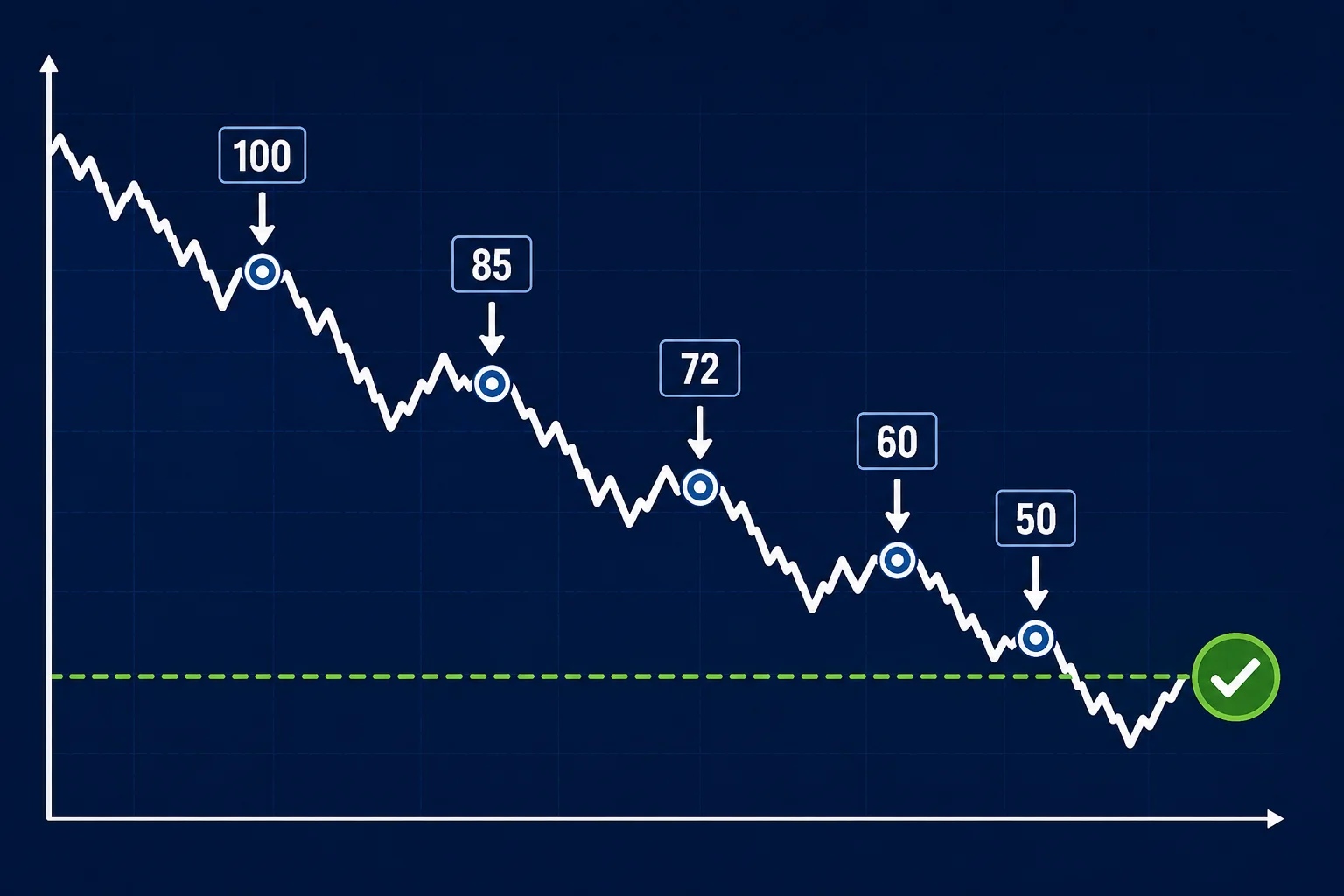
The $10,000 Question
You bought 100 shares of a company at $100 — a $10,000 position you were proud of. Three months later it trades at $70, and your account shows a $3,000 unrealized loss. You now face the decision that defines whether you build wealth or bleed it: do you buy more at $70, sell and move on, or freeze and hope?
Buying more to lower your cost is called averaging down. Done with a real thesis, it is how investors like Warren Buffett turned market panics into fortunes. Done on autopilot, it is how a $3,000 loss becomes a $9,000 one. This guide shows you exactly which situation you are in — and the math behind both.
TL;DR — Quick Summary
30-sec read- 1Averaging down means buying more shares of a stock you already own after the price falls below your cost, which lowers your average cost per share.
- 2A lower average cost means you need a smaller price recovery to break even — a $100 buy plus a $70 buy sets your break-even at $85, not $100.
- 3The strategy only works when business fundamentals are intact and the drop is market noise, not permanent decline.
- 4Never average down to 'get back to even' on emotion — size the position and confirm the thesis first.
- 5Use the Stock Averager Calculator to see the exact share count and cash needed to reach any target average.
Continue reading for the full guide with examples and strategies.
Who This Is For
Beginner LevelPerfect if you:
- You own a stock that has dropped and you're wondering whether to buy more
- You've heard 'average down' thrown around and want the plain-English meaning and math
- You want a repeatable checklist instead of reacting emotionally to red numbers
- You're deciding between averaging down and a systematic monthly plan
You'll learn:
- The exact definition and formula for averaging down
- How a lower cost basis changes the recovery you need to break even
- The 5 conditions that must be true before you add to a losing position
- How averaging down differs from dollar-cost averaging
- A worked, step-by-step numeric example you can copy
Not for you if:
Key Takeaways
6 points- 1Averaging down = buying more shares of a stock you own after its price has fallen below your original cost.
- 2This lowers your average cost per share, reducing the recovery needed to break even.
- 3The strategy only works when the business fundamentals are intact — the drop is market noise, not deterioration.
- 4Averaging down is reactive and conviction-based; dollar-cost averaging is systematic and emotion-free. They are not the same thing.
- 5Never average down without a fundamental thesis — 'hoping it bounces' is not a strategy.
- 6Use the Stock Averager Calculator to calculate exactly how many shares lower your cost to your target.
What Is Averaging Down in Stocks?
If you are wondering what averaging down in stocks means for beginners, here is the simplest definition: averaging down is the strategy of purchasing additional shares of a stock after its price has fallen below your original purchase price, thereby reducing (averaging down) your cost per share. You are deliberately buying the same business at a lower price to bring your break-even point closer.
The mechanics are pure arithmetic. Suppose you bought 100 shares at $100, a $10,000 position. The stock drops to $70 and you buy 100 more for $7,000. You now hold 200 shares for $17,000 invested, so your new average cost is $85 per share — down from $100. The stock only has to climb back to $85, not $100, before you are whole again. That single shift, from a 43% required recovery to an 18% required recovery, is the entire appeal of the strategy.
The Averaging Down Formula
New Average = (Existing Shares × Original Price + New Shares × Current Price) ÷ Total SharesThis is the same math behind cost basis averaging in any brokerage account. If you want to skip the mental arithmetic across multiple lots, our Stock Averager Calculator does it instantly, and our guide on how to calculate average stock price walks through the formula lot by lot.
How Averaging Down Changes Your Break-Even Point
The reason averaging down feels powerful is that it attacks the most punishing math in investing: the recovery required after a loss grows faster than the loss itself. A stock that falls 50% must double — gain 100% — just to get you back to even. Lowering your average cost shrinks that required recovery. The table below shows the effect of adding an equal-sized second lot at progressively lower prices, starting from a first lot bought at $100.
Buy 100 at $100, then add 100 more at a lower price
Equal share counts | Illustrative, excludes fees and taxes
| Second Buy Price | New Average Cost | Recovery to Break Even | Without Averaging |
|---|---|---|---|
| $90 (down 10%) | $95.00 | 5.6% | 11.1% |
| $80 (down 20%) | $90.00 | 12.5% | 25.0% |
| $70 (down 30%) | $85.00 | 21.4% | 42.9% |
| $50 (down 50%) | $75.00 | 50.0% | 100.0% |
💡 What This Table Shows
In every row, averaging down roughly halves the recovery you need versus doing nothing. But notice the trade-off in the bottom row: to lower your average from $100 to $75, you doubled your dollars at risk. Averaging down improves your odds of breaking even only if the stock actually recovers — it does nothing to help if the business keeps declining. Confirm your exact target with our Break-Even Calculator.
Why Investors Average Down on a Falling Stock
The logic behind how to average down on a stock the right way is straightforward: if you believed the shares were worth $100 when you bought them and nothing about the business has changed, then at $70 they are an even better deal. You are getting the same company at a 30% discount. This is the core principle of value investing — buying more of what you have good reason to believe is undervalued.
Warren Buffett built several of his largest positions this way. His Apple, Bank of America, and Coca-Cola stakes were accumulated during periods of market pessimism when the price fell but the underlying earnings power did not. The discipline is not in buying when things feel good; it is in buying more when the price is falling and your analysis still holds.
When Averaging Down Is a Smart Strategy
- • The business fundamentals are unchanged — revenue growing, margins stable, balance sheet healthy
- • The drop is sector-wide or market-wide, not specific to your company
- • You have genuine conviction in the long-term thesis (a 3-5+ year horizon)
- • The position will remain 10-15% or less of your total portfolio after buying
- • You would be comfortable owning the stock even if it fell another 20% from here
Averaging Down in Action
Educational ExampleA worked example showing exactly how a second purchase reshapes your cost basis and break-even.
Setup: You own 200 shares of a quality software company at an average cost of $150 — a $30,000 position. A broad market correction hits and the stock falls to $110. You check the business: revenue is still growing double digits, the company has net cash on its balance sheet, and no customers have left. This looks like market noise, not deterioration.
You decide to add 250 shares at $110, investing another $27,500.
- • Lot 1: 200 shares × $150 = $30,000
- • Lot 2: 250 shares × $110 = $27,500
- • Total: 450 shares, $57,500 invested
- • New average cost: $57,500 ÷ 450 = $127.78 per share
Before averaging down you needed a 36% rebound (from $110 back to $150) just to break even. Now you need only a 16% rebound (from $110 to $127.78). If the correction fades and the stock recovers to $140, you are already in profit at a portfolio level — even though your original $150 lot, viewed alone, is still underwater.
This is a hypothetical scenario using historical market data for educational purposes only. Past performance does not guarantee future results.
Averaging Down vs Dollar-Cost Averaging
These two ideas get confused constantly, but they are fundamentally different in what triggers the purchase:
- Averaging down is reactive. You buy more because the price fell below your cost. It is conviction-based and requires you to re-analyze the business each time.
- Dollar-cost averaging (DCA) is systematic. You invest a fixed amount on a fixed schedule regardless of price. It is automated and emotion-free.
When comparing averaging down vs dollar-cost averaging for long-term investors, the right choice depends on what you own. For diversified index funds, DCA usually wins — no company analysis is needed and the fund's own diversification protects you from any single failure. You can model a steady monthly plan with our SIP Calculator. For individual stocks, selective averaging down backed by fundamental conviction is the appropriate tool. We break the whole comparison down in Averaging Down vs DCA: Which Strategy Wins?
The Danger: Catching a Falling Knife
Every advantage of averaging down flips into a liability the moment the business is genuinely deteriorating. The market is not always wrong. Sometimes a stock is down 40% because customers are leaving, debt is mounting, or the entire industry is being disrupted. Buying more shares of a company like that is called "catching a falling knife," and it is how investors turn a manageable loss into a portfolio-defining one.
⚠️ The Ego Trap
The most dangerous reason to average down is to "get back to even." That is not a thesis — it is an emotional refusal to admit a mistake. The stock does not know or care what you paid. Before you add a single share, confirm the business is healthy and size the position so a further drop will not wreck your portfolio. We cover the full checklist in When NOT to Average Down: 7 Red Flags.
Is Averaging Down a Good Strategy for Beginners?
For new investors, averaging down is only a good strategy when it is paired with research, not emotion. The danger is adding to a losing position simply because the price is lower — that turns a small loss into a large one if the company is genuinely failing. Before you buy more, confirm the business is healthy and size the position so a further drop will not wreck your portfolio.
A safer starting point for many beginners is a fixed monthly plan, since automated DCA removes the temptation to catch a falling knife. If you do decide to average down, run the numbers first: use our Break-Even Calculator to see exactly what price recovery you need, and our Target Price Calculator to set a realistic exit before committing more capital. Position sizing is the guardrail that keeps a wrong call from becoming a catastrophe — our position sizing guide shows how to cap single-stock exposure.
How Much Should You Average Down? Use Tranches, Not One Big Buy
The single most common way beginners get hurt is not choosing the wrong stock — it is committing all their spare cash on the first dip. If you spend everything at $70 and the stock keeps falling to $50, you have no capital left to buy the better price. The professional answer is to plan your buys as tranches: split the capital you are willing to commit into two, three, or four pieces and deploy them at pre-decided price levels rather than all at once.
A staggered plan for a stock bought at $100
Illustrative tranche schedule | Sizes and prices are examples only
| Tranche | Trigger Price | Share of Reserve Cash | Purpose |
|---|---|---|---|
| Add 1 | $85 (down 15%) | 40% | First confirmation the drop is real |
| Add 2 | $70 (down 30%) | 35% | Deeper discount, thesis re-checked |
| Add 3 (reserve) | $55 (down 45%) | 25% | Only if fundamentals still hold |
Two guardrails turn this from a gamble into a plan. First, cap the position: a widely used rule of thumb is that no single stock should exceed roughly 5-15% of your portfolio once you finish adding — if the next tranche would push you past your ceiling, you stop, no matter how cheap the shares look. Second, decide in advance the maximum number of times you will average down on any one name. Endless averaging with no limit is how a small loss becomes an account-defining one. Our position sizing guide shows how to set that ceiling, and the Stock Averager Calculator lets you test each tranche before you commit cash.
Never Average Down With Money You Need
Tranche capital should be money you can leave invested for years without touching. If the cash you would use is earmarked for rent, a down payment, or your emergency fund, it does not belong in a stock that is actively falling. Averaging down works only when you can outlast the drawdown — being forced to sell at the bottom for cash-flow reasons erases the entire advantage.
Averaging Down vs Pyramiding: Buying on the Way Down vs the Way Up
A distinction that separates disciplined investors from hopeful ones is knowing the difference between averaging down and pyramiding (also called scaling in on strength). Both add to an existing position, but they are triggered by opposite signals — and they carry very different risk profiles.
Averaging Down
- • You add as the price falls below your cost
- • Trigger: the market disagrees with you
- • Lowers your average cost and break-even
- • Rewards conviction, punishes hope
- • Best for long-term value investors with a proven thesis
Pyramiding (Scaling In)
- • You add as the price rises above your cost
- • Trigger: the market confirms you
- • Raises your average cost but rides a winner
- • Rewards trends, caps risk on losers
- • Favored by momentum traders and trend followers
Neither is universally right — they suit different mindsets. Averaging down concentrates more money into a position the moment it is losing, which is powerful when your analysis is correct and ruinous when it is not. Pyramiding does the opposite: it only ever adds to positions that are already working, so your largest bets are your winners. Many blow-ups happen when a trader who should be pyramiding averages down out of ego instead. If you are investing in a quality business for the long run, selective averaging down is a legitimate tool; if you are trading price momentum, adding to losers usually violates your own rules.
The 6-Point Checklist Before You Add a Single Share
- 1. Are revenue, margins, and the balance sheet still healthy — or is the business deteriorating?
- 2. Is the drop market/sector-wide, or specific bad news about this company?
- 3. Would you buy this stock fresh today with new money at the current price?
- 4. Will the position stay inside your single-stock ceiling after buying more?
- 5. Is this money you can leave invested for 3-5+ years without needing it?
- 6. Is your motive a real thesis — not the urge to "get back to even"?
If any answer is shaky, hold off. The full list of warning signs is in When NOT to Average Down, and remember that selling losers can carry a tax benefit — see the tax implications of averaging down.
Calculate Your Average Down in Seconds
Stop guessing how many shares you need to hit a target cost. Our free Stock Averager Calculator handles any number of lots and shows the exact share count and cash required.
Enter your existing shares and average cost
Enter the current price and your target average
See the exact shares and cash to buy
Average Down or Cut the Loss? A Five-Question Decision Framework
Every investor eventually stares at a red position and faces the same fork: buy more at a better price, or sell and move on. The advice available is uselessly split between "buy the dip" and "cut your losses," both stated as universal rules. Neither is. Run these five questions instead — and note that you should be able to answer all five before you own the position, not after it falls.
1. Has the investment case actually changed, or just the price?
This is the only question that really matters. If earnings, competitive position and balance sheet are intact and the price fell with the whole market, you are buying the same asset cheaper. If the business deteriorated — margin collapse, lost contract, accounting concerns, rising debt — the lower price is information, not a discount. Be ruthlessly honest here, because this is precisely where people rationalise.
2. Would you open this position today at this price, knowing nothing about your entry?
If the answer is no, adding is not conviction — it is anchoring to a purchase price the market does not care about. Your original entry is a sunk cost and should carry zero weight in the decision. This one question resolves most cases on its own.
3. Will the larger position breach your size limit?
Averaging down mechanically increases your exposure to the thing that is already hurting you. If adding pushes the holding past your maximum single-position limit, the answer is no regardless of how attractive the price looks. A conviction that requires breaking your own risk rules is not conviction, it is desperation.
4. Can this asset go to zero?
A broad index cannot, which is why averaging into one during a crash is sound. A single company absolutely can, and every market has its list of former blue chips that did. This is the sharpest dividing line in the whole question: averaging into a diversified index is a strategy, while averaging into one falling company is a bet that it survives.
5. Is there a better home for this capital?
The real cost of adding is not the risk — it is the opportunity. Money committed to rescuing a loser is money unavailable for your best current idea. Ask whether this is genuinely the most attractive use of the next unit of capital, or simply the most emotionally satisfying one.
The scoring rule
Add only if you can answer yes to all five. A single no is enough to stop. In practice most losing positions fail at question two, and single stocks that have fallen sharply usually fail at question four as well.
The deeper point: a planned, pre-sized ladder of entries is a strategy. An unplanned addition made because a position is red is a different behaviour entirely, however similar the trade ticket looks. If you decided the full position size and the invalidation level before your first purchase, you are executing a plan. If you are deciding now, you are reacting. Our guide on when not to average down covers the specific red flags in detail.
People Also Ask
What does it mean to average down on a stock?
Averaging down means buying more shares of a stock you already own after the price has dropped below your purchase price. This lowers your average cost per share, so the stock needs a smaller recovery to reach your break-even point. It only makes sense when the underlying business is still fundamentally sound.
How do I calculate my new average price after averaging down?
Add the total dollars invested across all your purchases, then divide by the total number of shares you now own. For example, 100 shares at $100 ($10,000) plus 100 shares at $70 ($7,000) equals $17,000 for 200 shares, or an $85 average. Our Stock Averager Calculator does this instantly for any number of lots.
Is averaging down a good idea?
It can be, but only under specific conditions: the business fundamentals are intact, the price drop is market noise rather than deterioration, you have a multi-year horizon, and the position stays within 10-15% of your portfolio. Averaging down purely to recover a loss, without checking the business, is one of the most common ways investors amplify losses.
What is the difference between averaging down and dollar-cost averaging?
Averaging down is reactive — you buy more because the price fell below your cost, and it requires conviction and analysis. Dollar-cost averaging is systematic — you invest a fixed amount on a schedule regardless of price, with no decision-making. DCA suits diversified index funds; averaging down suits high-conviction individual stocks.
How much of my portfolio should I put into averaging down?
A common guideline is to keep any single stock under roughly 5-15% of your total portfolio, including the shares you add. Instead of spending all your reserve cash on the first dip, split it into two to four tranches and deploy them at pre-set lower prices so you keep dry powder if the stock falls further. Once a position hits your ceiling, stop adding no matter how cheap it looks.
When should I stop averaging down and just cut my losses?
Stop when the reason for the decline is fundamental rather than temporary — falling revenue, mounting debt, fraud, or a real risk the company fails. Also stop if you have hit your position-size cap, if you need the money within a year, or if your only motive is to get back to even. Cutting a loss on a deteriorating business frees capital for better ideas and can create a tax benefit through loss harvesting.
Frequently Asked Questions
What is averaging down in stocks?
Averaging down is buying additional shares of a stock you already own after its price has fallen, which reduces your average cost per share. You commit more capital at a lower price so that the price you need to break even also falls. The strategy rewards conviction when a good business is temporarily cheap and punishes hope when a bad business keeps declining.
When should you average down on a stock?
Average down only when the company fundamentals are intact, the price drop is due to market noise rather than business deterioration, your time horizon is 3-5+ years, and the position will not exceed 10-15% of your portfolio after buying more. If you would not buy the stock fresh at today's price with new money, you should not average down.
Does averaging down reduce risk?
Averaging down reduces your break-even price but increases your dollars at risk in a single position. It lowers the recovery needed if the stock rebounds, but it concentrates more capital in one name. That is why position sizing matters: a lower average cost is only helpful if the business recovers, and a larger position magnifies the damage if it does not.
How many shares do I need to buy to reach a target average?
The share count depends on your existing average, the current price, and the target average you want. The lower your target relative to the current price, the more shares you must buy. Rather than solving the algebra by hand, enter your numbers into the Stock Averager Calculator and it returns the exact share count and total cash required.
Related Articles
Investment Risk Disclaimer
This content is for educational purposes only and should not be considered financial advice. All investments carry risk, including the potential loss of principal. Past performance does not guarantee future results. Before making any investment decisions, please consult with a qualified financial advisor who understands your personal financial situation, risk tolerance, and investment goals.
Stock Averager provides tools and educational content but does not provide personalized investment advice or recommendations.
Explore this topic in depth
Cost Averaging & Averaging Down
Lowering your average cost deliberately — when it compounds returns, and when it compounds a mistake.
- Averaging Down vs Dollar-Cost Averaging: Which Strategy Wins?Reactive conviction buying versus a systematic schedule — routinely confused.
- When NOT to Average Down: 7 Red Flags to WatchSeven red flags, with a real bankruptcy as the worked example.
- How to Calculate Your Break-Even After Averaging DownThe formula for your new break-even, and why it moves less than you expect.
- Tax Implications of Averaging Down Stocks: What Every Investor Must KnowWash sales, cost basis methods and tax lots before you add shares.
- How to Calculate Average Share Price (Formula + Worked Examples)The weighted-average formula, worked through multiple lots.
- How to Build Wealth with Dollar Cost Averaging (Without Timing the Market)The systematic default for most investors, and its real limits.
- Cost Averaging Explained: Dollar, Rupee, Pound & Euro Cost AveragingCost averaging across dollars, rupees, pounds and euros.
- Value Averaging: The Smarter DCA Alternative?Targeting a portfolio value rather than a fixed contribution.
- How to Build a DCA Portfolio: Step-by-Step GuideTurning the principle into an actual allocation and schedule.
- DCA Out: How to Sell Without Timing the MarketSelling systematically, so the exit isn't a single timing bet.
- Lump Sum vs DCA: When to Invest All at OnceWhat the evidence says about deploying a windfall gradually or at once.
- SIP vs Lump Sum: The definitive Guide to Investing Your MoneyThe definitive comparison, with the maths behind each approach.
Related topics
- Risk Management & Position SizingDeciding in advance how much you can lose — the part of investing that determines whether you survive.
- Systematic Investing & SIPsContributing on a schedule: frequency, escalation, inflation, and turning a corpus back into income.
- Investor PsychologyWhy disciplined rules get abandoned exactly when they matter most, and how to design around it.
Sources & Further Reading
Figures and rules cited in this article are drawn from the primary sources below. Tax and regulatory details change — always confirm against the current official guidance for your jurisdiction.
- 1Publication 550: Investment Income and Expenses — Internal Revenue ServiceCost basis rules and the wash sale window that applies when adding to a losing position.
- 2After 52 Years, Why Bed Bath & Beyond Went Bankrupt — ForbesWorked example of a business whose decline made averaging down unrecoverable.
About Stock Averager Team
Expert financial analysts dedicated to simplifying complex investment strategies for everyone. We build tools that help you make better money decisions.