
Daily vs Weekly vs Monthly SIP: Which Frequency Gives Best Returns?
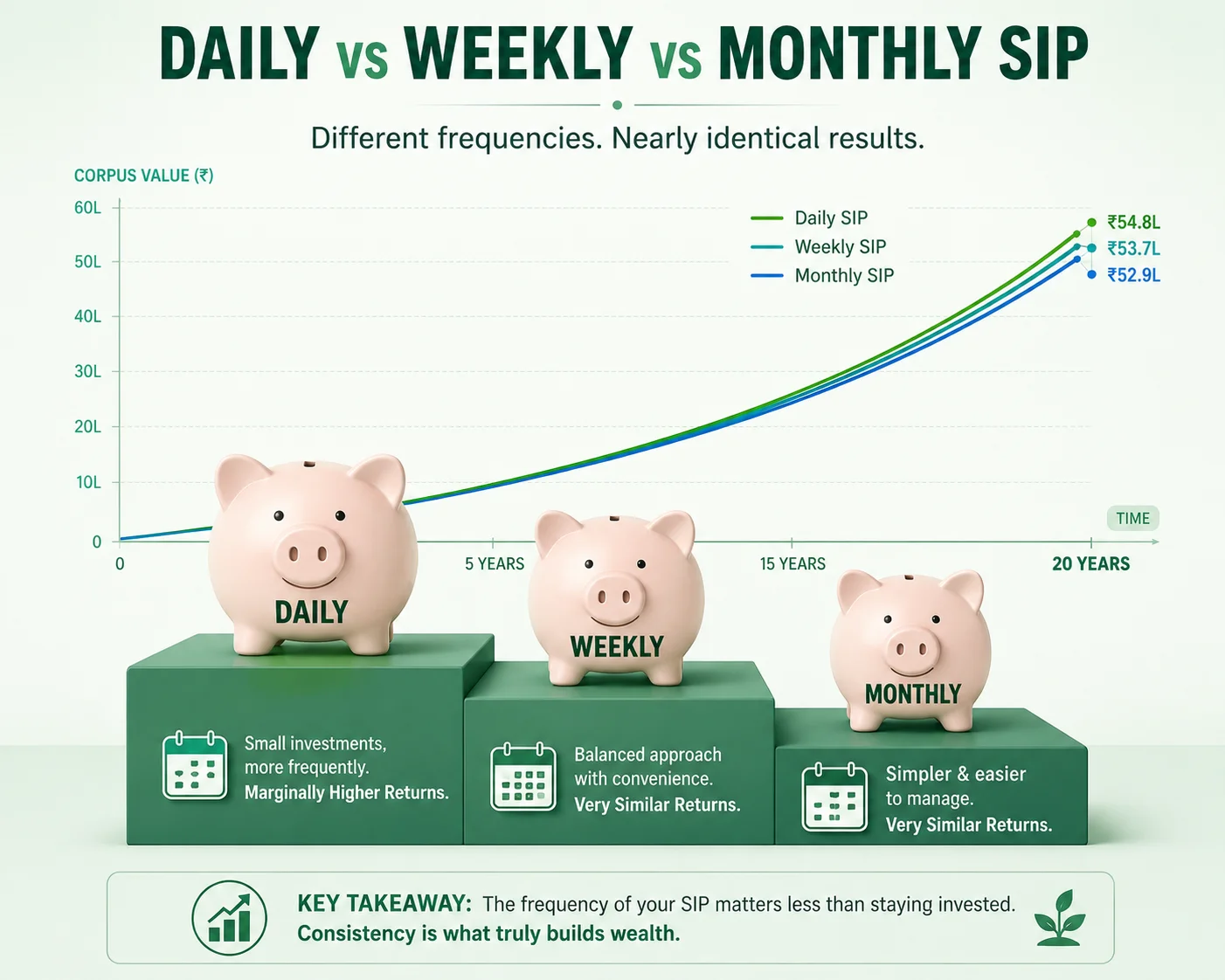
Daily, Weekly, or Monthly — Does It Really Matter?
Monthly, weekly, or daily SIP — does the frequency actually change your returns? If you've ever wondered which SIP frequency is best for long-term wealth, the honest answer surprises most people: the difference is small. But small is not zero. In volatile markets, the right frequency can add roughly 0.2-0.5% a year — and on a ₹10,000/month SIP over 20 years, that's ₹10-15 lakh more corpus.
The catch is that chasing frequency can distract you from the two things that matter 100 times more: how much you invest and how long you stay invested. This guide separates the real, data-backed effect of frequency from the noise, so you can set your SIP once and stop second-guessing it.
TL;DR — Quick Summary
30-sec read- 1Daily SIP captures the most price averaging in theory, but transaction costs can quietly offset the benefit.
- 2Weekly SIP (52 installments/year) closely approximates daily averaging without excessive transactions.
- 3Monthly SIP is simplest and lowest-cost, and research shows its returns land within 0.2-0.4% of daily SIP.
- 4Frequency matters far less than your investment amount and time horizon — start monthly, optimise later.
Continue reading for the full guide with examples and strategies.
Key Takeaways
6 points- 1Daily SIP theoretically captures the most price averaging, but transaction costs can offset the benefit.
- 2Weekly SIP (52 investments/year) closely approximates daily averaging without excessive churn.
- 3Monthly SIP is the simplest, lowest-cost option and research shows returns within 0.2% of daily SIP.
- 4Frequency matters most for volatile funds — for large-cap and index funds the gap is tiny.
- 5Pick a monthly SIP date that aligns with your salary credit; consistency beats calendar optimisation.
- 6Increasing your SIP by ₹1,000/month outweighs any frequency tweak you could make.
The Theory: Why More Frequent Looks Better on Paper
The core benefit of any SIP is rupee cost averaging — you automatically buy more units when the NAV is low and fewer when it's high. To understand how SIP frequency affects rupee cost averaging, remember that each installment is a fresh sample of the price. The more often you invest, the more data points you capture across the price cycle, and the smoother your average cost becomes.
A daily SIP captures roughly 250 trading sessions per year. A weekly SIP captures 52. A monthly SIP captures 12. With more frequent investments you get a richer "sample" of prices — which, in theory, is especially valuable in a market that swings sharply within each month. If you want the deeper mechanics of why averaging works at all, our guide to rupee cost averaging breaks it down with worked examples.
What the Data Actually Shows: Daily vs Weekly vs Monthly SIP Returns
Theory says "more is better," but reality is more modest. Multiple back-tests of Nifty 50 SIP data over 15-20 year periods converge on the same conclusion:
- Daily SIP: Best theoretical returns — but only by a very small margin.
- Weekly SIP: Within 0.1-0.2% of daily SIP returns.
- Monthly SIP: Within 0.2-0.4% of daily SIP returns.
The difference sounds trivial — and over a single year it is. But on a ₹10,000/month SIP compounded over 20 years, a 0.3% higher CAGR works out to roughly ₹12-15 lakh of extra corpus. Not life-changing, but not nothing either. The key insight is that this edge only reliably appears in volatile funds, and it can be erased entirely by transaction costs.
The Honest Summary
Across full market cycles, no single frequency wins every time. Daily edges ahead in some periods, monthly in others, because averaging benefits depend on the exact sequence of ups and downs — which nobody can predict in advance. The differences are small enough that convenience, cost, and consistency should drive your choice, not a fractional-percent chase.
Practical Comparison: Monthly vs Weekly vs Daily SIP
| Factor | Monthly SIP | Weekly SIP | Daily SIP |
|---|---|---|---|
| Investments per year | 12 | 52 | ~250 |
| Price averaging | Basic | Good | Best |
| Management effort | Minimal | Low | Low (if automated) |
| Transaction costs | Low | Moderate | High (if charged per trade) |
| Available platforms | All | Most | Some (Zerodha, Groww, etc.) |
| Best for | Most investors | Active investors, volatile funds | Zero-cost automated platforms |
| Return advantage vs monthly | Baseline | +0.1-0.2% | +0.2-0.4% |
When SIP Frequency Actually Matters Most
SIP frequency makes the biggest difference in high-volatility markets. When a fund's NAV swings 3-5% within a week, more frequent purchases capture more of those low-NAV windows. So if you're asking whether weekly SIP is better than monthly SIP for small-cap funds, the answer is usually yes — for highly volatile funds (mid-cap, small-cap, sectoral, thematic), weekly SIP can outperform monthly by 0.3-0.5% annually.
For low-volatility funds — large-cap index funds, debt funds, liquid funds — the averaging benefit shrinks to almost nothing. A monthly SIP is essentially as good as daily, because there simply aren't large intra-month swings to average across.
Weekly SIP Helps When:
- • You invest in mid-cap, small-cap, or sectoral funds
- • Markets are choppy with sharp weekly swings
- • Your platform charges nothing extra per installment
- • You want maximum averaging without daily clutter
Monthly SIP Is Fine When:
- • You invest in large-cap or index funds
- • You value simplicity and a single monthly debit
- • Your cash flow is tied to a monthly salary
- • You are just starting and want zero friction
Watch the Transaction Costs
Daily SIP only makes sense on platforms where each installment is free. If your broker or fund house charges a flat fee per transaction, 250 small debits a year can quietly eat the entire 0.2-0.4% averaging edge — and then some. Always confirm the cost per installment before choosing daily frequency.
The Best Date for a Monthly SIP
For a monthly SIP, historical data shows that mid-month dates (the 10th to 15th) have slightly outperformed month-start and month-end dates for Nifty 50 SIPs — though the difference is marginal and not guaranteed to persist. Month-end can occasionally be worse because of derivative expiry volatility, but this too is a small effect.
Far more important than the exact date is consistency. Pick a date a day or two after your salary is credited, so the money is invested before you can spend it. An automated SIP that never bounces will beat a perfectly-timed one that you occasionally skip because the balance ran low.
Does Changing SIP Frequency Affect Your Tax or Holding Period?
A common question is whether switching from monthly to weekly or daily SIP changes how your gains are taxed. It doesn't change the tax rate, but it does affect record-keeping: each individual SIP installment is treated as a separate purchase for capital gains, so more frequent SIPs create more tranches to track.
In equity funds, each tranche must be held for over 12 months to qualify for long-term capital gains treatment. A daily SIP therefore produces hundreds of tranches a year, each maturing into long-term status on its own date. Most platforms handle this accounting automatically, but if you plan to redeem partially, be aware that your earliest units qualify for long-term treatment first. When you do withdraw, model the projected corpus and drawdown with our SWP calculator so the redemption plan matches your goal.
Rahul's ₹12,000 Split Three Ways
Educational ExampleA worked example comparing the same annual investment across three frequencies in a volatile fund.
Rahul wants to invest ₹1,44,000 a year into a mid-cap fund. He compares three ways to split it, keeping the total identical so the comparison is fair:
- • Monthly: ₹12,000 on the 12th of each month — 12 installments.
- • Weekly: ₹2,770 every week — 52 installments.
- • Daily: ₹576 every trading day — about 250 installments.
Over a choppy 10-year stretch, the weekly plan edged out monthly by roughly 0.3% CAGR because it caught more of the sharp mid-week dips typical of mid-caps. The daily plan was marginally ahead of weekly on averaging — but Rahul's platform charged a small fee per transaction, and once those 250 fees were subtracted, daily actually finished behind weekly.
The takeaway: for his volatile fund, weekly was the sweet spot. Had he been investing in a large-cap index fund with zero-cost daily SIP, all three would have finished within a whisker of each other, and monthly's simplicity would have won.
This is a hypothetical scenario using historical market data for educational purposes only. Past performance does not guarantee future results.
Quarterly SIP and Other Frequencies: Are They Worth It?
Beyond the daily-weekly-monthly trio, most platforms also offer quarterly SIP (four installments a year) and, less commonly, fortnightly or annual options. Quarterly SIP is occasionally pitched to investors with irregular income — freelancers, small-business owners, or anyone paid in lumpy cycles — because it lines up with quarterly cash inflows instead of a monthly salary.
The trade-off is that quarterly SIP averages across only four price points a year, so it captures far less of the market's ups and downs than monthly. In a volatile year, that thinner sampling can leave your average cost noticeably higher or lower than a monthly SIP purely by luck of timing. For most salaried investors, quarterly SIP is a step in the wrong direction — you give up averaging without gaining any real convenience. It earns its place only when your cash flow genuinely arrives in quarterly chunks. If your income is irregular, a smaller monthly SIP topped up with occasional lump sums usually beats a large quarterly one; you can size those top-ups with our lumpsum calculator.
| Frequency | Installments / year | Best suited to |
|---|---|---|
| Daily | ~250 | Zero-cost automated platforms, volatile funds |
| Weekly | 52 | Active investors in mid/small-cap funds |
| Fortnightly | 26 | A middle ground — rarely offered, rarely needed |
| Monthly | 12 | Almost everyone — aligns with salary |
| Quarterly | 4 | Irregular or lumpy income cycles only |
How to Choose Your SIP Frequency: A Quick Checklist
If you would rather not run back-tests, this short checklist gets you to a sensible answer in under a minute. Work down it in order and stop at the first frequency that fits — there is no prize for over-optimising.
Decide in Five Questions
- 1. Is your income monthly? If yes, default to monthly SIP dated a day or two after your salary credit. This covers 80% of investors.
- 2. Are your funds volatile (mid/small-cap, sectoral)? If yes and your platform charges nothing extra, weekly SIP can add a small averaging edge.
- 3. Does each installment cost a fee? If yes, avoid daily and weekly — the fees erode the tiny return advantage. Stay monthly.
- 4. Is your income lumpy or quarterly? Only then does quarterly SIP (or monthly plus top-ups) make sense.
- 5. Could you just invest more instead? Before tweaking frequency, ask whether a higher amount or a step-up SIP would move the needle more. It almost always does.
Three Myths About SIP Frequency
A lot of the "which frequency wins" debate runs on half-truths. Three worth clearing up:
- Myth: Daily SIP always beats monthly. Over full market cycles the gap is a fraction of a percent, and once per-transaction fees are counted, daily can finish behind. It only reliably leads in fee-free, high-volatility scenarios.
- Myth: More frequent means lower risk. Every frequency averages across the same price series. Real timing risk is reduced by spreading across asset classes and dollar-cost averaging over years, not by slicing the calendar finer.
- Myth: Changing frequency is a returns hack. It is a fine-tuning knob, not a lever. The amount you invest and how long you stay invested dwarf any frequency choice — see how the gap compounds in our SIP vs lump sum guide.
The Practical Verdict on Choosing the Best SIP Frequency
- For beginners, start with monthly SIP. It's simple, consistent, aligns with your salary, and the return difference is small.
- If your platform offers weekly SIP at zero extra cost, use it for small and mid-cap funds where volatility rewards more frequent averaging.
- Daily SIP is worth it only when there are no per-transaction costs — otherwise the fees quietly eat the benefit.
- The investment amount matters 100 times more than the frequency. Increasing your SIP by ₹1,000/month — or adding a step-up SIP — outweighs any frequency optimisation.
Compare Frequencies for Your Own SIP
The fastest way to settle the debate is to run your own numbers. Use our calculators to compare the same annual investment across frequencies and against a one-time lump sum.
Fix your total annual investment
Project the corpus in the SIP calculator
Compare against a lump sum alternative
Still deciding on frequency? Common questions
Is daily SIP better than monthly SIP?
Daily SIP has marginally better returns due to more frequent averaging — roughly 0.2-0.4% more CAGR in volatile markets. But the difference is small versus monthly SIP, and per-transaction fees can wipe it out entirely. Your investment amount and time horizon matter far more. Increasing your SIP by ₹1,000/month outweighs any frequency optimisation.
What is the best date to do a monthly SIP?
Mid-month dates (10th-15th) have slightly outperformed month-start and month-end dates historically for Nifty 50 SIPs, but the difference is minimal. Pick a date that aligns with your salary credit — consistency matters far more than the specific date. An SIP that never bounces beats a perfectly-timed one you occasionally skip.
Is weekly SIP better than monthly for small-cap funds?
Usually yes. Small-cap and mid-cap funds are volatile, with sharp intra-month swings, so weekly SIP captures more low-NAV windows and can outperform monthly by 0.3-0.5% annually. For large-cap and index funds, the benefit is negligible and monthly is just as good.
Does SIP frequency change my tax?
No, it doesn't change the tax rate. But each installment is a separate purchase for capital gains, so more frequent SIPs create more tranches, each needing 12+ months of holding to qualify for long-term treatment in equity funds. Platforms track this automatically, but partial redemptions draw from the oldest units first.
Which SIP frequency is best for salaried employees?
Monthly SIP is almost always the best fit for salaried investors. It lines up with your salary credit, keeps record-keeping simple, and reduces the chance of a bounced installment. The return difference versus weekly or daily is small, so the convenience and consistency of a single monthly debit usually wins. Date it a day or two after payday so the money is invested before you can spend it.
Is quarterly SIP a good idea?
Quarterly SIP makes sense mainly for people with lumpy or irregular income — freelancers or business owners paid in cycles. With only four installments a year it averages across far fewer price points, so it captures less of the market's swings than monthly. For most salaried investors, a monthly SIP topped up with occasional lump sums is a better use of the same money.
Frequently Asked Questions
Should I switch my existing monthly SIP to weekly?
Only if you invest in volatile funds and your platform charges nothing extra per installment. For a large-cap or index SIP, switching adds complexity for a negligible return gain. If you do switch, keep the same total monthly outlay so you are comparing like with like. In most cases, leaving a working monthly SIP alone and focusing on increasing the amount is the better move.
Do multiple frequencies at once help diversify timing risk?
Splitting a single fund's SIP across daily, weekly, and monthly adds administrative clutter for essentially no benefit — they all average across the same price series. A cleaner way to reduce timing risk is to spread investments across asset classes and fund categories rather than across calendar frequencies. Read our diversification guide for the framework.
Is lump sum better than any SIP frequency?
It depends on the market. A lump sum puts all your capital to work immediately, which wins when markets subsequently rise, but exposes the full amount to timing risk on day one. Any SIP frequency spreads that risk over time. For most salaried investors without a windfall, a regular SIP is the lower-stress path. Compare both outcomes with our lump sum calculator before deciding.
How much extra corpus does frequency really add over 20 years?
On a ₹10,000/month SIP over 20 years, a 0.3% higher CAGR from frequency optimisation adds roughly ₹12-15 lakh. Meaningful, but modest next to what a 10% annual step-up or a larger monthly amount would add. Treat frequency as a fine-tuning decision, not a core one.
Investment Risk Disclaimer
This content is for educational purposes only and should not be considered financial advice. All investments carry risk, including the potential loss of principal. Past performance does not guarantee future results. Before making any investment decisions, please consult with a qualified financial advisor who understands your personal financial situation, risk tolerance, and investment goals.
Stock Averager provides tools and educational content but does not provide personalized investment advice or recommendations.
Explore this topic in depth
Systematic Investing & SIPs
Contributing on a schedule: frequency, escalation, inflation, and turning a corpus back into income.
- SIP vs Lump Sum: The definitive Guide to Investing Your Money (main guide)The definitive comparison, with the maths behind each approach.
- How Inflation Erodes Your SIP Returns (And What to Do About It)Planning in real money, and choosing a defensible inflation assumption.
- Escalating Contributions: The 10% Rule That Doubles Your PortfolioEscalating contributions annually — the rule that roughly doubles a corpus.
- Saving vs Investing: Fixed Deposits, CDs & RDs vs Index FundsDeposits and CDs against index funds, compared after tax and inflation.
- Investing From Abroad: The Cross-Border & Expat Investor's GuideCross-border and expat investing: accounts, reporting and tax exposure.
- Best SIP Plans for 2026: Top 10 Mutual Funds in IndiaHow to evaluate a fund rather than chase last year's return table.
- NRI Investing in India 2025: Complete Guide for Non-Resident IndiansNRE and NRO accounts, repatriation limits and compliance.
- Systematic Withdrawal Plan (SWP): How to Turn a Corpus Into Monthly IncomeConverting a corpus into monthly income without draining it early.
- How to Build Wealth with Dollar Cost Averaging (Without Timing the Market)The systematic default for most investors, and its real limits.
- How to Build a DCA Portfolio: Step-by-Step GuideTurning the principle into an actual allocation and schedule.
- How to Calculate CAGR: Formula, Examples & Free Calculator (2026)The compounding formula, and why XIRR is correct for regular contributions.
- Dividend Reinvestment (DRIP): How to Snowball Dividends Into WealthCompounding distributions automatically, and the tax you still owe.
Related topics
- Cost Averaging & Averaging DownLowering your average cost deliberately — when it compounds returns, and when it compounds a mistake.
- Tax & Financial PlanningThe structural decisions — account type, tax treatment and cash buffers — that compound alongside returns.
- Fundamentals & ValuationWorking out what a business is worth before deciding what its shares are worth paying.
About Stock Averager Team
Expert financial analysts dedicated to simplifying complex investment strategies for everyone. We build tools that help you make better money decisions.