
Escalating Contributions: The 10% Rule That Doubles Your Portfolio
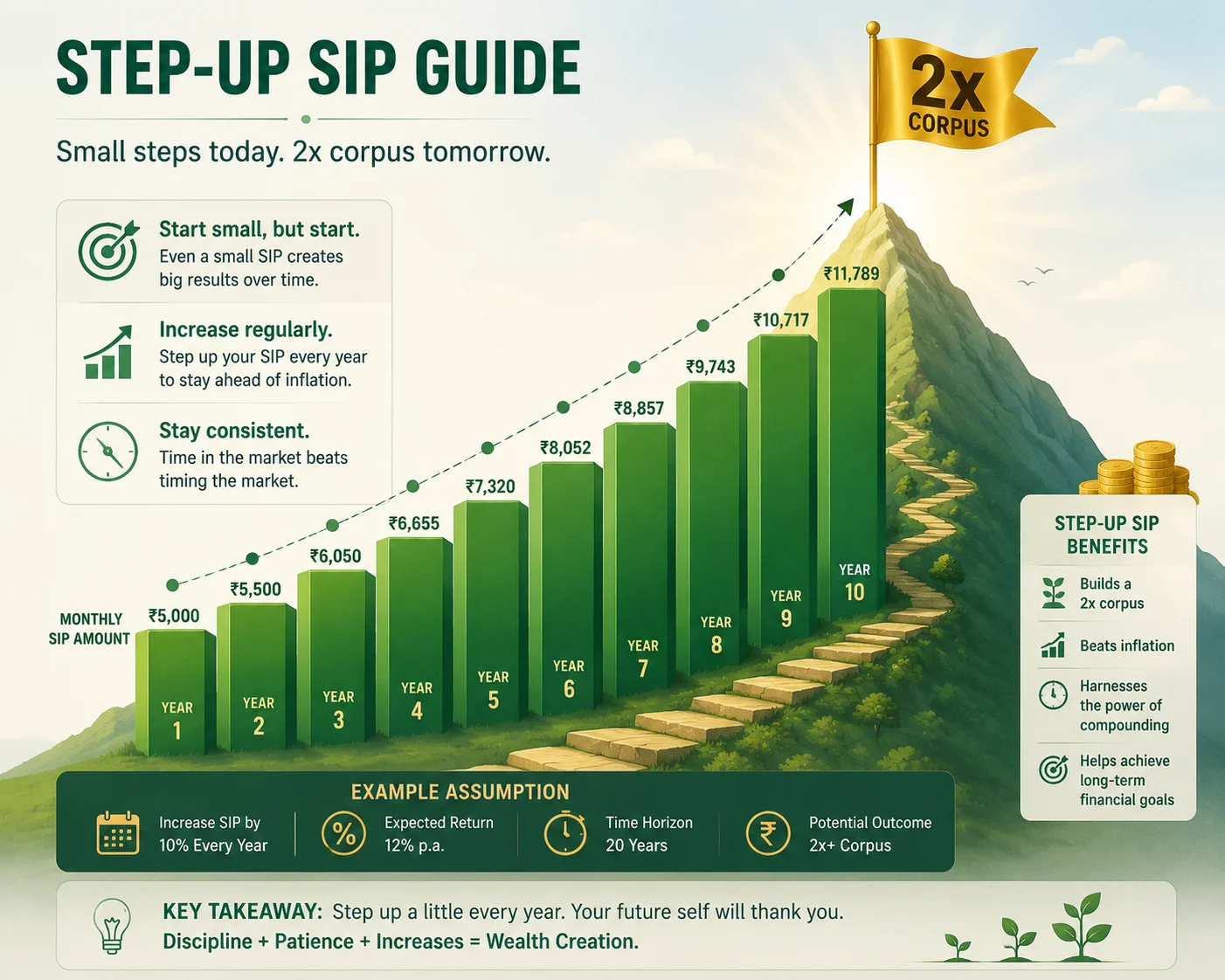
Same Discipline, Nearly Double the Wealth
Invest 1,000 a month for 20 years at 10% and you build roughly 765,000. Raise that contribution by just 10% each year and the same starting amount, the same fund and the same 20 years produce about 1,530,000. Nearly double — from a single setting you change once.
Escalating contributions is the most underused wealth-building tool in personal finance, in every country. It costs nothing extra, takes one click, and quietly channels every pay rise into your future instead of your lifestyle. If you do only one thing after reading this, make it switching your flat contribution to an escalating one.
TL;DR — Quick Summary
30-sec read- 1An escalating contribution — called a step-up SIP in India, auto-escalation in a US 401(k), an annual increase elsewhere — raises your monthly investment by a fixed % each year.
- 2A 10% annual increase roughly matches typical salary growth plus inflation, so your savings stay constant as a share of income.
- 3Over 20 years, a 10% annual increase produces roughly double the final balance of a flat contribution — in any currency.
- 4Nearly every major platform supports it natively at no extra cost; most people simply never switch it on.
- 5The tax treatment is identical to a flat contribution — only the amount changes, never the rate.
Continue reading for the full guide with examples and strategies.
Key Takeaways
6 points- 1Escalating contributions means raising your monthly investment by a fixed % each year, typically 10-15%.
- 2A 10% annual increase roughly matches salary growth plus inflation, keeping your savings rate constant.
- 3Over 20 years the escalating plan builds close to double the balance of a flat one, in every currency.
- 4The mechanism is available almost everywhere — US 401(k) auto-escalation, step-up SIP in India, annual increase options on most European and UK platforms.
- 5Even a modest 5% annual increase meaningfully outperforms a flat contribution over 15+ years.
- 6Match your escalation rate to your actual annual pay rise for a plan you can sustain.
One mechanism, many names
Different labels, identical arithmetic. If your provider offers any of these, the feature described in this guide is already available to you.
What Is an Escalating (Step-Up) Investment Plan?
An escalating contribution plan is a standing instruction to raise your monthly investment by a fixed percentage or fixed amount every year. Instead of investing 1,000 every month forever, you start at 1,000, move to 1,100 in year two, 1,210 in year three, and so on — a 10% annual increase applied automatically.
This mirrors how wealth actually accumulates: as income grows, savings should grow proportionally. A flat contribution ignores every pay rise; an escalating one captures them without you having to decide each year. That is the entire difference in any step-up versus regular contribution comparison — one freezes your commitment while the other scales it with your earning power. It works hand in hand with beating inflation, because the annual increase is precisely what stops rising prices eroding your real savings rate.
The Numbers: 5% vs 10% vs 15% Annual Increases
Below is a flat plan compared with three escalation rates over 20 years. Notice that a larger increase lifts both the total you contribute and the final balance — and that the final balance grows faster than the contributions do, because the extra money still has years to compound.
| Plan type | Starting amount | Total contributed (20 yrs) | Final balance at 10% |
|---|---|---|---|
| Flat contribution | 1,000/month | 240,000 | 765,000 |
| 5% annual increase | 1,000/month | 397,000 | 1,067,000 |
| 10% annual increase | 1,000/month | 687,000 | 1,530,000 |
| 15% annual increase | 1,000/month | 1,229,000 | 2,247,000 |
Illustrative, at a constant 10% annual return, currency-neutral. Multiply by your own contribution to scale.
Because the arithmetic is currency-neutral, the same comparison holds in every market — only the units and the realistic return assumption change.
Flat vs 10% annual increase over 20 years, by market
A typical monthly contribution in each market, at that market's realistic long-run equity return.
| Market | Monthly start | Return used | Flat plan | 10% escalating | Extra wealth |
|---|---|---|---|---|---|
| United StatesUSD · S&P 500 | $1,000 | 10% | $765,000 | $1,530,000 | +$765,000 |
| EurozoneEUR · MSCI World | €500 | 8% | €295,000 | €612,000 | +€317,000 |
| United KingdomGBP · FTSE All-World | £500 | 9% | £334,000 | £690,000 | +£356,000 |
| IndiaINR · Nifty 50 | ₹10,000 | 12% | ₹99.9 lakh | ₹1.98 crore | +₹98 lakh |
The escalating plan roughly doubles the outcome in every market, despite very different return assumptions. That consistency is the point: the advantage comes from the escalation itself, not from picking a high-return market.
Why Escalating Contributions Beat a Flat Plan So Decisively
The advantage comes from two compounding forces working at once:
- More capital goes in. Each year you contribute more. Over 20 years a 10% escalator contributes roughly 687,000 against 240,000 for the flat plan — nearly three times as much principal.
- The extra money still has time to compound. The larger contributions in years 8 through 15 still have five to twelve years of growth ahead of them. Escalating while you are still years from the goal means each additional unit works far harder than a late catch-up contribution would.
This is also why escalating early beats escalating aggressively later. Someone who raises contributions 10% a year from year one finishes well ahead of someone who keeps a flat plan for a decade and then triples the amount — even if the second person ends up contributing a similar total.
The lifestyle-creep defence
When income rises, the money usually disappears into a bigger apartment, a newer phone, more subscriptions. An automatic escalation intercepts a slice of every raise before it becomes a spending habit. You never miss money you never got used to having — which is why this is as much a behavioural tool as a mathematical one. Behavioural economists found that pre-committing to escalate future raises produces dramatically higher savings rates than asking people to cut current spending, and the finding has held up across countries and income levels. For more on that psychology, see our guide to behavioural finance.
How to Switch It On in Your Country
The feature exists almost everywhere and costs nothing. In most cases it is a checkbox you missed during setup rather than something you need to apply for.
Where to find the escalation setting
Look for wording like auto-increase, annual escalation, step-up, or top-up.
- •Most 401(k) providers offer automatic annual increase — often a 1% of salary bump each year up to a cap you set
- •Many plans enable it by default under auto-enrolment; check whether yours did and what the ceiling is
- •For IRAs and taxable brokerage accounts, raise the recurring transfer amount once a year — set a calendar reminder for the week your raise lands
- •Raising the deferral rate rather than the dollar amount escalates automatically with every pay rise
- •Most ISA and SIPP platforms allow an annual increase to be configured on a regular direct debit
- •Workplace pension schemes frequently include a contribution escalation option through the provider portal
- •Increasing the percentage rather than the pound amount keeps it aligned with salary automatically
- •Watch the annual allowance if escalation pushes pension contributions toward the limit
- •Several brokers offer a dynamic savings plan with a built-in annual percentage uplift
- •Where it is not offered natively, editing the standing order once a year takes under two minutes
- •Check whether your provider charges per order — some free-plan tiers cap the contribution size
- •Occupational pension schemes in many member states have their own escalation mechanism
- •Every major fund platform supports step-up natively, configured when you create the SIP
- •Choose either a percentage or a fixed rupee increment, applied annually
- •You no longer need to cancel and recreate the SIP each year, as was once the case
- •Bank-led platforms with mutual fund integration offer the same option
- •Pre-authorised contribution plans can usually be edited online to raise the amount
- •Group RRSP plans through an employer often include an automatic escalation feature
- •Contribution room carries forward, so a missed year of escalation can be caught up later
- •Raising the contribution as a percentage of pay keeps it self-adjusting
- •Employer super contributions already scale with salary automatically
- •Additional salary sacrifice can be set as a percentage so it escalates with every pay rise
- •Check the concessional contributions cap before setting an aggressive escalation rate
- •Unused cap amounts can be carried forward in some circumstances
Contribution limits, allowances and plan features vary by provider and change over time. Confirm the current rules with your provider or a qualified adviser.
If your provider supports it
Enable it once and never think about it again. Set the rate to match your expected pay rise and add a cap so it cannot outrun your budget.
If it doesn't
Set a recurring annual calendar reminder for the month your pay review lands, and raise the standing order manually. Doing it the same week the raise arrives is what makes it painless.
What Escalation Rate Should You Choose?
- 5% a year: Conservative — roughly matches inflation in most developed markets without a real increase. Still adds substantially over 20 years versus a flat plan.
- 10% a year: The sweet spot for most salaried professionals. Captures typical salary growth and comfortably beats inflation, so your real savings rate rises slightly each year.
- 15% a year: Aggressive. Appropriate for early-career, high-growth phases. Plan to dial it back once salary growth stabilises, or set a cap.
The simplest rule: escalate by the same percentage as your annual pay rise. A 7% raise means a 7% increase. This keeps your savings rate constant as a share of income, which is the correct discipline for long-term wealth building — you are neither squeezing your lifestyle nor letting it absorb the entire raise. Want to sanity-check whether your fund's historical return supports these projections? Run it through our CAGR calculator.
Two Colleagues, One Decision, 20 Years
Educational ExampleIdentical salaries and identical funds. One escalates, one doesn't. Illustrative only.
Two colleagues both start investing 1,500 a month at age 30 into the same index fund, assumed to return 10%. Both receive similar 10% annual raises. The only difference is what they do with those raises.
- • The flat investor: keeps the contribution frozen at 1,500 for 20 years. Contributes 360,000 in total and finishes with roughly 1,148,000.
- • The escalating investor: raises the contribution 10% each year in step with salary. Contributes about 1,031,000 in total and finishes with roughly 2,295,000.
The escalating investor ends with about 1,147,000 more — not because they earned more or picked a better fund, but because they let contributions grow with income instead of freezing them. Note too that they never felt poorer: each increase came out of a raise they had just received.
This is a hypothetical scenario using historical market data for educational purposes only. Past performance does not guarantee future results.
Is Escalating Better Than Investing a Lump Sum?
These solve different problems and are not really competitors. A lump sum puts capital to work immediately, which wins when markets are cheap, but exposes the whole amount to timing risk on day one. An escalating plan spreads entries across years, cost-averages through every market cycle, and scales your commitment with your income.
For most salaried investors without a windfall, escalating is the lower-stress and more sustainable path — and the two combine perfectly well. If you do have a lump sum, model the alternative with our lumpsum calculator and compare side by side. For the full framework on when each wins, read our monthly vs lump sum guide, or learn how to combine both in a systematic portfolio.
Common Mistakes to Avoid
Setting the rate too high to sustain. A 20% escalation looks spectacular on a calculator and typically breaks by year five when the amount outpaces your salary. Pick a rate you can honestly maintain through a bad year.
Escalating into an unsuitable fund. Raising contributions into a concentrated or high-volatility fund magnifies both upside and drawdown. Match the vehicle to your risk tolerance, not to last year's returns.
Escalating manually and forgetting. A missed year quietly compounds into a permanently smaller balance. Automate wherever the option exists.
Ignoring contribution caps. Tax-advantaged accounts have annual limits. An aggressive escalation can breach them, triggering penalties — set the cap deliberately rather than discovering it.
Percentage Increase vs Fixed-Amount Increase
Most platforms ask how the contribution should grow: by a percentage of the current instalment, or by a fixed amount each year. They diverge sharply over a long horizon, so it is worth understanding before you set it and forget it.
| Feature | Percentage (e.g. 10%) | Fixed amount (e.g. +100) |
|---|---|---|
| How it grows | Compounds — each year's rise is bigger than the last | Linear — the same jump every year |
| A 1,000 start by year 20 | Roughly 6,100/month | 2,900/month |
| Best for | Salaried professionals whose income compounds | Fixed budgets, freelancers, cautious savers |
| Main risk | Later instalments can outrun your salary | Falls behind inflation over long horizons |
Should you cap the escalation?
A percentage escalation compounds relentlessly — a 1,000 contribution rising 10% a year exceeds 6,100 a month by year 20, which may be well beyond your budget or your account's annual limit. Most platforms let you set a maximum instalment: the plan escalates until it hits your ceiling, then holds steady. Setting a realistic cap up front keeps the plan sustainable without needing an annual intervention. Model both paths in our monthly investment calculator before committing.
Does Escalating Change Your Tax Treatment?
No. Tax depends on the type of asset you hold and how long you hold it — never on whether contributions were flat or escalating. The escalation changes how much you invest, and nothing else.
What does matter is how instalments are treated at sale. Each monthly contribution is a separate purchase with its own holding period, and most jurisdictions default to first-in-first-out when you sell. So the oldest instalments — which usually qualify for long-term treatment — are counted first, while your most recent and largest instalments may still be short-term. This matters more with an escalating plan precisely because the later contributions are the big ones.
Practical takeaway
Because each instalment runs its own clock, selling an escalating plan all at once can trigger a mix of short- and long-term gains at very different rates. Withdrawing in tranches — letting recent instalments age past the long-term threshold first — is usually more tax-efficient. Where your platform allows specific-lot identification rather than automatic FIFO, that gives you even more control. Rules and thresholds vary by country and change, so confirm current treatment with a qualified adviser before selling.
See the Gap in Your Own Currency
The difference between a flat and an escalating plan is easiest to believe when you see your own numbers. Project both and watch the gap widen year after year, in any of 10 currencies.
Enter your starting monthly amount
Add your annual increase percentage
Compare flat against escalating
People Also Ask
How much difference does increasing my investment 10% a year make?
Over 20 years it roughly doubles the final balance. Starting at 1,000 a month at a 10% return, a flat plan reaches about 765,000 while a 10% annual escalation reaches about 1,530,000. Roughly two thirds of that gap comes from contributing more and one third from those larger contributions still having years to compound. The proportion holds in any currency.
What is the best annual increase percentage?
For most salaried professionals, 10% is the sweet spot — it tracks typical salary growth and beats inflation, so your real savings rate creeps up each year. A 5% increase is conservative but still adds meaningfully over two decades, while 15% suits early-career high-growth phases. The simplest rule is to escalate by the same percentage as your actual annual pay rise.
Is a step-up plan better than a regular fixed contribution?
For long horizons, decisively yes. A fixed contribution freezes your commitment while an escalating one scales it with income, capturing pay rises that would otherwise vanish into lifestyle inflation. Over 15-20 years this can nearly double the outcome for the same starting amount and the same effort. The only prerequisite is a rising or stable income.
Can I add automatic escalation to an existing investment plan?
Usually yes. Most platforms let you modify an existing recurring contribution to include an annual increase, or you can stop it and restart with escalation enabled. US 401(k) providers, UK ISA and SIPP platforms, European ETF savings plans and Indian fund platforms all support this at no extra cost. If yours does not, an annual calendar reminder achieves the same thing.
Should I cap how far my contribution escalates?
Almost always. A percentage escalation compounds, so a 1,000 monthly contribution rising 10% a year exceeds 6,100 by year 20 — potentially more than your budget allows or more than a tax-advantaged account permits annually. Setting a maximum instalment lets the plan escalate until it reaches your ceiling then hold steady, which keeps it sustainable without an annual review.
Do escalating contributions have different tax rules?
No. Capital gains treatment depends on the asset type and holding period, not on whether contributions were flat or rising. What does differ is the practical effect at sale: each instalment carries its own holding period and most systems sell oldest-first, so your largest and newest contributions may still be short-term. Withdrawing in tranches rather than all at once is usually more tax-efficient.
Frequently Asked Questions
Does an escalating plan cost more in fees?
No. Escalation is simply an instruction to increase the amount on a schedule — there is no extra platform charge for enabling it. You pay the same expense ratio on the fund whether contributions are flat or rising. The only thing that grows is your contribution, which is entirely the point.
What if I can't afford the increase one year?
Most platforms let you pause, skip or reduce an escalation if circumstances change — a job loss, a medical expense, a career break. It is a helpful default, not a binding contract. Skipping one year's increase slightly reduces the final balance but does not derail the plan. Resume it when cash flow recovers, and consider a slightly larger catch-up increase the following year.
Should the escalation rate change over time?
Ideally it should track your salary growth, which is rarely constant. Early in a career, when raises are large, 12-15% is realistic. As income growth flattens in later years, dialling back to 5-8% keeps it sustainable. Reviewing it once a year against your actual pay rise is the right cadence — more often is unnecessary, less often lets it drift out of line.
Is this good for retirement planning specifically?
It is one of the best tools available. Retirement targets are large because inflation compounds over decades, and an escalating plan builds that scale without requiring an intimidating starting amount. It also naturally matches the shape of a career, where income rises fastest in the middle years. Combined with planning in inflation-adjusted terms, it makes a daunting retirement number reachable on an ordinary salary.
Does this work for irregular or freelance income?
A percentage escalation assumes predictable annual raises, which freelancers rarely have. Two alternatives work better: escalate by a fixed amount you are confident of covering even in a lean year, or contribute a fixed percentage of each payment received so the amount self-adjusts with income. The second approach is effectively continuous escalation and suits variable earnings far better than an annual step.
Related Articles
Investment Risk Disclaimer
This content is for educational purposes only and should not be considered financial advice. All investments carry risk, including the potential loss of principal. Past performance does not guarantee future results. Before making any investment decisions, please consult with a qualified financial advisor who understands your personal financial situation, risk tolerance, and investment goals.
Stock Averager provides tools and educational content but does not provide personalized investment advice or recommendations.
Explore this topic in depth
Systematic Investing & SIPs
Contributing on a schedule: frequency, escalation, inflation, and turning a corpus back into income.
- SIP vs Lump Sum: The definitive Guide to Investing Your Money (main guide)The definitive comparison, with the maths behind each approach.
- How Inflation Erodes Your SIP Returns (And What to Do About It)Planning in real money, and choosing a defensible inflation assumption.
- Daily vs Weekly vs Monthly SIP: Which Frequency Gives Best Returns?Whether daily, weekly or monthly contributions actually change the outcome.
- Saving vs Investing: Fixed Deposits, CDs & RDs vs Index FundsDeposits and CDs against index funds, compared after tax and inflation.
- Investing From Abroad: The Cross-Border & Expat Investor's GuideCross-border and expat investing: accounts, reporting and tax exposure.
- Best SIP Plans for 2026: Top 10 Mutual Funds in IndiaHow to evaluate a fund rather than chase last year's return table.
- NRI Investing in India 2025: Complete Guide for Non-Resident IndiansNRE and NRO accounts, repatriation limits and compliance.
- Systematic Withdrawal Plan (SWP): How to Turn a Corpus Into Monthly IncomeConverting a corpus into monthly income without draining it early.
- How to Build Wealth with Dollar Cost Averaging (Without Timing the Market)The systematic default for most investors, and its real limits.
- How to Build a DCA Portfolio: Step-by-Step GuideTurning the principle into an actual allocation and schedule.
- How to Calculate CAGR: Formula, Examples & Free Calculator (2026)The compounding formula, and why XIRR is correct for regular contributions.
- Dividend Reinvestment (DRIP): How to Snowball Dividends Into WealthCompounding distributions automatically, and the tax you still owe.
Related topics
- Cost Averaging & Averaging DownLowering your average cost deliberately — when it compounds returns, and when it compounds a mistake.
- Tax & Financial PlanningThe structural decisions — account type, tax treatment and cash buffers — that compound alongside returns.
- Fundamentals & ValuationWorking out what a business is worth before deciding what its shares are worth paying.
Sources & Further Reading
Figures and rules cited in this article are drawn from the primary sources below. Tax and regulatory details change — always confirm against the current official guidance for your jurisdiction.
- 1India Retains 4% Inflation Target for RBI — Drishti IASThe 4% CPI target and ±2 percentage point tolerance band that a step-up percentage should outpace.
- 2SIP Stoppage Ratio Surges to 109 Per Cent in January 2025 Amid Market Downturn — Outlook MoneyEvidence that contribution discipline, not return assumptions, is the usual point of failure.
- 3India Inflation Rate — CPI historical data — Trading EconomicsLong-run CPI series for setting a realistic annual escalation rate.
About Stock Averager Team
Expert financial analysts dedicated to simplifying complex investment strategies for everyone. We build tools that help you make better money decisions.