
How to Calculate Your Break-Even After Averaging Down
The One Number You Must Know First
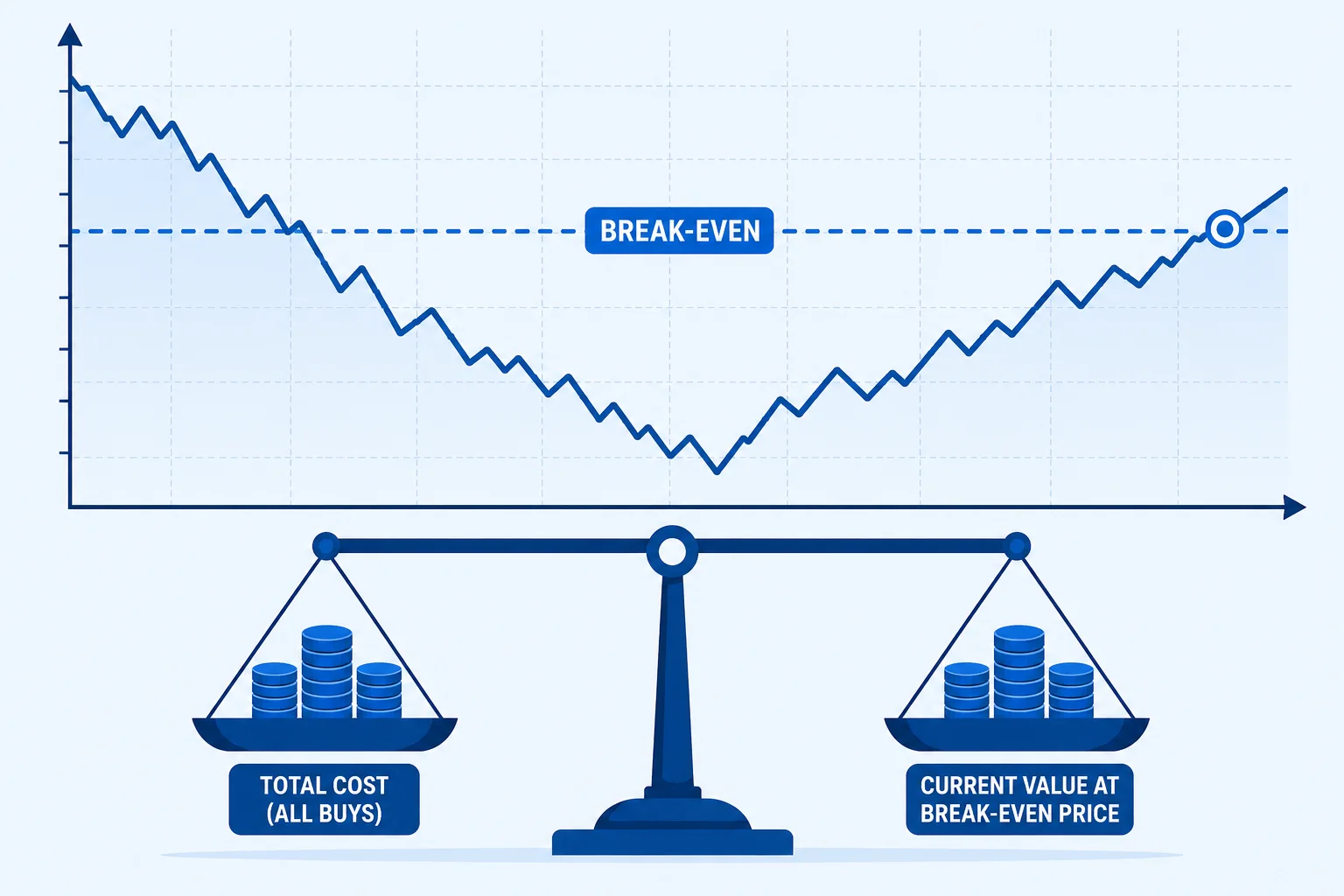
Before you average down, you must know one number: your new break-even price. Not the price you need to "get back to even" from your original purchase — the price you need to break even after all your purchases combined. These are two completely different numbers, and confusing them is one of the most expensive beginner mistakes in investing.
Buy 100 shares at $100, watch it fall to $70, then buy 100 more — and your break-even is no longer $100. It's $85. That $15 difference is the entire point of averaging down, but it comes with a hidden cost most investors never calculate: your total capital at risk just grew by 70%. This guide shows you the exact math on both sides of that trade.
TL;DR — Quick Summary
30-sec read- 1Break-even after averaging down equals your new blended average cost per share across all purchase lots.
- 2The formula: New Average = total dollars invested divided by total shares owned.
- 3Averaging down lowers the percentage recovery you need — but raises your absolute dollars at risk.
- 4A lower break-even is not the same as a good investment; always weigh opportunity cost.
Continue reading for the full guide with examples and strategies.
Who This Is For
Beginner LevelPerfect if you:
- You hold a losing stock and are deciding whether adding more shares makes sense
- You already averaged down and want to know your true recovery target
- You keep confusing your original purchase price with your blended break-even
- You want to size a second lot to hit a specific break-even price
You'll learn:
- The exact formula for break-even (new average cost) after averaging down
- A full worked example showing $100, $70, and $60 purchase lots
- Why a lower break-even still means more total capital at risk
- How to reverse-engineer how many shares to buy to reach a target break-even
- The opportunity-cost trap that makes 'breaking even' a poor goal
Not for you if:
Key Takeaways
5 points- 1Break-even after averaging down = your new average cost per share (including all purchases).
- 2More shares at a lower price = lower break-even, but more total capital at risk.
- 3The math: new average = (lot1_shares × lot1_price + lot2_shares × lot2_price) ÷ total_shares.
- 4Averaging down requires a smaller % recovery to break even — but a larger absolute price move.
- 5Use the Stock Averager to calculate break-even before committing capital.
What Break-Even Means After Averaging Down
Your break-even price is the price at which you neither gain nor lose money on your total investment. If you've ever wondered how to calculate break-even after averaging down a stock, the key insight is this: when you average down, you buy more shares at a lower price, which lowers your break-even — but only in percentage terms. In absolute dollar terms, you now need the stock to reach a higher total portfolio value to recover all the capital you have committed. This is the most common point of confusion in break-even after averaging down for beginners, so it's worth slowing down before adding to a losing position.
Think of it this way. Your break-even is not a fixed feature of the stock — it is a feature of your transactions. Every buy order rewrites it. That is why the phrase "cost basis break even" matters: your break-even is simply the average cost basis of every share you own. The moment you place a second buy below your first, that blended average drops, and the price the stock needs to reclaim for you to be whole again drops with it.
The Break-Even Formula
There is exactly one formula you need, and it works for two lots or twenty. To find the new average price after buying more shares, sum the money spent on every lot and divide by the total shares owned:
New Average Cost (Break-Even)
New Average = (Lot 1 Shares × Lot 1 Price + Lot 2 Shares × Lot 2 Price) ÷ Total SharesFor multiple lots: sum all (shares × price) and divide by total shares owned.
Notice what the formula is really doing: it is a weighted average, not a simple average. A common beginner error is to average the two prices ($100 and $70) and assume the break-even is $85. That only happens to be correct here because both lots have the same number of shares. Buy a larger or smaller second lot and the weighting shifts. This is precisely why an averaging down break even calculator beats mental math — it weights every lot by its share count automatically.
Step-by-Step Example
Initial position: You buy 100 shares at $100 = $10,000 invested. The stock drops to $70. You're down $3,000, or 30%.
Averaging down: You buy 100 more shares at $70 = $7,000 more invested. Total invested is now $17,000 across 200 shares.
Calculating the new break-even
= (100 × $100 + 100 × $70) ÷ 200
= ($10,000 + $7,000) ÷ 200
= $17,000 ÷ 200
= $85 new break-even (vs. original $100)
You now need a 21% recovery from $70 to $85 — versus a 43% recovery from $70 to $100 without averaging down. This is exactly what the new break-even price is after buying more shares at a lower price: a lower threshold to recover, even though your total capital exposure has grown. That's the power of the strategy when the underlying business is genuinely sound. If you want to model any custom lot sizes, the Stock Averager does this instantly.
💡 Percentage vs. Dollars
Averaging down cut the recovery you need from +43% to +21% — that feels like cutting your problem in half. But your money at risk went from $10,000 to $17,000. The stock is now easier to "win" on, yet a total collapse costs you far more. Break-even math and risk math point in opposite directions, and you must read both.
The Trade-Off: Less % Recovery, More Capital at Risk
Watch what happens as you keep averaging down. Each new lot pulls the break-even closer to the current price, but the total dollars committed climb steeply. The table below extends our example to a second averaging-down purchase of 200 shares at $60:
| Scenario | Total Invested | Break-Even Price | Recovery Needed |
|---|---|---|---|
| Hold only (100 shares at $100) | $10,000 | $100 | +43% from $70 |
| Average down 1x (+100 at $70) | $17,000 | $85 | +21% from $70 |
| Average down 2x (+200 more at $60) | $29,000 | $72.50 | +4% from $70 |
Notice the pattern: each additional averaging down reduces the break-even further, but doubles and triples your capital at risk. If the stock goes to zero, you lose all $29,000 instead of the original $10,000. Always weigh the break-even improvement against the additional capital concentration in a single name. This is where the discipline of position sizing matters most — averaging down is, at its core, a decision to make one position bigger.
What Improves
- Lower break-even price per share
- Smaller percentage move needed to recover
- Larger share count to benefit from any bounce
- Lower cost basis on the whole position
What Gets Worse
- Total dollars at risk in one stock
- Concentration — less diversification
- Absolute loss if the business keeps declining
- Opportunity cost of capital tied up recovering
How Many Shares Do I Need to Hit a Target Break-Even?
Sometimes you start from the answer: "I want my break-even at $85 — how many shares must I buy at today's price?" You can rearrange the formula, but this is where a calculator earns its keep. The relationship is:
Shares Needed for a Target Break-Even
New Shares = (Old Shares × (Old Avg − Target)) ÷ (Target − Current Price)Only works when the current price is below your target break-even.
Using our numbers: 100 shares, old average $100, target $85, current price $70 gives (100 × 15) ÷ 15 = 100 shares — matching the example exactly. If today's price were $60 instead, you would need only (100 × 15) ÷ 25 = 60 shares to reach the same $85 break-even, because each cheaper share drags the average down harder. Rather than solve this by hand each time, the Break-even Calculator lets you punch in a target and see the exact share count.
Using a Break-Even Calculator
Don't do this math manually on a live trade. If you're looking for the simplest way to calculate a new average cost per share after averaging down, the Stock Averager Calculator computes the exact break-even after any combination of purchases. For a stripped-down break-even figure on a single position, the Break-even Calculator works too. Enter:
- Shares currently owned plus your original average price
- The current market price — what you'd pay for additional shares
- Your desired target average, i.e. your break-even goal
The calculator shows exactly how many shares to buy to reach any target break-even price, and updates your blended cost the instant you change a number. If you're still learning the underlying mechanics, our guide on how to calculate average stock price walks through the same weighted-average logic in plain language.
Worked Example: Sizing a Second Lot to a Target
Educational ExamplePriya owns a losing position and wants her break-even at a specific level before earnings. Here is how the numbers fall out — illustrative only.
Priya bought 200 shares of a stock at $50 ($10,000). It has since dropped to $32, leaving her down $3,600 (36%). Her current break-even is $50, meaning the stock must rally +56% from $32 just to get her whole. She has conviction in the business and $6,400 free to deploy. Her goal: pull her break-even down to $42.
New Shares = (200 × ($50 − $42)) ÷ ($42 − $32)
= (200 × $8) ÷ $10
= $1,600 ÷ $10
= 160 shares at $32 = $5,120 additional
After buying 160 shares at $32, Priya owns 360 shares for $15,120 — a blended break-even of $42. Her required recovery drops from +56% (to $50) down to just +31% (from $32 to $42). But her money at risk climbed from $10,000 to $15,120.
The trade-off in one sentence: Priya cut the rally she needs almost in half, and in exchange put 51% more capital on a single stock. If her thesis is right, that is a smart deployment. If the drop reflects a broken business, she just enlarged a mistake. The math never tells you which — only your research does.
This is a hypothetical scenario using historical market data for educational purposes only. Past performance does not guarantee future results.
A Critical Warning: Opportunity Cost
Breaking even is not the same as making a good investment decision. If you deploy $7,000 averaging down a stock that grinds back to your break-even over three years, you've made 0% on that capital across those three years. That same $7,000 in a broad index fund might have returned 25-35% over the same period. Breaking even can feel like a win, but relative to what your money could have done elsewhere, it can be a quiet, expensive loss.
Always ask: "If I average down, what is my realistic return versus deploying this capital elsewhere?" Your break-even calculation is the floor — it tells you when you stop losing, not when you start winning. Make sure the upside justifies the added risk and the years your capital stays committed. Running the same dollars through a CAGR Calculator or a Target Price Calculator gives you a realistic benchmark to compare against before you commit.
Reframe the Goal
Stop asking "how do I get back to even?" and start asking "is this the single best place for my next dollar?" Break-even is an accounting milestone, not an investment thesis. A stock that will merely return you to zero over three years is competing against every other opportunity in the market — and often losing.
Averaging Down vs. Dollar-Cost Averaging: Are They the Same?
A frequent beginner question is the difference between averaging down and dollar-cost averaging, since both lower your average cost. Dollar-cost averaging is a disciplined, scheduled approach — you invest a fixed amount on a regular cadence regardless of price, which naturally buys more shares when prices fall. Averaging down is a reactive, conviction-based decision: you deliberately add to a position specifically because it has dropped.
The break-even math is identical for both, but the risk profile is not. Averaging down concentrates capital into one stock that is already moving against you, while dollar-cost averaging usually spreads risk across time and often across a basket of assets. We break this distinction down fully in averaging down vs. dollar-cost averaging, and if you're weighing whether to add at all, read the red flags in when NOT to average down first.
The Recovery Math: Why a Bigger Loss Needs a Bigger Bounce
There is a piece of arithmetic that makes break-even harder to reach than most people expect, and it is the real reason averaging down is so tempting: losses and gains are not symmetric. A 50% drop does not need a 50% gain to recover — it needs a 100% gain, because you are now rebuilding from a smaller base. The deeper the hole, the steeper the climb, and the relationship is non-linear.
| If you're down… | Gain needed to break even |
|---|---|
| 10% | +11.1% |
| 20% | +25% |
| 30% | +42.9% |
| 40% | +66.7% |
| 50% | +100% |
| 60% | +150% |
| 75% | +300% |
This is exactly where averaging down does its work. It doesn't change the shape of this curve — it changes which row you are sitting on. In our earlier example, holding at a 30% loss meant needing a +43% bounce to reach the original $100. After one round of averaging down, your effective loss versus the new $85 break-even shrank to about 18% from $70, so the required bounce dropped to +21%. You moved from a steep row to a gentler one. The catch is unchanged: you moved rows by committing more capital, so a further fall now drops you down this table faster in dollar terms.
The One-Line Takeaway
Averaging down is really a bet that you can move to a shallower row on this table faster than the market can push you to a deeper one. If your thesis is right, you climb out with a modest bounce. If it's wrong, you've enlarged the position at exactly the moment the recovery math is turning against you.
Does Your Break-Even Include Fees, Dividends, and Taxes?
The blended-average formula gives you your accounting break-even. Your true, all-in break-even — the price at which you can actually sell and walk away whole — is usually a little different, because a few real-world items quietly shift it. Most retail brokers are commission-free today, so this matters less than it once did, but the adjustments still add up on larger positions.
Costs raise it
Any commissions, transaction taxes (e.g. STT in India), regulatory fees, and the bid-ask spread you pay on entry all get baked into your cost basis, nudging your true break-even slightly higher.
Dividends lower it
Every dividend you collect while holding effectively reduces your net cost. A stock paying a 4% yield trims your break-even a little each year — one reason averaging down on quality dividend payers is less punishing.
Taxes are asymmetric
Selling exactly at break-even triggers no capital gains tax because there's no gain. But your taxable cost basis per lot can differ from your simple average depending on the accounting method your broker uses.
A practical rule: for a quick decision, the weighted-average break-even is close enough. For an exact exit target on a large or dividend-paying position, add your total fees back to the cost side and subtract the dividends you've banked. The Cost Basis Calculator handles multiple lots cleanly, and because tax cost basis can diverge from your planning average, the tax implications of averaging down guide covers how FIFO, specific identification, and the wash sale rule change what you actually owe. If your position pays income, a Dividend Estimator shows how much those payouts chip away at your effective break-even over time.
Calculate Your Break-Even in Seconds
Skip the manual math. Enter your lots and see your exact blended break-even, plus how many shares you'd need to hit any target price.
Enter shares owned and your average price
Add the current price and lot size
Read your new break-even instantly
Breakeven math: the questions that come up most
How do I calculate break-even after averaging down?
Add up the total dollars invested across every lot and divide by the total shares owned. For two lots: (Lot1 shares × Lot1 price + Lot2 shares × Lot2 price) ÷ total shares. The result is your new blended average cost, which is your break-even price. A calculator weights each lot by its share count automatically.
Does averaging down always lower my break-even?
Yes, mathematically — buying any shares below your current average always reduces it. But it also increases your total capital at risk. A lower break-even means a smaller percentage recovery is needed, while a larger position means a bigger absolute loss if the stock keeps falling.
Is a lower break-even always a good thing?
No. A lower break-even makes recovery easier but says nothing about whether the investment is worthwhile. If your capital merely returns to even over several years, you may have lost far more to opportunity cost than a broad index fund would have earned. Break-even is a floor, not a thesis.
How many shares do I need to buy to reach a target break-even?
Use New Shares = (Old Shares × (Old Avg − Target)) ÷ (Target − Current Price). The cheaper the current price relative to your target, the fewer shares you need. This only works when the current price is below your desired break-even.
If I'm down 50%, how much does the stock have to rise to break even?
A 50% loss requires a 100% gain to recover, because you're rebuilding from a smaller base. The relationship is not symmetric: down 20% needs +25%, down 30% needs about +43%, and down 60% needs +150%. Averaging down helps by moving you to a shallower loss row, reducing the bounce you need.
Do brokerage fees and dividends change my break-even?
Yes. Commissions, transaction taxes, and the bid-ask spread get added to your cost basis and raise your true break-even slightly. Dividends work the other way, lowering your effective break-even each time you collect one. On commission-free platforms the fee effect is small, but it still matters on large or long-held positions.
Frequently Asked Questions
What is the difference between my original purchase price and my break-even after averaging down?
Your original purchase price is the price of your first lot only. Your break-even after averaging down is the weighted average of every lot you own. When you buy more shares below your first price, the break-even falls below the original price. Getting 'back to even' now means reclaiming the lower blended average, not the original higher price.
If I average down twice, how do I calculate break-even across three lots?
The formula scales to any number of lots. Multiply each lot's shares by its price, sum all those products, then divide by the total shares across all lots. For example, (100 × $100 + 100 × $70 + 200 × $60) ÷ 400 = $72.50. Every additional lot at a lower price pulls the average down further.
Why does a lower break-even still leave me with more money at risk?
Because averaging down means buying more shares, which requires more capital. In our example the break-even fell from $100 to $85, but the amount invested rose from $10,000 to $17,000. If the company fails, you lose the larger amount. The percentage recovery gets easier while the absolute stakes get higher.
Should I use the break-even calculator or the stock averager?
Use the Stock Averager when you want to enter multiple purchase lots and see your exact blended cost basis and position value. Use the Break-even Calculator when you want to work backward from a target break-even to figure out how many shares to buy at the current price. They complement each other.
Does averaging down change my break-even for tax purposes too?
Your break-even for planning is the blended average, but tax rules can track each lot separately with its own cost basis and holding period. Methods like FIFO or specific identification can make your taxable cost basis differ from your simple average. See our tax implications guide for how cost basis methods and the wash sale rule interact with averaging down.
Related Articles
Investment Risk Disclaimer
This content is for educational purposes only and should not be considered financial advice. All investments carry risk, including the potential loss of principal. Past performance does not guarantee future results. Before making any investment decisions, please consult with a qualified financial advisor who understands your personal financial situation, risk tolerance, and investment goals.
Stock Averager provides tools and educational content but does not provide personalized investment advice or recommendations.
Explore this topic in depth
Cost Averaging & Averaging Down
Lowering your average cost deliberately — when it compounds returns, and when it compounds a mistake.
- What Is Averaging Down? Complete Beginner's Guide (2026) (main guide)The mechanics, the maths, and the narrow conditions where it works.
- Averaging Down vs Dollar-Cost Averaging: Which Strategy Wins?Reactive conviction buying versus a systematic schedule — routinely confused.
- When NOT to Average Down: 7 Red Flags to WatchSeven red flags, with a real bankruptcy as the worked example.
- Tax Implications of Averaging Down Stocks: What Every Investor Must KnowWash sales, cost basis methods and tax lots before you add shares.
- How to Calculate Average Share Price (Formula + Worked Examples)The weighted-average formula, worked through multiple lots.
- How to Build Wealth with Dollar Cost Averaging (Without Timing the Market)The systematic default for most investors, and its real limits.
- Cost Averaging Explained: Dollar, Rupee, Pound & Euro Cost AveragingCost averaging across dollars, rupees, pounds and euros.
- Value Averaging: The Smarter DCA Alternative?Targeting a portfolio value rather than a fixed contribution.
- How to Build a DCA Portfolio: Step-by-Step GuideTurning the principle into an actual allocation and schedule.
- DCA Out: How to Sell Without Timing the MarketSelling systematically, so the exit isn't a single timing bet.
- Lump Sum vs DCA: When to Invest All at OnceWhat the evidence says about deploying a windfall gradually or at once.
- SIP vs Lump Sum: The definitive Guide to Investing Your MoneyThe definitive comparison, with the maths behind each approach.
Related topics
- Risk Management & Position SizingDeciding in advance how much you can lose — the part of investing that determines whether you survive.
- Systematic Investing & SIPsContributing on a schedule: frequency, escalation, inflation, and turning a corpus back into income.
- Investor PsychologyWhy disciplined rules get abandoned exactly when they matter most, and how to design around it.
Sources & Further Reading
Figures and rules cited in this article are drawn from the primary sources below. Tax and regulatory details change — always confirm against the current official guidance for your jurisdiction.
- 1Publication 550: Investment Income and Expenses — Internal Revenue ServiceCost basis methods (FIFO, specific identification) that determine which shares' break-even applies on a partial sale.
- 2Investing Basics: Cost Basis — U.S. Securities and Exchange Commission (Investor.gov)Regulator guidance on tracking purchase price across multiple lots.
About Stock Averager Team
Expert financial analysts dedicated to simplifying complex investment strategies for everyone. We build tools that help you make better money decisions.
Recommended Tools
Related Articles
What Is Averaging Down?
Tax Implications of Averaging Down
How to Calculate Average Share Price (Formula + Worked Examples)
How Many Shares Do You Need to Make $1 Million? (Real Math)
Averaging Down on ETFs vs Individual Stocks: Same Maths, Different Bet
Averaging Down on Crypto: The Same Formula With Nothing Underneath It