
Delta Neutral Strategy: Profit Without Predicting Direction
Profit Without a Crystal Ball
What if you could make money without predicting whether a stock goes up or down? Delta neutral strategies do exactly that — they profit from volatility, time decay, or changes in implied volatility, regardless of direction. It's how professional market makers earn a living.
The catch is that "neutral" is never permanent. As the stock moves, Gamma quietly re-tilts your position, and staying neutral becomes an active job. This guide shows you how delta neutral positions are built, why they drift, how to re-hedge them, and which strategies suit which market — with worked numbers you can follow.
TL;DR — Quick Summary
30-sec read- 1Delta neutral means your position's total Delta is roughly zero — small stock moves barely affect P&L.
- 2It's used by market makers, volatility traders, earnings traders, and advanced retail traders.
- 3Common structures: straddles, strangles, iron condors, and calendar spreads.
- 4Profit comes from Theta (time decay), Vega (IV changes), or realized volatility — not from direction.
- 5Positions drift out of neutral because of Gamma, so they require active delta hedging.
Continue reading for the full guide with examples and strategies.
Key Takeaways
5 points- 1Delta neutral = portfolio Delta ≈ 0. Small stock moves don't affect your P&L.
- 2Used by: market makers, volatility traders, earnings traders, and advanced retail traders.
- 3Common delta neutral strategies: straddles, strangles, iron condors, calendar spreads.
- 4Profit sources: IV decay after events (short Vega), theta decay over time (short Theta), or IV expansion (long Vega).
- 5Requires active management: Delta drifts as the stock moves (due to Gamma), so you must delta hedge to stay neutral.
Updated for 2026
Delta-neutral trading in the current vol regime
- • VIX has been range-bound 14-22 most of the year. That is a mid-vol environment — neither cheap enough for outright long premium nor expensive enough to mass-short volatility. Iron condors and short strangles with tight risk controls have outperformed bare straddles in this regime.
- • 0DTE has changed short-premium math. Daily-expiry contracts have compressed weekly IV and accelerated Theta capture, but they have also raised Gamma risk dramatically into the close. Short straddles on 0DTE are not a beginner trade — Gamma can wipe a week of Theta in 30 minutes.
- • Earnings IV crush still works. The textbook sell-premium-into-earnings, close-after-the-announcement trade has stayed profitable on average for liquid mega-caps, but realized moves have widened — size each position smaller than the implied move suggests.
- • Use IV Rank, not absolute IV. A 35% IV today is not the same opportunity as a 35% IV two years ago. Filter every setup by IV Rank: sell premium only when IV Rank is above 50, and lean long-vol when it is below 20.
What Is a Delta Neutral Strategy?
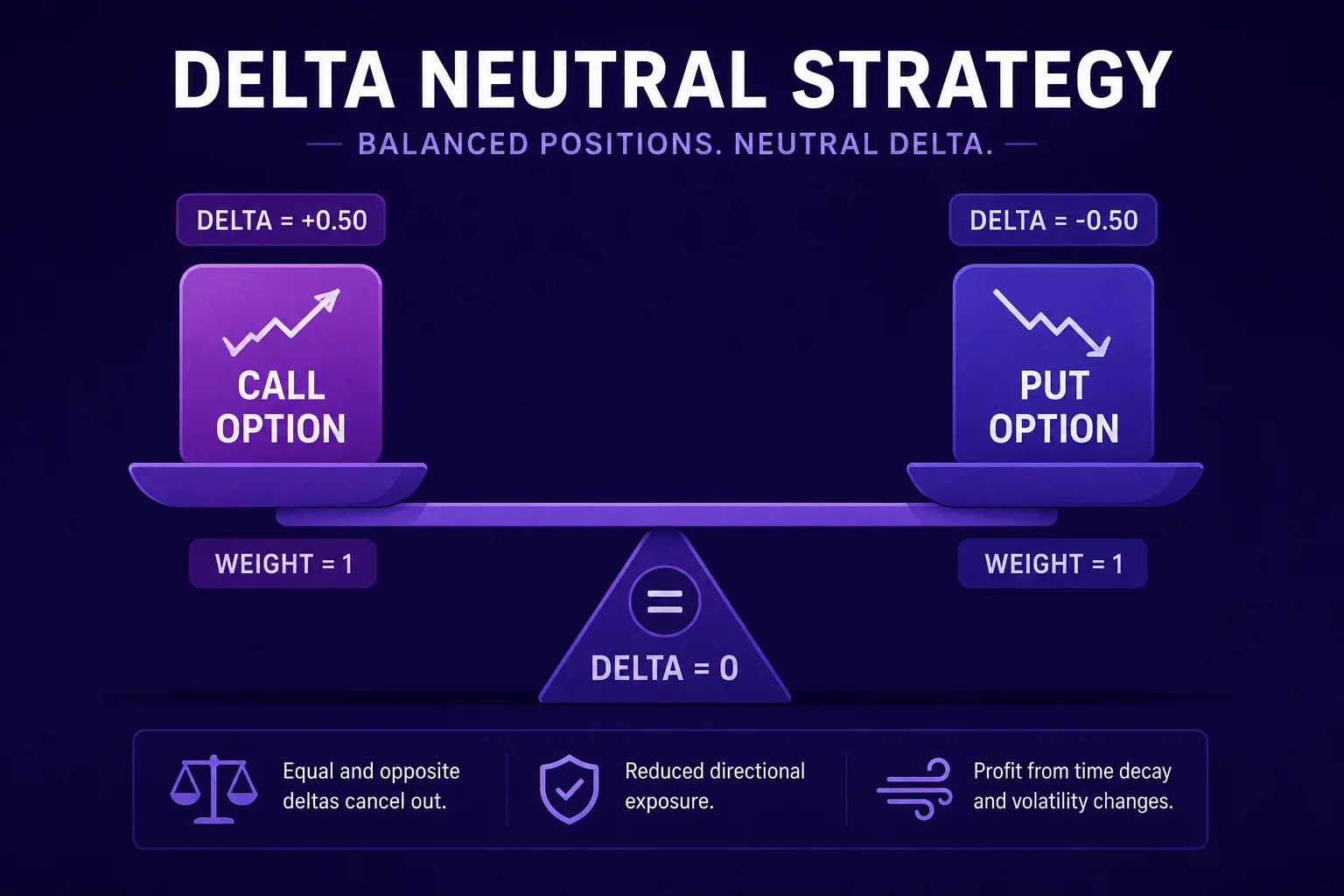
If you're wondering what a delta neutral strategy is in options trading for beginners, the short answer is this: a delta neutral position has a total Delta of approximately zero. That means for small moves in the underlying, your profit or loss is minimal — you are not directionally exposed. Instead of betting on where the stock goes, you're betting on how much it moves, how fast time passes, or where implied volatility heads. If you need a refresher, start with understanding Delta and the full options Greeks guide.
Example: you own 100 shares of a stock (Delta = +1.0 per share = +100 total). You buy 2 puts with Delta = -0.50 each (-100 total). Net Delta = 100 + (-100) = 0. The position is delta neutral — a small move up or down leaves your combined P&L roughly flat, because the shares and the puts offset each other.
How to Sum Position Delta
Net Delta = Σ (contract Delta × quantity × 100) + share countLong calls and short puts add positive Delta; short calls and long puts add negative Delta. Aim for the total near zero. Each equity option controls 100 shares.
Common Delta Neutral Options Strategies
There are several ways to build a near-zero Delta position, and each profits from a different source. The table summarizes them; the notes below explain each.
Delta Neutral Strategy Comparison
| Strategy | Gamma | Vega | Theta | Profits When |
|---|---|---|---|---|
| Long straddle | + | + | − | Big move OR IV spikes |
| Short straddle | − | − | + | Stock sits still, IV falls |
| Iron condor | − | − | + | Stock stays in range (defined risk) |
| Calendar spread | ± | + | + | Stock near strike, IV rises |
Long Straddle (Positive Gamma, Positive Vega)
Buy an ATM call and an ATM put at the same strike. Delta ≈ 0. The position profits if the stock makes a large move in either direction or if IV rises sharply. This is one of the most common delta neutral options strategies for earnings volatility, used by traders expecting a big move. The cost is premium — Theta works against you daily.
Short Straddle (Negative Gamma, Negative Vega)
Sell an ATM call and an ATM put. Delta ≈ 0. Profits if the stock stays near the current price (Theta decay) and if IV falls (negative Vega). Used in high-IV environments. The risk is large and technically undefined if the stock moves sharply — this is not a beginner trade.
Iron Condor (Defined Risk)
Sell an OTM call spread and an OTM put spread. Near-zero Delta. Profits if the stock stays within a range, and your max loss is capped by the long wings — retail traders generally prefer this to naked straddles for exactly that reason. See our full guide to the iron condor strategy.
Calendar Spread (Long Vega Income)
Sell a near-expiry option and buy a far-expiry option at the same strike. Near-zero net Delta. Profits from the time-decay differential (the near leg decays faster) and from IV expansion. It's a Vega-positive Theta strategy — see calendar spreads.
Why Delta Doesn't Stay Neutral: The Gamma Problem
A delta neutral position doesn't stay neutral. As the stock price moves, Gamma causes Delta to drift. If you're long a straddle and the stock rises $5, your call Delta increases and your put Delta shrinks — you are now net positive Delta, benefiting from the stock's direction. That drift is exactly why long straddles make money on large moves: the position automatically leans into the trend.
For short straddles, the opposite happens. A rising stock pushes your net Delta negative — you're now short Delta and losing from the move, and the further it runs the faster you lose (negative Gamma accelerating against you). This is why short delta neutral positions are gamma-scalping territory: professionals continuously buy and sell shares to re-neutralize Delta as it drifts. Understanding how to keep a position delta neutral as the stock moves is the single hardest part of running these trades profitably.
Gamma Sets the Hedging Pace
The higher your Gamma, the faster Delta drifts and the more often you must re-hedge. Near expiration, Gamma is enormous, so a "neutral" short straddle can require hedging every few minutes. Long-dated positions drift slowly and need far less babysitting. Match your hedging bandwidth to the Gamma you're carrying.
Delta Hedging a Short Straddle, Step by Step
Educational ExampleHow gamma scalping turns Delta drift into a re-hedging routine.
You sell a short straddle on a $150 stock: short 1 call (Delta -0.50) and short 1 put (Delta +0.50). Net Delta = 0. You've collected premium and want to stay neutral while Theta works for you.
- The stock rises $10 to $160. Gamma re-tilts your Greeks: the call Delta is now -0.65 and the put Delta +0.35. Net Delta = -0.30, or -30 deltas. You're short the market on an up-move — losing.
- Re-hedge: buy 30 shares at ~$160 (+30 deltas) to bring net Delta back to zero. You're neutral again, now holding 30 shares plus the straddle.
- The stock falls back to $150. Delta drifts positive as it drops, so you sell those 30 shares at ~$150 to re-neutralize — a $10 loss per share on the hedge.
- The cost of negative Gamma: a short-Gamma hedger is forced to buy high and sell low, which is exactly why choppy markets bleed short straddles. A long-Gamma hedger (long straddle) does the opposite — sells into rallies, buys into dips — turning realized volatility into profit. That buy-low/sell-high mechanic is the essence of gamma scalping.
The takeaway: your Gamma sign decides whether hedging pays you or costs you. Model the full payoff and Greeks of any structure in the Options Strategy Builder before committing capital.
This is a hypothetical scenario using historical market data for educational purposes only. Past performance does not guarantee future results.
Who Uses Delta Neutral Strategies?
- Market makers: continuously delta-hedge to extract pure volatility premium from the bid-ask spread while staying directionally flat.
- Earnings volatility traders: long straddles when they expect an outsized move; short straddles or strangles to harvest IV crush after the announcement.
- Income traders: iron condors and short strangles to collect Theta in range-bound markets, using defined risk to survive the tail moves.
- Advanced retail traders: calendar spreads for managed Vega exposure, and small delta-neutral setups filtered by IV Rank.
⚠️ Neutral Is Not Riskless
Delta neutral removes directional risk, not all risk. Short-vol structures still carry Gamma and Vega risk that can dwarf the premium collected — a gap through your strikes can produce a loss many times your credit. Prefer defined-risk structures, size positions small relative to the implied move, and pair these trades with sound position sizing and risk management.
Delta Neutral vs Directional Trading: Which Should Beginners Choose?
A common question is delta neutral vs directional options trading — which is better for beginners. Directional trades (buying a call or a put) are simpler to understand and only require a view on where the stock is heading. Delta neutral strategies, by contrast, remove the need to be right on direction but demand active monitoring, hedging, and a working grasp of Gamma, Theta, and Vega. For most newcomers, mastering a single defined-risk directional or income trade first — then graduating to neutral setups like iron condors — is the safer learning path. If you'd like the platform to suggest structures for your market view, try the strategy suggestions tool.
Delta Neutral vs Market Neutral: Not the Same Thing
These two terms get used interchangeably, but they describe different things and mixing them up leads to nasty surprises. Delta neutral is a single-instrument concept: your net Delta on one underlying is roughly zero, so a small move in that stock barely moves your P&L. Market neutral is a portfolio-level concept: you balance long and short exposure across many names (often long one basket, short another) so that broad market direction — the "beta" — doesn't drive your returns.
The practical difference is what each one leaves you exposed to. A delta neutral options position is still fully exposed to Gamma, Theta, and Vega on its underlying. A market neutral equity portfolio removes market beta but can still be crushed by sector rotation, factor moves, or a single name gapping against the pair. You can even be delta neutral and directionally wrong on volatility at the same time — neutrality on price says nothing about your volatility bet.
Quick distinction
Delta neutral = no exposure to small price moves in one underlying (but still exposed to volatility and time). Market neutral = no exposure to the overall market's direction across a portfolio (but still exposed to stock-picking, sector, and factor risk). One is a Greeks problem; the other is a beta problem.
The Hidden Costs of Staying Neutral
Delta hedging is not free, and the frictions are exactly what separate a profitable neutral book from a losing one. Before you assume the theoretical edge is yours, price in these leaks:
- Commissions and contract fees: frequent re-hedging means many small trades. On a high-Gamma position hedged several times a day, per-trade costs quietly compound against your Theta.
- Bid-ask slippage: every hedge crosses a spread. On wide-spread underlyings or illiquid options, the round-trip cost of buying high and selling low on the hedge itself can exceed the volatility you are trying to capture.
- Negative-Gamma bleed: as shown in the worked example, a short-Gamma hedger is structurally forced to buy high and sell low. In choppy, whipsawing markets this can erase a week of collected Theta in a day.
- Overnight and gap risk: you cannot hedge while the market is closed. A neutral position at Friday's close can open Monday with a large Delta and a loss no re-hedge can undo.
- Vega mispricing: if you sell premium at a low IV Rank, an IV expansion can hand you a mark-to-market loss even while the stock sits perfectly still. Neutral on price is not neutral on volatility.
The upshot: your realized edge is the volatility you capture minus all of the above. This is why disciplined neutral traders filter by IV conditions, hedge in bands rather than on every tick, and favor liquid, tight-spread underlyings. You can pressure-test how a small price move and an IV change hit your position using the volatility impact calculator.
How to Set Up a Delta Neutral Trade: A Checklist
If you want to build your first neutral position without guessing, work through these steps in order. The goal is a defined-risk structure entered at a sensible volatility level with a hedging plan already written down.
- Pick your volatility thesis first. Decide whether you expect realized movement to be higher (lean long-Gamma/long-Vega) or lower (short premium) than what the market has priced. Confirm it with IV Rank — sell only when IV Rank is elevated, buy when it is depressed.
- Choose a defined-risk structure. For most retail traders that means an iron condor or a calendar spread rather than a naked short straddle. Capped risk lets you survive the tail move that inevitably comes.
- Sum the net Delta of every leg. Use the formula above (contract Delta × quantity × 100, plus shares). Adjust strikes or add a small share hedge until the total sits near zero.
- Check your other Greeks. Know your Gamma (how fast Delta will drift), Theta (your daily income or bleed), and Vega (your IV exposure) before you enter, not after. Model them in the options Greeks calculator.
- Write the hedging rule down. Decide in advance: re-hedge when net Delta drifts past a threshold (say ±15 to ±25), not on every tick. Pre-committing to a band controls both slippage and emotion.
- Size small and set an exit. Cap the position at a small fraction of capital and pre-decide your profit target (often 25–50% of max credit) and your max-loss stop. Pair it with sound position sizing.
Build a Delta Neutral Position the Right Way
Sum the Delta of every leg and see your payoff before risking a dollar. Model straddles, condors, and calendars, then check your net Greeks in one place.
Add each leg in the Strategy Builder
Confirm net Delta is near zero
Check Gamma, Theta, and Vega exposure
If You're Delta Neutral, Where Does the Profit Come From?
This is the question that stops most people understanding delta-neutral trading. If the position does not profit from the underlying going up or down, what exactly is it profiting from? The answer is that you are no longer trading direction — you are trading volatility. Two mechanisms produce the return, and they work in opposite directions.
Long gamma: profit from movement
You own options, so your position delta shifts in your favour as the underlying moves — it gets longer as price rises and shorter as it falls. Rebalancing back to neutral therefore forces you to sell into strength and buy into weakness, mechanically. That repeated round trip is gamma scalping, and each rebalance banks a small profit.
- • You profit when the underlying moves more than implied volatility predicted
- • You pay for the privilege through theta decay every single day
- • A quiet market is your enemy — the decay accrues while no movement arrives
Short gamma: profit from stillness
You have sold options, so time decay credits your account daily. Your position delta now moves against you as price moves, meaning each rebalance forces you to buy high and sell low — a small, repeated loss that eats into the premium you collected.
- • You profit when the underlying moves less than implied volatility predicted
- • Theta pays you every day the market stays calm
- • A violent move is your enemy — rebalancing losses can exceed all collected premium
The trade in one sentence
A delta-neutral position is a bet on realised volatility versus implied volatility. Buy options and you are betting the underlying will move more than the market priced in; sell them and you are betting it will move less. Direction is genuinely irrelevant — a stock that oscillates violently sideways can be highly profitable for a long-gamma trader and ruinous for a short-gamma one, even though it ends exactly where it started.
Why this is harder than it looks in practice
- • Rebalancing frequency is a real decision with no clean answer. Hedge too often and transaction costs consume the scalping profit; hedge too rarely and you carry unintended directional risk between adjustments. There is no optimal frequency, only trade-offs.
- • Delta neutral is not risk neutral. You have removed first-order directional exposure while retaining full exposure to volatility, time and interest rates. Vega alone can produce a large loss on a position that never moved directionally at all.
- • Neutrality expires immediately. The moment price moves, gamma has already changed your delta. "Delta neutral" describes a single instant, not a state you can maintain without continuous work.
- • Costs scale with activity. This is among the most transaction-intensive strategies in options, which is why it is largely the domain of desks with institutional commission rates rather than retail accounts.
Delta-neutral questions from real traders
What is a delta neutral strategy?
A delta neutral strategy is an options position whose total Delta is approximately zero, so small moves in the underlying barely change its value. Instead of profiting from direction, it profits from time decay (Theta), changes in implied volatility (Vega), or realized volatility. Straddles, strangles, iron condors, and calendar spreads are common examples.
How do you keep a position delta neutral?
You delta hedge. As the stock moves, Gamma pushes your net Delta away from zero, so you trade the underlying shares (or offsetting options) to bring it back. If your net Delta drifts to -30, you buy 30 shares; if it drifts to +30, you sell 30 shares. Higher Gamma means faster drift and more frequent re-hedging.
Is delta neutral trading profitable?
It can be, but the profit comes from being right about volatility, not direction. Short-vol neutral trades profit when realized movement stays below what implied volatility priced in; long-vol trades profit when it exceeds it. Success depends on entering at the right IV Rank, sizing small, and hedging discipline — it is not a free lunch.
What is gamma scalping?
Gamma scalping is the process of delta-hedging a long-Gamma position to harvest realized volatility. Because a long straddle's Delta grows positive as the stock rises and negative as it falls, the hedger repeatedly sells shares into rallies and buys them in dips — locking in profit from the movement. It pays off when actual volatility exceeds the implied volatility paid.
What is the difference between delta neutral and market neutral?
Delta neutral means one position's net Delta on a single underlying is roughly zero, so small price moves in that stock barely affect it — though it's still exposed to Gamma, Theta, and Vega. Market neutral is a portfolio-level idea: you balance long and short exposure across many names so the broad market's direction (beta) doesn't drive returns, though sector and stock-picking risk remain. One is a Greeks problem on a single name; the other is a beta problem across a book.
How much does delta hedging cost?
There's no fixed figure, but the cost is the sum of commissions on frequent re-hedges, the bid-ask spread crossed on every hedge, and the buy-high/sell-low bleed you pay when short Gamma in a choppy market. Those frictions eat directly into your Theta or realized-volatility edge, which is why traders re-hedge in bands rather than on every tick and stick to liquid, tight-spread underlyings.
Frequently Asked Questions
How much Delta counts as delta neutral?
There's no single number, but most traders treat a net Delta within roughly ±5 to ±10 per position (or a small fraction of one share-equivalent per contract) as effectively neutral. The point isn't perfect zero — it's keeping directional exposure small enough that Theta, Vega, or realized volatility dominate your P&L rather than the stock's direction.
Can beginners trade delta neutral strategies?
Beginners should start with defined-risk versions like the iron condor rather than naked short straddles. Undefined-risk neutral trades can lose many multiples of the premium collected during a sharp move. Master a single directional or covered strategy first, understand all four Greeks, and only then add neutral structures with strict position sizing.
What's the difference between a straddle and an iron condor?
A short straddle sells a call and put at the same ATM strike — high premium but undefined risk. An iron condor sells an OTM call spread and an OTM put spread, collecting less premium but capping the maximum loss with long wings. Both are delta neutral and profit from range-bound, falling-IV conditions; the condor simply trades income for safety.
Why do market makers use delta neutral positions?
Market makers earn the bid-ask spread by continuously buying and selling options, which leaves them holding directional risk they don't want. By delta hedging that inventory back to neutral, they strip out the directional bet and are left holding a volatility position they can manage. This lets them profit from order flow and volatility rather than guessing market direction.
Do I need to hedge with shares, or can I use options?
Either works. Shares provide clean, linear Delta with no added Gamma, Theta, or Vega, which is why professionals often hedge with the underlying. Options can also adjust Delta but bring their own Greeks along, which can complicate the position. For most retail delta-neutral traders, hedging small amounts of Delta with shares is the simplest approach.
Related Articles
Investment Risk Disclaimer
This content is for educational purposes only and should not be considered financial advice. All investments carry risk, including the potential loss of principal. Past performance does not guarantee future results. Before making any investment decisions, please consult with a qualified financial advisor who understands your personal financial situation, risk tolerance, and investment goals.
Stock Averager provides tools and educational content but does not provide personalized investment advice or recommendations.
Explore this topic in depth
Options Strategies
Constructing positions: income, defined risk, direction-neutral structures, and portfolio protection.
- Covered Calls: Earn 1-3% Monthly on Stocks You Own (main guide)Income against shares you own, and the upside you genuinely give up.
- Cash-Secured Puts: Get Paid to Wait for Lower PricesBeing paid to wait for a lower entry, with the obligation spelled out.
- Credit Spreads: Limited Risk Options Strategy for Consistent IncomeDefined-risk premium selling and how the width sets your worst case.
- Iron Condor: Profit from Sideways MarketsProfiting from a range, plus the assignment and tail risks involved.
- Options Calendar Spreads: Income from Time DecaySelling near-dated time against a longer-dated holding.
- Hedging with Options: Protect Your Portfolio from CrashesProtective puts, collars and portfolio-level crash protection.
- How to Read an Options Chain: A Complete Step-by-Step GuideOpen interest, implied volatility and skew, read column by column.
Related topics
- Options GreeksThe variables that price every option — direction, time, volatility — and how they fight each other.
- Risk Management & Position SizingDeciding in advance how much you can lose — the part of investing that determines whether you survive.
- Dividends & Portfolio IncomeTurning holdings into cash flow — dividends, reinvestment, covered calls and structured withdrawals.
Sources & Further Reading
Figures and rules cited in this article are drawn from the primary sources below. Tax and regulatory details change — always confirm against the current official guidance for your jurisdiction.
- 1Options Statistics — Cboe Global MarketsExchange volume and open interest data underpinning liquidity assumptions for delta hedging.
- 2Characteristics and Risks of Standardized Options — The Options Clearing CorporationThe official options disclosure document covering assignment, exercise and settlement mechanics.
- 3Do 80% of Options Expire Worthless? — SteadyOptionsBreakdown of contracts closed early (~55-60%), expired worthless (~30-35%) and exercised (~10%).
About Stock Averager Team
Expert financial analysts dedicated to simplifying complex investment strategies for everyone. We build tools that help you make better money decisions.