
Hedging with Options: Protect Your Portfolio from Crashes
Insurance You Can Actually Price
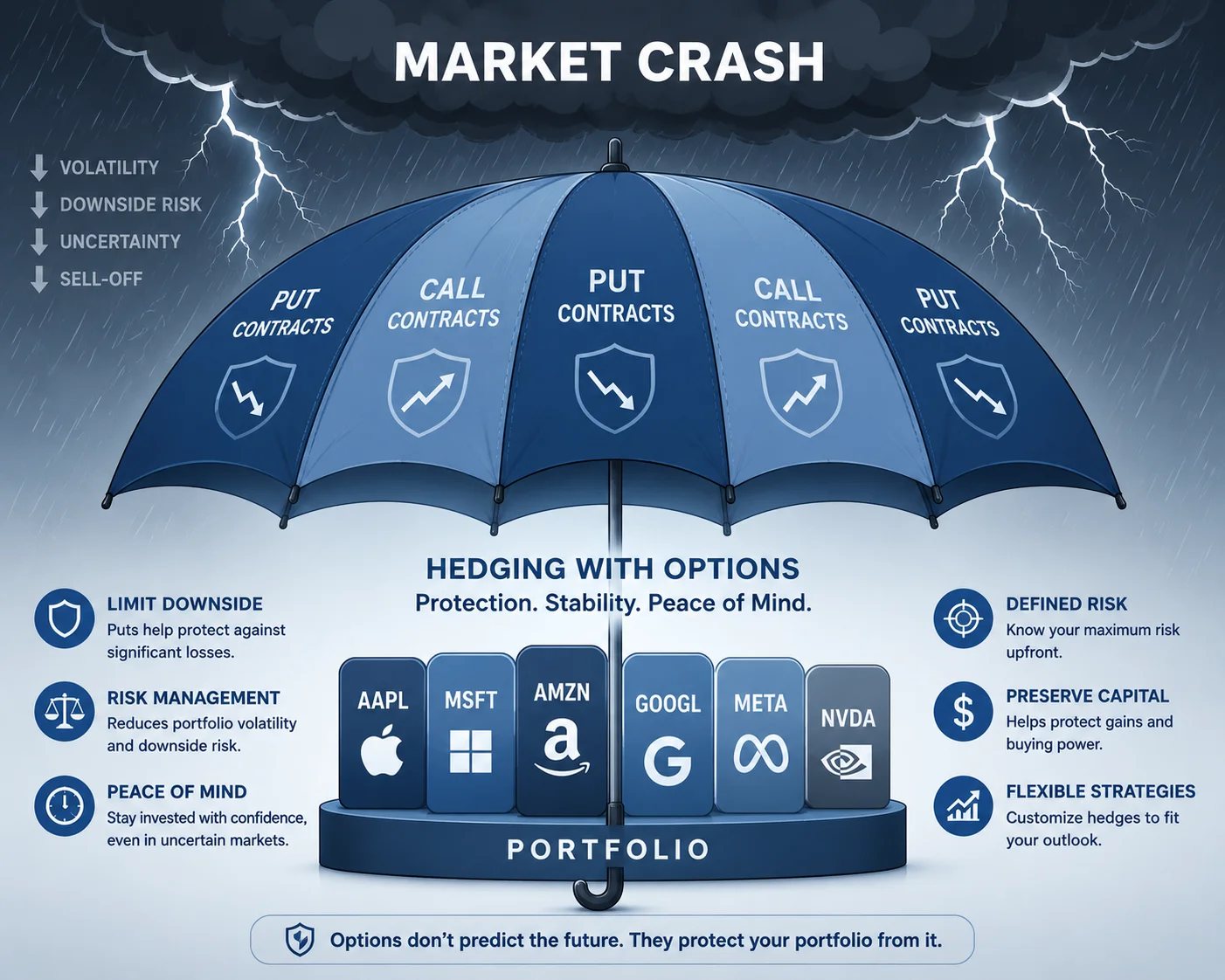
Hedging with options is like buying insurance for your portfolio. You pay a small, defined premium to protect against catastrophic downside — and unlike a stop-loss, which can fill far below your level in a gap-down open, a put option gives you protection that is mathematically defined. No slippage. No gaps blowing past your exit.
The question was never whether to hedge. It is which tool fits your situation and at what cost. A protective put, a collar, and an index hedge all protect you — but they cost different amounts, cap your upside differently, and suit different portfolios. This guide walks through each, with worked examples, and shows you the one timing rule that separates cheap insurance from expensive panic-buying.
TL;DR — Quick Summary
30-sec read- 1Hedging reduces risk but costs money (premium); the goal is protection worth more than what you pay for it
- 2Protective put = buy a put on stock you own; it caps your downside and the premium is your insurance cost
- 3Collar = sell a covered call to fund a protective put; often near-free, but caps upside as well as downside
- 4Portfolio hedge = buy SPY or index puts to protect a diversified book against a broad market crash
- 5Timing matters: buy puts when IV is low (cheap insurance), not after the crash has already started
Continue reading for the full guide with examples and strategies.
Key Takeaways
6 points- 1Hedging reduces risk but costs money; the goal is protection worth more than the premium you pay
- 2Protective put: buy a put on a stock you own to cap downside — the premium is your insurance cost
- 3Collar: sell a covered call plus buy a protective put for a free or low-cost hedge that caps both ends
- 4Portfolio hedge: buy SPY or index puts to protect a broad portfolio during market crashes
- 5Hedge timing matters: buy puts when IV is low (cheap insurance), not after the crash begins
- 6A hedge is a recurring, budgeted expense — not a reactive purchase made in a panic
Why Hedge with Options at All?
If you are learning how to hedge a stock portfolio with options for beginners, start with the core idea: portfolio insurance with options gives you something stocks and bonds cannot — defined, precise protection. With a stop-loss order, a violent gap-down open can fill you far below your intended level; you find out where you exited only after it has happened. With a put option, your downside is defined in advance — no slippage, no gap jumping past your protection level.
That precision is why hedging is a discipline, not a reaction. Selling everything to "go to cash" crystallizes taxes and forces you to time the re-entry. A hedge lets you stay invested, keep your long-term compounding intact, and cap the damage of a specific window of risk. It fits naturally into a broader plan — see our risk management 101 guide and position sizing guide for how hedging sits alongside sizing and stops.
The trade-off in one sentence
Every hedge costs something — premium, capped upside, or both. A good hedge is one where the protection is worth more to you than what it costs. If you would not pay for the insurance, you do not need the hedge.
The Three Core Hedging Strategies at a Glance
Before the details, here is how the three main hedges compare. Match the strategy to what you are protecting and how much upside you are willing to give up.
| Strategy | Cost | Upside | Best For |
|---|---|---|---|
| Protective Put | Premium paid (1-3% per quarter) | Fully open | Holding a stock through a known risk event |
| Collar | Near zero (call funds the put) | Capped at the call strike | Concentrated positions you will not sell |
| Index Put Hedge | Premium paid (1-2% per quarter) | Fully open | Diversified portfolios vs. market crashes |
Hedging Strategy 1: The Protective Put
How a protective put works to protect stock gains: you own 100 shares of a stock, and you buy a put option to protect against downside. If the stock falls below the put's strike price, the put gains value, offsetting your stock losses. Your upside stays completely open — you have simply set a floor under the position.
Worked Example
You own 100 shares of a stock at $350. You buy a $320 put for $8 per share ($800 total for one 100-share contract).
- If the stock falls to $280: the put is worth $40. Stock loss is $70/share, offset by the put — net loss capped near $38/share (the $30 stock decline to the strike plus the $8 premium). That is your insurance cap.
- If the stock rises to $400: the put expires worthless. You lose the $8 premium but keep a $50/share gain on the stock. Upside intact.
Best for: long-term holders who want to ride through an earnings report or a stretch of macro uncertainty without risking a catastrophic drawdown. Choose the put's Delta to balance cost and coverage — a -0.30 to -0.40 Delta put is a common sweet spot for meaningful protection at a reasonable premium.
Hedging Strategy 2: The Collar (The Cheapest Way to Hedge)
How a collar option strategy works step by step: you buy a protective put for downside protection AND sell a covered call to fund the put's cost. The result: your potential upside is capped at the call strike, but your downside is protected below the put strike — often at zero or very low net cost. This is the answer many investors want when comparing a protective put vs collar for downside protection: the collar trades away some upside in exchange for a much cheaper, sometimes free, hedge. It is frequently the cheapest way to hedge a single position.
Worked Example
You own 100 shares at $350. You buy a $320 put (pay $8) and sell a $380 call (collect $7.50). Net cost: $0.50/share — a nearly free hedge.
- If the stock falls to $280: protected below $320. Net loss capped near $30.50/share (the $30 decline to the put strike plus the $0.50 net premium).
- If the stock rises to $400: gains capped at $30/share ($380 call strike minus $350 cost). You forgo everything above $380.
Best for: investors holding concentrated positions who want low-cost protection without selling the stock and triggering a taxable event. The covered-call leg is the same mechanic covered in our covered calls strategy guide — a collar simply spends that premium on a protective put instead of pocketing it.
Hedging Strategy 3: The Portfolio Put Hedge
If you are wondering how to hedge a portfolio against a market crash without buying a put on every single holding, the answer is index puts. For a diversified portfolio, buying individual stock puts is expensive and clumsy. Instead, buy puts on a broad index — SPY or SPX for a US equity book — to hedge the market (beta) risk of the whole portfolio in one trade.
Worked Example
You hold a $500,000 diversified US equity portfolio. You buy OTM SPY puts sized to roughly match the portfolio's market exposure, spending about $5,000-$7,500 for a quarter of coverage. If the market drops 15%, those puts gain substantial value, offsetting much of the portfolio decline.
The math: to hedge $500,000 with SPY near $500, you cover roughly 1,000 units of exposure — about 10 SPY option contracts (100 shares each) at a strike below the current level.
This hedges beta, not alpha
An index put hedges market (beta) risk, not individual stock (alpha) risk. If your portfolio is concentrated in single names that move very differently from the index, the hedge may not track your losses closely. The more your book resembles the index, the better an index put protects it.
When to Hedge: IV Timing Is Everything
Options are insurance, and insurance is cheapest when everyone feels safe (low implied volatility) and most expensive when everyone is scared (high IV, during crashes). Buying protection reactively — after the market has already dropped — means paying peak premium for insurance right when it has become most expensive. This is the single most common and costly hedging mistake.
Best time to buy hedges
- • When IV Rank is below 30% — options are cheap
- • Before a known risk event, while markets are calm
- • As a scheduled, recurring expense
Worst time to buy hedges
- • During a crash when IV is 50-80% — maximum premium
- • After the drop has already happened
- • Reactively, driven by fear rather than a plan
The rule: buy protective puts as a regular, budgeted expense — like paying an insurance premium — not reactively during fear. If you want to see exactly how a spike or collapse in implied volatility changes the value of your hedge, run the numbers through our Volatility Impact Calculator before committing capital.
How Much Does It Cost to Hedge a Portfolio with Puts?
A common question for anyone pricing protection is how much it costs to hedge a portfolio with put options. As a rough rule, a single quarter of out-of-the-money index put protection typically runs 1-2% of the value you are insuring when implied volatility is calm. Annualize that and continuous protection can cost 4-8% of the insured value per year — a meaningful drag that is why few investors hedge 100% of their book all the time.
Buy that same protection during a panic and the bill can double or triple. That is exactly why the smartest approach is to budget hedging as a recurring, predictable expense rather than a reactive purchase made after a sell-off has already started. Many investors hedge only their most vulnerable positions, or only around known catalysts, to keep the cost sensible.
| Market Condition | IV Environment | Approx. Quarterly Cost |
|---|---|---|
| Calm | Low IV (IV Rank below 30) | 1-2% of insured value |
| Uncertain | Elevated IV (IV Rank 30-60) | 2-4% of insured value |
| Panic / crash | High IV (IV Rank above 60) | 4-6%+ of insured value |
Protecting Gains Through an Earnings Report
Educational ExampleHow a protective put lets an investor hold a winning position through a volatile catalyst.
An investor bought a stock at $200 and it has run to $350 — a $150/share gain they do not want to give back. Earnings are two weeks away and could move the stock 15% either direction. They do not want to sell (taxes, and they believe long-term), but they cannot stomach a 20% overnight gap down.
They buy a $320 put for $8/share ($800 for one contract), locking in a floor near $312 net until expiration.
Earnings disappoint, stock gaps to $290
The put is worth ~$30. The realized loss is capped near $38/share instead of $60 — the $800 premium bought back roughly $2,200 of downside per contract.
Earnings beat, stock jumps to $400
The put expires worthless. The $800 premium is the cost of the insurance, and the investor keeps essentially all of the $50/share rally.
The premium bought peace of mind and a defined worst case. Model your own version with the Options Profit Calculator before you place it.
This is a hypothetical scenario using historical market data for educational purposes only. Past performance does not guarantee future results.
Common Hedging Mistakes to Avoid
Hedging only after the drop
Buying puts once the market is already crashing means paying peak IV. Hedge before you need it, while premiums are cheap.
Over-hedging
Hedging 100% of a portfolio continuously can cost 4-8% a year and erase long-term returns. Hedge the vulnerable parts, not everything.
Mismatched hedge size
Too few contracts leave you exposed; too many turn a hedge into a bet. Size the puts to your actual exposure.
Forgetting the upside cost of collars
A collar's short call caps your gains. If the stock rips higher, you leave money on the table — know that trade-off going in.
How to Choose the Strike and Expiration for Your Hedge
A hedge is only as good as the two numbers you pick: the strike (how deep your protection starts) and the expiration (how long it lasts). Get these wrong and you either overpay or leave a gap the crash slips through. Here is the framework most experienced hedgers use.
| Put Strike (below spot) | Cost | Protection | When it fits |
|---|---|---|---|
| 2-5% OTM (near the money) | Highest | Tightest floor, smallest gap | Protecting gains you cannot afford to give back |
| 8-12% OTM | Moderate | Absorbs the first leg down yourself | Balancing cost against a reasonable floor |
| 15%+ OTM (tail hedge) | Lowest | Only pays in a genuine crash | Cheap disaster insurance, not day-to-day cover |
Expiration: the 60-90 day sweet spot
Theta (time decay) accelerates hard inside the final 45 days, so very short-dated puts bleed value fast. For most catalyst windows, roughly 60 to 90 days to expiration covers the event with room to spare and keeps per-day cost low. Longer-dated puts cost more upfront but decay slower and need renewing less often.
Rolling: keep the clock away from zero
When your put drops under about 30 days and you still want coverage, roll it out — close the near-dated put and open a new one 60-90 days out. Rolling before decay accelerates preserves more of your premium than letting the hedge expire and re-buying from scratch. Check the remaining Delta with our Options Greeks Calculator before you roll.
A useful shortcut: pick the strike by Delta rather than by eyeballing the price. A put near -0.30 Delta is a common balance of meaningful protection and reasonable cost, while a -0.15 Delta put is cheaper tail insurance. Our guide to Delta explains how that number doubles as a rough probability estimate.
The Tax Side of Hedging: What US Investors Should Know
Hedging is not tax-neutral, and the surprises here are expensive. This is a general overview, not tax advice — confirm the specifics with a tax professional before you place a hedge on an appreciated position.
Three rules that catch investors off guard
- Married put holding period: if you already owned a stock for more than a year before buying a protective put, your long-term holding period is generally preserved — the gain stays long-term whether the put is exercised, sold, or expires. Buying a put on a stock you have held less than a year, though, can pause the holding-period clock.
- Collars trigger the straddle rules: because a collar pairs offsetting positions, it is treated as a straddle. Losses on one leg generally cannot be deducted until all the offsetting positions are closed, and the holding period on the stock can be suspended while the collar is on.
- Constructive sale risk on tight collars: if the put and call strikes are set too close together, the IRS can treat the collar as a "constructive sale" and tax you as if you had sold the stock. Practitioners commonly keep a band of at least 15-20% between the strikes to stay clear of that trap.
The point of hedging is often to defer tax
Many investors hedge precisely so they can protect a large unrealized gain without selling and triggering capital-gains tax. That only works if the hedge itself does not accidentally count as a sale — which is exactly why the constructive-sale band and the straddle rules matter. Model the after-tax picture, not just the premium, using our Capital Gains Calculator.
Size Your Hedge Before You Buy It
Guessing at hedge size is how you end up over-insured or exposed. Use our tools to size the protection to your position, verify the Delta of your puts, and stress-test the cost.
Size the hedge to your position
Verify the put's Delta and cost
Stress-test against an IV spike
How Options Markets Differ Around the World
Everything above — protective puts, collars, portfolio hedges — works identically in every options market, because the pricing mathematics is universal. What is not universal is the contract mechanics, and those differences change how many contracts you need, when you can be assigned, and what a hedge actually costs. Traders who move between markets get this wrong constantly.
Contract mechanics by market
Check these four things before placing your first hedge in an unfamiliar market.
- •Equity options represent 100 shares and are American style — assignable any day before expiry
- •Index options such as those on the S&P 500 are usually European style and cash-settled, which removes early-assignment risk
- •Weekly expirations exist on most liquid names, giving fine-grained control over hedge duration
- •Early assignment risk on short calls spikes around ex-dividend dates
- •Most European equity options are European style — exercisable only at expiry, so no early assignment
- •Contract sizes vary by exchange and underlying rather than following a universal 100-share convention
- •Liquidity is concentrated in index options; single-stock option spreads can be wide
- •Check whether your contract settles physically or in cash before you rely on it as a hedge
- •Index and stock options are European style and index options are cash-settled
- •Contracts trade in exchange-defined lot sizes that are revised periodically, not a fixed 100 shares
- •Weekly index expiries make short-dated hedging inexpensive and highly liquid
- •Physical settlement applies to stock options held to expiry in the money, which surprises many traders
- •Contract multipliers, tick sizes and settlement conventions differ market by market
- •Liquidity outside the main index products can be thin, widening the real cost of a hedge
- •Some markets impose position limits that constrain large portfolio hedges
- •Currency of settlement may differ from the currency of your portfolio, adding a second exposure
Contract specifications, lot sizes and settlement rules are set by each exchange and change over time. Always confirm the current specification for your exact contract before trading.
The three questions to ask in any market
1. What does one contract control? Get this wrong and your hedge is off by a factor of ten. Multiply the contract multiplier by the strike to find the notional you are actually covering.
2. American or European style? American-style short options can be assigned early, which can break a multi-leg structure at the worst moment. European-style options cannot, which makes them cleaner for a set-and-forget hedge.
3. Cash or physical settlement? A cash-settled index option simply pays the difference. A physically settled stock option delivers shares — and if you did not plan for that, you can wake up to a large unwanted position and a margin call.
Hedging questions from portfolio owners
What is the cheapest way to hedge a portfolio?
A collar is usually the cheapest way to hedge a single position: you sell a covered call and use that premium to buy a protective put, often for near-zero net cost. The trade-off is that the short call caps your upside at its strike. For a diversified portfolio, buying a single index put (SPY or SPX) is far cheaper than buying puts on every holding, and it hedges the whole book's market risk in one trade.
Protective put vs collar — which should I use?
Use a protective put when you want to keep all of your upside and are willing to pay the premium outright — ideal for holding through a specific catalyst. Use a collar when you want protection at little or no cost and are willing to cap your upside at the call strike — ideal for concentrated positions you do not want to sell. The collar is cheaper; the protective put keeps more upside.
When is the best time to buy a portfolio hedge?
Buy hedges when implied volatility is low — IV Rank below about 30% — because options are cheap then. Avoid buying during a crash when IV is 50-80%, as you pay peak premium for protection precisely when it has become most expensive. Treat hedging like insurance: buy it before you need it, ideally as a scheduled, recurring expense.
How much does it cost to hedge a portfolio with puts?
In calm markets, a quarter of out-of-the-money index put protection typically costs 1-2% of the value you are insuring, which can annualize to roughly 4-8% for continuous coverage. During panics the cost can double or triple. Because full-time hedging is a real drag on returns, most investors hedge only their most vulnerable positions or only around known risk events.
How far out should I buy a protective put?
For most catalyst windows, a put with roughly 60 to 90 days to expiration is the sweet spot — it covers the event while avoiding the sharp time decay that hits inside the final 45 days. Very short-dated puts are cheap but bleed value quickly, and longer-dated puts cost more upfront but decay slower per day. When your put slips under about 30 days and you still want coverage, roll it out to a new 60-90 day contract rather than letting it expire.
Does hedging with a collar affect my taxes?
Yes. A collar is treated as a straddle for US tax purposes, so losses on one leg generally cannot be deducted until all positions are closed, and your stock's holding period can be suspended while the collar is on. If the put and call strikes are set too close together, the IRS may treat the collar as a constructive sale and tax you as though you sold the stock — practitioners commonly keep at least a 15-20% band between the strikes. This is general information, not tax advice.
Frequently Asked Questions
What is the cheapest way to hedge a stock position?
A collar (sell a covered call plus buy a protective put) is often near-zero cost. The covered-call premium funds the put purchase. You cap your upside at the call strike but protect against downside below the put strike — at minimal net cost. It is the go-to hedge for concentrated positions you do not want to sell.
When should I buy portfolio hedges?
Buy hedges when IV Rank is below 30% — options are cheap. Do not buy hedges during crashes when IV is 60-80% (too expensive). Think of portfolio hedges like insurance: buy before you need it, not after the emergency begins. Budgeting protection as a recurring expense keeps you disciplined instead of reactive.
Does a protective put cap my upside?
No. A standalone protective put only sets a floor under your downside — your upside stays completely open. You pay a premium for that protection, and if the stock rises the put simply expires worthless. It is a collar (put plus a short call) that caps upside, because the short call obligates you to sell at its strike.
Can I hedge my whole portfolio with a single option?
You can hedge the market (beta) risk of a diversified portfolio with index puts (SPY or SPX), sized to match your exposure — often just a handful of contracts. This works well when your holdings track the index. It does not fully protect concentrated positions in single names that move very differently from the market, since that is stock-specific (alpha) risk the index put does not cover.
Is hedging with options better than using a stop-loss?
They solve different problems. A stop-loss triggers a market sale at a level, but in a gap-down open it can fill far below your intended price — you have no protection against slippage. A protective put gives you a defined floor regardless of how violently the market gaps, because your right to sell at the strike does not disappear. The trade-off is that the put costs premium upfront, whereas a stop-loss is free until it triggers.
Investment Risk Disclaimer
This content is for educational purposes only and should not be considered financial advice. All investments carry risk, including the potential loss of principal. Past performance does not guarantee future results. Before making any investment decisions, please consult with a qualified financial advisor who understands your personal financial situation, risk tolerance, and investment goals.
Stock Averager provides tools and educational content but does not provide personalized investment advice or recommendations.
Explore this topic in depth
Options Strategies
Constructing positions: income, defined risk, direction-neutral structures, and portfolio protection.
- Covered Calls: Earn 1-3% Monthly on Stocks You Own (main guide)Income against shares you own, and the upside you genuinely give up.
- Cash-Secured Puts: Get Paid to Wait for Lower PricesBeing paid to wait for a lower entry, with the obligation spelled out.
- Credit Spreads: Limited Risk Options Strategy for Consistent IncomeDefined-risk premium selling and how the width sets your worst case.
- Iron Condor: Profit from Sideways MarketsProfiting from a range, plus the assignment and tail risks involved.
- Options Calendar Spreads: Income from Time DecaySelling near-dated time against a longer-dated holding.
- Delta Neutral Strategy: Profit Without Predicting DirectionRemoving directional exposure to isolate volatility and time.
- How to Read an Options Chain: A Complete Step-by-Step GuideOpen interest, implied volatility and skew, read column by column.
Risk Management & Position Sizing
Deciding in advance how much you can lose — the part of investing that determines whether you survive.
- Risk Management 101: The 1% Rule That Saves Portfolios (main guide)Capital preservation and the asymmetric maths of recovering a loss.
- Position Sizing: How Much to Invest in Each StockDeciding how much before deciding whether — the highest-leverage habit.
- Stop-Loss Orders: Your Insurance Against Catastrophic LossesDefining the exit in advance, and the order types that fail in fast markets.
- Diversification: The Only Free Lunch in InvestingWhat genuinely diversifies, and what only appears to.
- Portfolio Rebalancing: The Art of Selling WinnersKeeping risk where you set it, and the tax cost of doing so.
- International Diversification: How Much Should You Hold?How much to hold abroad, and why the answer isn't market weight.
- When NOT to Average Down: 7 Red Flags to WatchSeven red flags, with a real bankruptcy as the worked example.
- Market Orders vs Limit Orders: Which Should You Use?Control over price versus certainty of fill.
- FOMO Trading: How to Stop Chasing and Start ProfitingWhy chasing feels rational in the moment and rarely is.
Related topics
- Options GreeksThe variables that price every option — direction, time, volatility — and how they fight each other.
- Dividends & Portfolio IncomeTurning holdings into cash flow — dividends, reinvestment, covered calls and structured withdrawals.
- Investor PsychologyWhy disciplined rules get abandoned exactly when they matter most, and how to design around it.
- Cost Averaging & Averaging DownLowering your average cost deliberately — when it compounds returns, and when it compounds a mistake.
Sources & Further Reading
Figures and rules cited in this article are drawn from the primary sources below. Tax and regulatory details change — always confirm against the current official guidance for your jurisdiction.
- 1Characteristics and Risks of Standardized Options — The Options Clearing CorporationThe disclosure document every US broker must provide before approving options trading.
- 2Investor Bulletin: Opening an Options Account — U.S. Securities and Exchange CommissionApproval levels and suitability requirements for protective puts and collars.
- 3Options Statistics — Cboe Global MarketsIndex option volume data relevant to portfolio-level hedging.
About Stock Averager Team
Expert financial analysts dedicated to simplifying complex investment strategies for everyone. We build tools that help you make better money decisions.