
Saving vs Investing: Fixed Deposits, CDs & RDs vs Index Funds
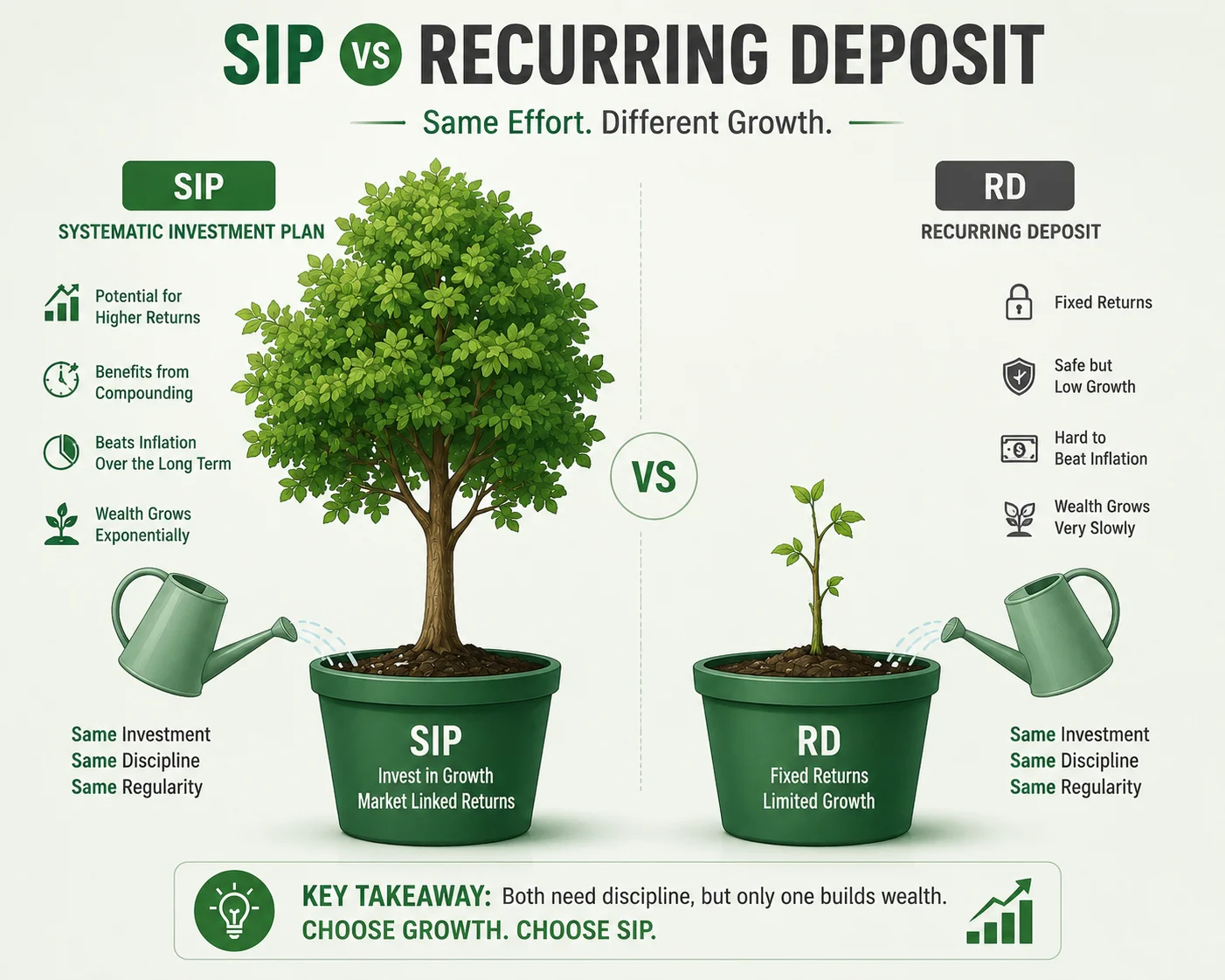
The Monthly Saving Decision Everyone Gets Wrong
A guaranteed savings product feels like the responsible choice — a fixed rate, no market risk, the option your parents trust. But save 1,000 a month at 4% for 20 years and you end up with roughly 368,000. Invest that same 1,000 a month in a broad equity index over the same 20 years, and history suggests something closer to 765,000 — more than double.
Same monthly discipline, same effort, wildly different outcomes. The safety of a fixed deposit is real, but so is its cost: over long horizons it quietly loses the race against both inflation and the market. The question isn't whether guaranteed saving is safe — it's whether safety is what your goal actually needs.
TL;DR — Quick Summary
30-sec read- 1Fixed-rate savings (RD, CD, regular saver, term deposit) guarantee 3-7% with zero market risk, but interest is usually taxed as ordinary income at your full rate.
- 2Monthly equity index investing has delivered 8-13% historically depending on the market, with capital gains usually taxed more lightly than interest.
- 3Over 20 years, monthly index investing typically builds roughly double the balance of the same fixed-rate deposit — the entire gap is compounding a 4-6% return difference.
- 4Use guaranteed savings for goals within 3 years; use equity investing for goals 5+ years away. That single rule resolves most of the debate.
- 5The tax treatment gap is as important as the return gap, and it is the part that differs most by country.
Continue reading for the full guide with examples and strategies.
Who This Is For
Beginner LevelPerfect if you:
- You already save monthly into a deposit account and wonder if investing would do better
- You want the discipline of a fixed monthly deposit but aren't sure about market risk
- You're choosing where to park money for a specific goal (car, home deposit, education)
- You keep hearing that investing beats saving but want to see the actual numbers and tax math
You'll learn:
- How guaranteed savings and equity investing compare over 10 and 20 years, pre-tax and post-tax, in four currencies
- Why interest income is taxed harder than capital gains almost everywhere — and what that costs you
- When a guaranteed deposit is genuinely the smarter choice
- A simple time-horizon rule that settles the decision in seconds
- The equivalent products and tax rules in the US, UK, EU, India, Canada and Australia
Not for you if:
Key Takeaways
6 points- 1Guaranteed deposits: fixed 3-7% returns, usually fully taxable as income, zero market risk.
- 2Monthly equity investing: 8-13% historical returns depending on market, with market risk and lighter capital-gains tax.
- 3The compounding gap is small at 10 years and enormous at 20 — time, not the rate, does most of the damage.
- 4Interest is taxed as ordinary income almost everywhere; long-term capital gains usually are not.
- 5Use deposits for 1-3 year goals, hybrid or balanced funds for 3-5 years, equity for 5+ years.
- 6Running both at once is not a compromise — it is correct asset allocation.
The Same Two Products, Different Names Everywhere
This comparison is searched in every market, using local product names that obscure how identical the underlying choice is. Before the numbers, here is the translation table.
What your country calls each side
| Market | Guaranteed monthly saving | Monthly investing |
|---|---|---|
| India | Recurring Deposit (RD), post office RD | SIP into an equity mutual fund |
| United States | CD ladder, high-yield savings, share certificate | Automatic investing into an index fund or ETF |
| United Kingdom | Regular saver account, cash ISA, fixed-rate bond | Monthly direct debit into a Stocks & Shares ISA |
| Eurozone | Termingeld / term deposit, Sparbuch | ETF-Sparplan (ETF savings plan) |
| Canada / Australia | GIC, term deposit | Pre-authorised contributions to an ETF |
Whatever the labels, the trade-off is identical: a guaranteed nominal return taxed as income, versus an uncertain higher return taxed as capital gains.
How Guaranteed Monthly Saving Works
A recurring deposit or its equivalent is an agreement with a bank: you deposit a fixed amount every month for a chosen term — typically one to five years — and the bank guarantees a fixed interest rate. At maturity you get your principal plus compounded interest. There is no market risk: the rate quoted on day one is the rate you receive.
These products feel a lot like monthly investing — the same discipline, the same auto-debit — which is exactly why they get compared so often. So why do financial planners keep choosing the market when the goal is long-term wealth? Three things: returns, taxation, and how long the money stays invested.
How Monthly Investing Works Instead
Monthly investing is not a product — it is a method. Your fixed contribution buys units of a fund at whatever the price is that day. When markets fall you buy more units; when they rise you buy fewer. This is cost averaging, and over time it smooths your purchase price.
The crucial difference is that returns are not guaranteed — they depend on the market. In exchange for accepting that uncertainty, you get access to equity returns that have historically far outpaced any deposit rate. Over short periods this can mean losses; over long periods it has meant substantially more wealth.
The Numbers: Saving vs Investing Over 10, 15 and 20 Years
The cleanest way to settle the debate is to compound the same monthly amount at each rate over long horizons. Here is what a fixed monthly contribution builds under each option, shown across four markets so the figures mean something wherever you are.
Guaranteed deposit vs equity investing: 20-year outcome
A typical monthly contribution in each market, compounded at a realistic local deposit rate versus a realistic long-run equity return.
| Market | Monthly | Deposit rate | Deposit at 20yr | Equity return | Equity at 20yr | Difference |
|---|---|---|---|---|---|---|
| United StatesUSD · CD vs S&P 500 | $1,000 | 4.0% | $368,000 | 10.0% | $765,000 | +108% |
| EurozoneEUR · term deposit vs MSCI World | €500 | 2.5% | €155,000 | 8.0% | €295,000 | +90% |
| United KingdomGBP · regular saver vs FTSE All-World | £500 | 4.0% | £184,000 | 9.0% | £334,000 | +82% |
| IndiaINR · RD vs Nifty 50 | ₹10,000 | 7.0% | ₹52.1 lakh | 12.0% | ₹99.9 lakh | +92% |
All figures pre-tax and illustrative, using each market's typical deposit rate and long-run equity return. Note that the gap is roughly the same proportion everywhere — around double — even though the absolute rates differ. The spread between the two rates, not the level of either, is what drives the outcome.
Why the gap explodes over time
Run the US example at shorter horizons and the pattern becomes obvious. At 10 years, investing leads by about $50,000 — meaningful, but not dramatic. At 15 years the lead is roughly $170,000. By 20 years it is nearly $400,000. Nothing changed except time. Compounding a 5-6% higher annual return does very little early and then does almost everything later. This is precisely why starting a long-horizon plan early beats waiting until you "feel safe."
Head-to-Head: Every Factor That Matters
Returns are only one dimension. Here is how the two compare across the factors that actually decide which is right for a given goal.
| Factor | Monthly equity investing | Guaranteed deposit |
|---|---|---|
| Typical returns | 8-13% depending on market (not guaranteed) | 3-7% depending on market (guaranteed) |
| Risk | Market risk; can fall 20-40% short-term | Virtually none; capital protected |
| Taxation | Capital gains rates, often with an annual allowance | Interest taxed as ordinary income at your full rate |
| Liquidity | High — sell on any business day | Locked till maturity; penalty on early exit |
| Inflation protection | Strong — historically beats inflation | Weak — often barely matches it after tax |
| Best time horizon | 5+ years | 1-3 years |
The Hidden Tax Disadvantage of Guaranteed Savings
The headline deposit rate is not the rate you keep. In nearly every developed tax system, interest is taxed as ordinary income — at your full marginal rate — while long-term capital gains are taxed at a lower preferential rate, often with an annual exemption on top. This asymmetry is deliberate policy, and it quietly transfers a large share of a deposit's return to the treasury.
Work through a 40% marginal-rate saver: a 4% deposit yields 2.4% after tax. If inflation is 3%, that is a real loss of purchasing power every year even as the account balance rises. The deposit is taxed hardest precisely where it is weakest — on the return itself.
How interest and capital gains are taxed in your country
The return gap is only half the story. The tax gap is the other half, and it varies more by country than returns do.
- •CD and savings interest is taxed as ordinary income, up to the top federal bracket plus state tax
- •Qualified long-term capital gains (held over 12 months) are taxed at preferential rates, well below ordinary income for most
- •Both disappear inside a Roth IRA or 401(k) — always fill the tax-advantaged wrapper first
- •Interest is taxed annually as it accrues; capital gains are deferred until you sell
- •The Personal Savings Allowance shields a slice of interest, then it is taxed at your income tax rate
- •Capital gains have their own separate annual exemption and lower rates
- •A Stocks & Shares ISA removes both income tax and CGT entirely on everything inside it
- •A Cash ISA does the same for interest — the right comparison is ISA-to-ISA, not taxed-to-sheltered
- •Many member states apply a flat withholding tax to both interest and investment income
- •Germany applies Abgeltungsteuer to both, with a Sparer-Pauschbetrag allowance covering a slice
- •France's PEA offers substantial relief on equities after a holding period
- •Ireland's deemed-disposal rule taxes ETF gains every eight years even without a sale
- •RD and fixed deposit interest is added to income and taxed at your slab rate, with TDS deducted above a threshold
- •Equity held over 12 months attracts long-term capital gains tax above an annual exemption
- •ELSS funds add a Section 80C deduction under the old regime, with a three-year lock-in
- •The combination of higher returns and lighter tax is what produces the near-double outcome
- •Interest is 100% included in taxable income at your marginal rate
- •Only a portion of a capital gain is included, making equity structurally more tax-efficient
- •A TFSA removes tax on both entirely — fill it before any taxable account
- •An RRSP defers tax on contributions until withdrawal
- •Australian interest is taxed at your marginal rate with no discount
- •Australia's CGT discount halves the taxable gain on assets held over 12 months
- •Singapore levies no capital gains tax at all, giving equity a decisive edge over taxed interest
- •Superannuation and CPF/SRS contributions carry their own concessional treatment
Rates, allowances and thresholds change regularly and depend on your personal circumstances. This is general information, not tax advice — confirm the current rules with a qualified adviser in your jurisdiction.
The annual-taxation catch on deposits
Deposit interest is generally taxed every year as it accrues, and in many countries the bank withholds it at source. Savers often assume the balance is quietly compounding untouched, only to find tax has already taken a slice each year — which means the after-tax rate compounds, not the headline rate. Investments face no such annual drag: tax applies only when you sell, so the full pre-tax amount keeps compounding in the meantime. Over 20 years this deferral is worth almost as much as the rate difference.
A 15-Year Education Goal: Deposit vs Investing
Educational ExampleA hypothetical, illustrative comparison — not a prediction. Actual deposit rates and market returns will differ.
An investor aged 30 wants to build a fund for a child's education in 15 years. They can contribute 1,000 a month and are torn between the guaranteed deposit their parents swear by and an index fund a colleague recommends. Assume a 40% marginal tax rate.
- Deposit at 4%: 180,000 contributed grows to about 246,000 pre-tax. But interest is taxed annually at 40%, so the effective compounding rate is nearer 2.4% and the real outcome is closer to 216,000.
- Equity at 10%: the same 180,000 grows to roughly 414,000 pre-tax. Tax applies only at the end, on the gain, at the lower capital-gains rate — leaving around 380,000.
The investing route leaves roughly 164,000 more after tax — enough to change what the child can afford. Because the goal is 15 years out, short-term volatility never threatens the outcome; it simply gives compounding room to work. Reproduce this with your own figures in the monthly investment calculator.
This is a hypothetical scenario using historical market data for educational purposes only. Past performance does not guarantee future results.
When a Guaranteed Deposit Is Genuinely the Right Choice
Deposits are not a bad product — they are simply mismatched to long-term goals. There are clear situations where the deposit is the smarter pick, and pretending otherwise is how people end up with a house deposit in an index fund during a bear market.
Choose a guaranteed deposit when:
- • The goal is 1-3 years away. Markets can fall 30-40% in a single year; you cannot risk that for a near-term need.
- • You need capital protection. A home deposit due in 18 months should never sit in equity.
- • You are drawing an income and want predictable cash flow over growth.
- • It anchors an emergency buffer at a better rate than a current account while staying low-risk.
Choose monthly investing when:
- • The goal is 5+ years away — retirement, education, long-term wealth.
- • You can tolerate short-term dips without selling in a panic.
- • You want inflation-beating growth, not just nominal capital safety.
- • You value tax efficiency and want the balance compounding pre-tax.
The Simple Time-Horizon Rule
You do not need to overthink this. Match the tool to how long the money can stay invested.
The mistake most savers make is using a deposit for a 15-year goal out of habit, or gambling a 1-year goal in equity out of greed. Get the horizon right and the choice makes itself. To see how inflation quietly eats a deposit's real return, read our breakdown of how inflation affects your investments and savings.
Building a Large Portfolio: Why This Isn't Actually an Either/Or
Framed as a duel, this comparison is misleading. Every serious portfolio holds both — the question is not which product wins but what proportion each should occupy. Cash and deposits are not a failed investment; they are the part of the portfolio that lets the equity part be left alone.
The cash buffer is what makes equity holdable
Investors with 6-12 months of expenses in deposits rarely sell equities in a crash, because they do not have to. Investors with no buffer are forced to liquidate at the worst possible price. The deposit portion is not dead money — it is what buys you the ability to ignore a 35% drawdown.
Ladder your deposits rather than holding one lump
Splitting fixed-term deposits across staggered maturities — a CD ladder in the US, staggered term deposits elsewhere — means something matures regularly, giving you liquidity without sacrificing the higher rate on longer terms. It is cost averaging applied to interest rates.
Shift the ratio as the goal approaches
A 100% equity allocation is right at year one of a 25-year plan and reckless in year 24. Glide the mix toward deposits and bonds as the target date nears, so a badly timed crash cannot undo two decades of contributions. This is sequence-of-returns risk, and it is the main thing that ends retirements early.
Above the deposit-insurance cap, the "guarantee" thins out
Deposit protection schemes cover a fixed amount per bank — commonly $250,000 in the US, £85,000 in the UK, €100,000 across the EU, and lower elsewhere. Large balances at a single institution are not fully guaranteed. Spreading across banks restores the protection but adds admin, which is one more reason large portfolios tilt toward securities.
Liquidity and Early Withdrawal: What Actually Happens
Access to your money is where these two differ most in daily life, and it rarely makes the headline comparison. A fixed-term deposit is designed to be held to maturity. Early closure is often allowed only after a minimum period, and even then you take a penalty — commonly a reduced rate, or forfeiting several months of interest. Miss a scheduled deposit and some products charge a small default fee.
Investments work the opposite way. You can pause contributions, stop them, or sell on almost any business day, with money reaching your account within a few working days. The only friction is a possible early-redemption fee on some funds plus tax on the gains. That flexibility cuts both ways — the same easy access that helps in a genuine emergency also makes it tempting to bail out during a dip, which is exactly when a long-term investor should sit still.
The liquidity rule of thumb
Money you might need on short notice belongs in neither a locked deposit nor a volatile equity fund — keep it in an instant-access savings or money-market account. Use a fixed-term deposit when you specifically want to remove the temptation to touch the money, and investments when you want growth plus the option to sell if life demands it.
Moving From Saving to Investing: A Practical Checklist
If the numbers have convinced you to shift long-term money out of deposits, do it deliberately rather than all at once. Here is a low-stress way to make the switch.
Curious whether staggering in beats deploying a windfall all at once? Our monthly vs lump sum guide and the lumpsum calculator let you test both paths with your own figures.
Run the Comparison on Your Own Numbers
Enter your monthly amount and horizon in any of 10 currencies. Run it once at your market's equity return, then again at your bank's deposit rate, and compare.
Enter your monthly amount and years
Compare your equity assumption against the deposit rate
Adjust for tax and pick your path
SIP or RD? The questions that decide it
Is investing better than a savings account or fixed deposit?
For goals five or more years away, monthly equity investing has historically built roughly double the balance of a guaranteed deposit with the same discipline, thanks to higher returns and lighter taxation. For goals within three years, the deposit is safer because markets can fall 30-40% in a single year. Match the choice to your time horizon rather than to how each one feels.
Why is interest taxed more heavily than capital gains?
Almost every developed tax system treats interest as ordinary income taxed at your full marginal rate, while granting long-term capital gains a lower preferential rate and often an annual exemption. Interest is also usually taxed each year as it accrues, whereas capital gains are deferred until you sell — so the full pre-tax balance keeps compounding in the meantime. Over 20 years that deferral is worth nearly as much as the rate difference itself.
Can I lose money investing but not in a deposit?
Yes, in nominal terms. A deposit guarantees your capital and a fixed rate, so the balance cannot fall. An equity investment is market-linked and can show losses, especially short-term. But a deposit can still lose in real terms: at a 4% rate, 40% tax and 3% inflation, your purchasing power shrinks every year even as the balance grows. Neither option is genuinely risk-free — they just carry different risks.
Should a beginner save or invest first?
Both, in order. Build 3-6 months of expenses in an instant-access savings account first — that buffer is what lets you hold investments through a crash without being forced to sell. Once it is in place, direct long-term money into a tax-advantaged investment account. Skipping the buffer to invest more is the most common beginner mistake, because it guarantees you sell at the worst possible moment.
How much should I keep in cash versus invested?
A common framework is 3-6 months of expenses in cash for emergencies, plus the full value of any goal due within three years, with everything beyond that invested according to your horizon. As a target date approaches, shift progressively from equity toward cash and bonds so a late crash cannot undo years of contributions. The right cash proportion is driven by your upcoming spending, not by your market view.
Can I withdraw early from a fixed deposit or an investment?
A fixed-term deposit is built to be held to maturity — early closure is typically permitted only after a minimum period and costs you a reduced rate or several months of forfeited interest. Investments are far more liquid: you can sell on almost any business day, subject to a possible early-redemption fee on some funds plus tax on any gain. The trade-off is that easy access also makes it easier to sell at the wrong time.
Frequently Asked Questions
How much does 1,000 a month become over 20 years, saved versus invested?
At a 4% deposit rate, 1,000 a month for 20 years grows to roughly 368,000 pre-tax. At a 10% equity return, the same 240,000 contributed grows to about 765,000 pre-tax. After tax the gap widens further, because interest is taxed annually at your full rate while gains are deferred and taxed at a lower one. These figures are illustrative and scale to any currency.
Why does a deposit lose to inflation?
If a deposit pays 4% and you are in a 40% tax bracket, your post-tax return is about 2.4%. With inflation at 3%, you lose purchasing power every year even though the balance rises. This is the central problem with long-horizon saving: nominal safety and real safety are not the same thing, and only the second one buys anything.
Are bank deposits actually guaranteed?
Up to a limit. Deposit protection schemes cover a fixed amount per depositor per institution — commonly $250,000 in the US, £85,000 in the UK and €100,000 across the EU, with lower caps in many other markets. Balances above the cap at a single bank are not protected. Spreading across institutions restores full coverage but adds administration, which is one reason larger portfolios tilt toward securities.
Can I run monthly saving and monthly investing at the same time?
Absolutely, and most well-constructed portfolios do. Use deposits for short-term goals and the emergency buffer, and investments for long-term wealth. This is not a compromise between the two options — it is correct asset allocation, and the cash side is precisely what makes the equity side possible to hold through a downturn.
What return rate should I use to compare them?
Use the actual rate your bank offers for the deposit side, and a conservative long-run figure for equities based on your market's history — roughly 7-8% real for developed markets, higher in nominal terms for higher-inflation economies. Then adjust both for tax at your own marginal rate. Do not assume: run your real numbers through the calculator, because the answer genuinely changes with your tax bracket.
Related Articles
Investment Risk Disclaimer
This content is for educational purposes only and should not be considered financial advice. All investments carry risk, including the potential loss of principal. Past performance does not guarantee future results. Before making any investment decisions, please consult with a qualified financial advisor who understands your personal financial situation, risk tolerance, and investment goals.
Stock Averager provides tools and educational content but does not provide personalized investment advice or recommendations.
Explore this topic in depth
Systematic Investing & SIPs
Contributing on a schedule: frequency, escalation, inflation, and turning a corpus back into income.
- SIP vs Lump Sum: The definitive Guide to Investing Your Money (main guide)The definitive comparison, with the maths behind each approach.
- How Inflation Erodes Your SIP Returns (And What to Do About It)Planning in real money, and choosing a defensible inflation assumption.
- Daily vs Weekly vs Monthly SIP: Which Frequency Gives Best Returns?Whether daily, weekly or monthly contributions actually change the outcome.
- Escalating Contributions: The 10% Rule That Doubles Your PortfolioEscalating contributions annually — the rule that roughly doubles a corpus.
- Investing From Abroad: The Cross-Border & Expat Investor's GuideCross-border and expat investing: accounts, reporting and tax exposure.
- Best SIP Plans for 2026: Top 10 Mutual Funds in IndiaHow to evaluate a fund rather than chase last year's return table.
- NRI Investing in India 2025: Complete Guide for Non-Resident IndiansNRE and NRO accounts, repatriation limits and compliance.
- Systematic Withdrawal Plan (SWP): How to Turn a Corpus Into Monthly IncomeConverting a corpus into monthly income without draining it early.
- How to Build Wealth with Dollar Cost Averaging (Without Timing the Market)The systematic default for most investors, and its real limits.
- How to Build a DCA Portfolio: Step-by-Step GuideTurning the principle into an actual allocation and schedule.
- How to Calculate CAGR: Formula, Examples & Free Calculator (2026)The compounding formula, and why XIRR is correct for regular contributions.
- Dividend Reinvestment (DRIP): How to Snowball Dividends Into WealthCompounding distributions automatically, and the tax you still owe.
Related topics
- Cost Averaging & Averaging DownLowering your average cost deliberately — when it compounds returns, and when it compounds a mistake.
- Tax & Financial PlanningThe structural decisions — account type, tax treatment and cash buffers — that compound alongside returns.
- Fundamentals & ValuationWorking out what a business is worth before deciding what its shares are worth paying.
Sources & Further Reading
Figures and rules cited in this article are drawn from the primary sources below. Tax and regulatory details change — always confirm against the current official guidance for your jurisdiction.
- 1India Retains 4% Inflation Target for RBI — Drishti IASThe inflation hurdle a fixed-deposit or recurring-deposit rate has to clear after tax.
- 2India Inflation Rate — CPI historical data — Trading EconomicsRealised CPI used to compare nominal deposit rates against real returns.
- 3Deposit Insurance (DICGC) coverage — Reserve Bank of IndiaDeposit insurance limits — the genuine advantage deposits hold over market-linked products.
About Stock Averager Team
Expert financial analysts dedicated to simplifying complex investment strategies for everyone. We build tools that help you make better money decisions.