
Tax-Loss Harvesting: Turn Losses into Savings
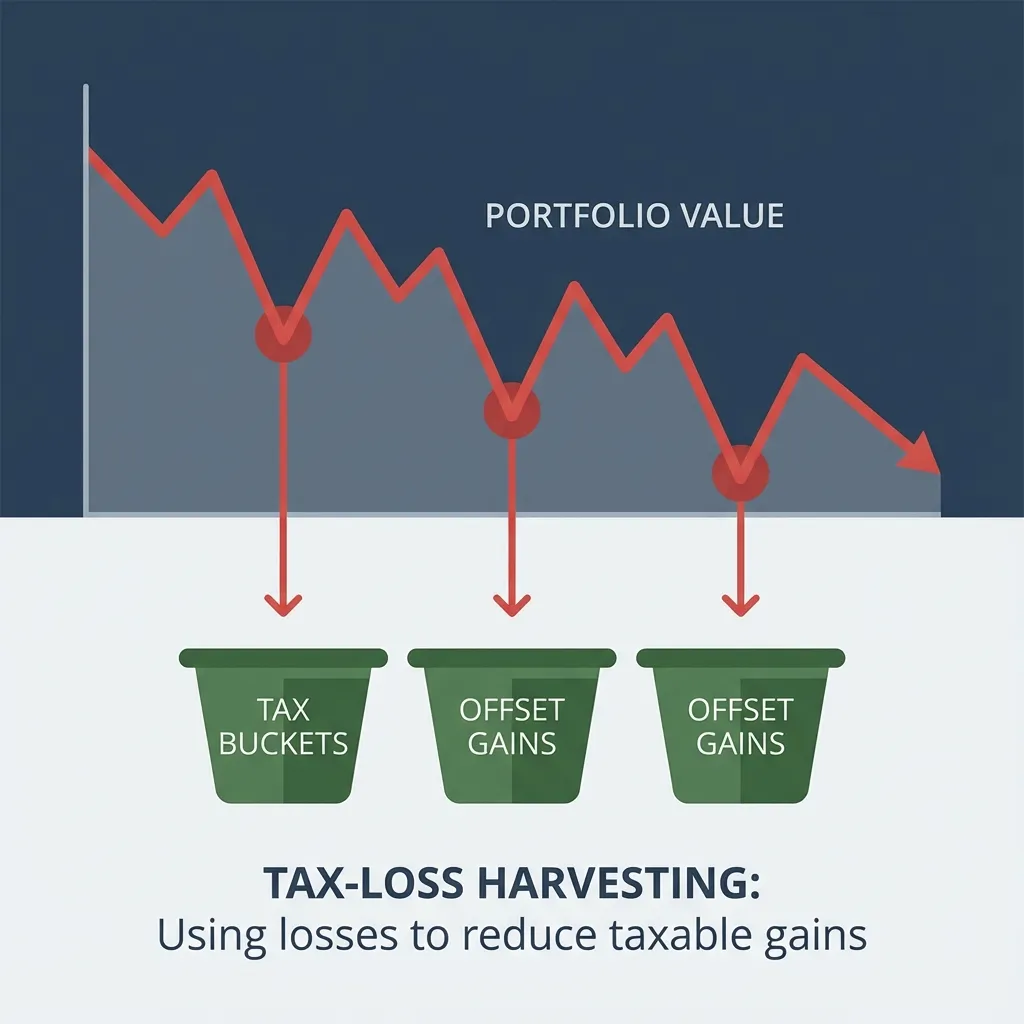
Your stock dropped 20%. That's painful—but what if you could turn that loss into tax savings? The IRS effectively offers a "coupon" for your losses, subsidizing your risk if you know how to claim it. Tax-loss harvesting is the only guaranteed "alpha" in improved after-tax returns, allowing you to offset gains, reduce your tax bill by thousands, and immediately reinvest to catch the recovery.
Key Takeaways
5 points- 1The Silver Lining: Tax-loss harvesting allows you to sell losing investments to offset capital gains dollar-for-dollar, lowering your overall tax bill.
- 2The $3,000 Deduction: If your losses exceed your gains, you can deduct up to $3,000 against your ordinary income (wages) annually. The rest carries forward forever.
- 3The Wash Sale Rule: You cannot buy the 'substantially identical' security within 30 days before or after the sale — a 61-day window in total. The loss is not destroyed; it is added to the cost basis of the replacement shares and deferred. The one exception is repurchasing inside an IRA or Roth IRA, where the basis adjustment is lost permanently.
- 4Asset Location: This strategy ONLY works in taxable brokerage accounts. You cannot harvest losses in IRAs or 401(k)s because they are tax-sheltered.
- 5Tax Gain Harvesting: The lesser-known sibling strategy. If your income is low (0% capital gains bracket), you intentionally sell winners to reset your cost basis tax-free.
Part 1: What Is Tax-Loss Harvesting?
So what is tax-loss harvesting in plain terms? Tax-loss harvesting (TLH) is the proactive strategy of selling assets that have declined in value to "realize" a loss for tax purposes. You then immediately maximize the efficiency of that capital by reinvesting it in a similar (but not identical) asset. If you are learning how to harvest tax losses for beginners, the core idea is simple: a paper loss does nothing for your taxes until you actually sell.
It creates a "Tax Asset" (the realized loss) that you can use to neutralize "Tax Liabilities" (realized gains).
Think of it as turning lemons into lemonade. The market gave you a loss; the IRS gives you a tax deduction. If you just hold the losing stock, you have the "paper loss" but no tax benefit. You must sell to unlock the value.
The Math of the Deduction
Scenario: You earn $150,000/year (24% bracket). You sold Nvidia for a $10,000 profit.
Without Harvesting: You owe $1,500 - $2,000 in Capital Gains taxes.
With Harvesting: You sell your losing PayPal position for a $10,000 loss.
Net Result: $10,000 Gain - $10,000 Loss = $0 Net Gain.
Tax Bill: $0. You just saved ~$2,000 cash.
Part 2: The Hierarchy of Offsets
The IRS has a specific order in which losses are applied. It’s not just a free-for-all. Understanding this hierarchy helps you plan which lots to sell.
1. Short-Term vs. Short-Term
Short-term losses (held < 1 year) first offset short-term gains (taxed at regular income rates, up to 37%). This is the most valuable offset because short-term tax rates are highest.
2. Long-Term vs. Long-Term
Long-term losses (held > 1 year) offset long-term gains (taxed at 0%, 15%, or 20%).
3. The Crossover
If you have excess short-term losses, they can then offset long-term gains. Conversely, excess long-term losses can offset short-term gains.
4. Ordinary Income (The Bonus)
If you still have net losses after offsetting ALL gains, you can deduct up to $3,000 against your salary/wages.
Example: You have a net loss of $20,000. You deduct $3,000 this year. You carry forward $17,000 to next year. This carry-forward is indefinite (until you die).
Part 3: The Wash Sale Rule (The Trap)
The IRS is smart. They don't want you to sell a stock to claim a loss and then immediately buy it back 5 minutes later just to game the system.
⚠️ Critical Rule
If you sell a security at a loss and buy a "substantially identical" security within 30 days before OR after the sale, the loss is disallowed. It is added to the cost basis of the new position.
How to Avoid the Wash Sale Rule When Harvesting Losses (The ETF Swap)
Understanding how to avoid the wash sale rule when harvesting losses comes down to one phrase: "substantially identical" is key.
• Identical: Selling VOO (Vanguard S&P 500) and buying SPY (State Street S&P 500). They track the exact same index. Risky.
• Similar, not Identical: Selling VOO (S&P 500) and buying VTI (Total US Market). The indices are different (500 stocks vs 4000 stocks), but the return correlation is 99%.
| Sell This (Loser) | Buy This (Replacement) | Safety Verdict |
|---|---|---|
| VTI (Total Stock Mkt) | SCHB (Schwab Broad Mkt) | Safe (Different Indices) |
| VOO (S&P 500) | VV (Large Cap) | Safe (Different methodology) |
| QQQ (Nasdaq 100) | VGT (Tech Sector) | Safeish (Correlated but distinct) |
| TSLA (Tesla) | TSLA Call Options | WASH SALE (Options count!) |
Real Example: The 'Tech Crash' Correction
Educational ExampleHarvesting $15,000 in losses while staying invested
It's October. The Nasdaq drops 15%. Your QQQ position is down $15,000.
Step 1: The Sale
Sell $100,000 of QQQ. Proceed: $85,000. Realized Loss: $15,000.
Step 2: The Swap
Immediately use the $85,000 to buy VGT (Vanguard Tech ETF). You are still invested in Tech.
Step 3: The Recovery
In November, Tech rallies 10%. Your VGT position goes up. You participated in the rally just like you would have with QQQ.
Step 4: The Switch Back
On Day 31 (after the Wash Sale window), you can sell VGT and buy back QQQ if you prefer the original ETF. Or just keep VGT.
This is a hypothetical scenario using historical market data for educational purposes only. Past performance does not guarantee future results.
Part 4: Accounting Methods (Spec ID vs FIFO)
This is an advanced detail that saves you thousands. By default, most brokers (Robinhood, Vanguard, Fidelity) use "FIFO" (First In, First Out). This means when you click "Sell," they sell the oldest shares first.
Why FIFO is bad for harvesting: In a bull market, your oldest shares are likely your biggest winners (lowest cost basis). Selling them produces the Highest Tax Bill.
You want "Spec ID" (Specific Identification): This allows you to cherry-pick exactly which shares to sell. You explicitly tell the broker, "Sell the 10 shares I bought last week at $200" (which are at a loss), not the ones you bought 5 years ago at $50.
- Vanguard: Search "Cost Basis Method" → Change to "Spec ID".
- Fidelity: Account Features → Cost Basis Information → Change to "Actual Cost".
- Robinhood: Often defaults to FIFO. Check help center for "Specific Lot Identification."
Part 5: Direct Indexing (The Billionaire Strategy)
Wealthy investors don't buy SPY ETF. They use "Direct Indexing."
Direct Indexing means buying all 500 stocks in the S&P 500 individually. Why would anyone do this nightmare administrative task? Deconstruction.
In any given year, the S&P 500 might be UP +10%. But inside that index, 150 companies might be DOWN -20%.
- If you own SPY ETF: You have a paper gain. You cannot harvest any losses.
- If you own Direct Index: You can sell those 150 losing stocks individually. You harvest massive losses to offset gains elsewhere, while still holding the 350 winning stocks.
Previously, you needed $10M+ AUM for this. Now, "Robo-Advisors" like Wealthfront (minimum $100k) and Betterment offer automated Direct Indexing. They use software to micro-harvest daily. It essentially squeezes tax efficiency out of a stone.
Part 6: Tax Gain Harvesting (The Reverse Uno Card)
Everyone talks about harvesting losses. But the difference between tax-loss harvesting and tax-gain harvesting is that sometimes you should deliberately harvest GAINS instead.
When your taxable income is low enough to fall into the 0% Capital Gains Bracket.
For 2024/2025, if your taxable income is under ~$45,000 (Single) or ~$90,000 (Married), your long-term capital gains tax rate is ZERO.
The Strategy:
1. You have a stock (AAPL) with a $10,000 gain.
2. You are in the 0% bracket this year (student, sabbatical, early retirement).
3. You SELL the stock. You realize the $10,000 gain.
4. You pay $0 taxes (thanks to the 0% bracket).
5. You immediately BUY IT BACK. (Wash Sale rule does NOT apply to gains).
The Result: You just "Stepped Up" your cost basis for free. If you sell AAPL in 10 years when you are in a high tax bracket, your tax will be calculated from this higher price, saving you huge money later.
Part 7: State Tax Considerations
Most states follow federal rules for capital gains, but not all.
- Tax-loss harvesting in high-tax states like California, New York, and New Jersey: These states treat capital gains as ordinary income. There is no lower "capital gains rate." This makes execution even more critical. Harvesting losses here saves you Federal Tax (15-20%) AND State Tax (up to 13%), totaling 33%+ instant ROI.
- The "Carry Forward" Trap: Some states restrict how much loss you can carry forward differently than the Feds. Always check with a local CPA if you have massive losses ($100k+).
Part 8: Common Tax-Loss Harvesting Mistakes to Avoid
Most people don't get audited for harvesting—they simply do it wrong and quietly forfeit the loss they thought they banked. These are the traps that silently disallow your deduction.
Mistake #1: Forgetting Automatic Dividend Reinvestment (DRIP)
This is the single most common way to accidentally trigger a wash sale. If you have DRIP turned on and a dividend automatically buys a few shares of the same fund within 30 days of your loss sale, you have purchased a "substantially identical" security—and part of your loss is disallowed. Fix: Switch dividends to "pay in cash" in any taxable account where you plan to harvest.
Mistake #2: Buying It Back in Your IRA or Spouse's Account
The wash sale rule is not limited to the account you sold from. If you sell VTI at a loss in your taxable brokerage and then buy VTI in your IRA, Roth IRA, or your spouse's account within the 30-day window, the loss is disallowed—and because it happened inside an IRA, that basis adjustment is permanently lost, not just deferred. Coordinate across every account in the household.
Mistake #3: Swapping Two Share Classes of the Same Fund
Selling the mutual fund version of a fund and buying the ETF version of the exact same fund (or the Admiral vs. Investor share class) is treated as substantially identical. Different funds tracking different indices are fine; the same fund in a different wrapper is not.
Mistake #4: Blowing Up Your Qualified Dividend Rate
To keep a dividend "qualified" (taxed at the lower long-term rate), you must hold the share for more than 60 days around the ex-dividend date. Harvesting a position too soon after it paid a dividend can flip that payout to "ordinary" income at your top marginal rate—sometimes wiping out the benefit of the harvest.
Mistake #5: Harvesting Trivial Losses
Harvesting a $150 loss resets your holding period, adds paperwork, and risks tracking errors—all to save maybe $30. Set a threshold (many investors use roughly $1,000 per position) below which it simply isn't worth the friction.
Part 9: Year-End Deadline & Harvesting Checklist
Harvesting is not a December-only event, but the calendar still matters. The trade must settle by December 31 to count for the current tax year. The tricky part: the 30-day wash sale window does not care about the calendar year. If you sell at a loss on December 28 and repurchase the substantially identical security on January 10, the wash sale still triggers—even though the two trades fall in different tax years.
The Harvesting Checklist
- Confirm the account is taxable (never an IRA/401k).
- Switch cost-basis method to Spec ID before selling.
- Turn off automatic dividend reinvestment on the position.
- Pick a replacement that is similar but not "substantially identical."
- Check no matching buy occurred in ANY account (yours, IRA, spouse's) in the prior 30 days.
- Sell the loser and immediately buy the replacement to stay invested.
- Set a calendar reminder for Day 31 in case you want to switch back.
- Log the realized loss so it flows onto Form 8949 / Schedule D at tax time.
Before you pull the trigger, size the actual benefit. Run the position through our Capital Gains Calculator, and if you are also tracking a cost basis across multiple buys, our Cost Basis Calculator makes it easy to see which lots are actually underwater.
Is Tax-Loss Harvesting Worth It for Small Investors?
A common question is whether tax-loss harvesting is worth it for small investors with modest accounts. The honest answer is that the benefit scales with your tax bracket and the size of your realized gains—harvesting $400 of losses to chase pennies of savings rarely justifies the trading effort and the holding-period reset. As a rough rule of thumb, prioritize harvesting only when a single position is down more than $1,000 and you have actual gains (or up to $3,000 of ordinary income) to offset. For small portfolios, automated robo-advisors can do the daily micro-harvesting for you, which removes the manual hassle entirely. Before you act, run the numbers in our Capital Gains Calculator so you know the exact dollar value of the loss you are about to realize.
FAQ: Tax Loss Harvesting
When is the best time to harvest?
Can I harvest crypto losses?
What about dividends?
Does this reset my holding period?
Wash-Sale Rules by Country: The Part That Changes Everything
Tax-loss harvesting lives or dies on one question: how long must you wait before buying the asset back? Every major tax authority has an anti-avoidance rule designed to stop you booking a loss while keeping the same exposure, but the rules differ sharply — in the length of the window, in whether it applies before as well as after the sale, and in what counts as "substantially identical." Getting this wrong means the loss is simply disallowed, and you have paid the transaction costs for nothing.
Anti-avoidance rules on harvested losses
Check your own jurisdiction before selling — the differences are larger than most guides admit.
- •A loss is disallowed if you buy a substantially identical security within 30 days before or after the sale — a 61-day window in total
- •The window runs in both directions, which catches people who bought more shares shortly before harvesting
- •It also applies across your accounts, including an IRA, where the loss is permanently lost rather than deferred
- •The disallowed loss is added to the cost basis of the replacement shares, so it is usually deferred rather than destroyed
- •Repurchasing the same shares within 30 days after the sale matches the disposal against the repurchase, negating the loss
- •Unlike the US, the rule looks forward only — a purchase before the sale is not caught the same way
- •Common workarounds include 'bed and ISA' (repurchase inside an ISA) or 'bed and spouse' (a spouse buys instead)
- •Switching to a similar but not identical fund also sidesteps it
- •A loss is denied if you or an affiliated person acquires identical property within 30 days before or after the sale and still holds it at day 30
- •'Affiliated person' explicitly includes a spouse and corporations you control, which is broader than the US rule
- •The denied loss is added to the cost base of the replacement property
- •Losses in a TFSA or RRSP cannot be claimed at all, since gains there are not taxed
- •There is no fixed day count — the ATO applies a general anti-avoidance provision based on purpose
- •A sale and near-immediate repurchase with no commercial purpose beyond the tax benefit can be struck down
- •The absence of a bright-line test makes this less predictable than the US or UK rules, not more permissive
- •The CGT discount on assets held over 12 months interacts with harvesting decisions
- •There is no statutory wash-sale provision, so selling and immediately repurchasing to book a loss is generally accepted practice
- •Losses must be set off in a prescribed order and can be carried forward for a set number of years if the return is filed on time
- •Short-term losses can offset both short- and long-term gains; long-term losses can only offset long-term gains
- •The absence of a waiting period makes harvesting mechanically simpler here than almost anywhere else
- •Rules differ substantially across member states — some have explicit holding requirements, others rely on general anti-abuse provisions
- •Germany restricts how certain losses can be offset against other categories of income
- •Several states apply a flat withholding tax that limits the value of harvesting entirely
- •Always confirm local rules rather than assuming the US framework applies
Tax rules change frequently and depend on your personal circumstances. This is general information, not tax advice — confirm current rules with a qualified tax professional in your jurisdiction before harvesting losses.
The universal workaround: swap, don't wait
In every jurisdiction with a waiting period, the standard solution is the same: sell the losing holding and immediately buy a similar but not identical one, so you stay invested while the clock runs. Sell one broad market index fund and buy a different provider's fund tracking a different-but-correlated index; sell one bank and buy a competitor. You keep essentially the same market exposure, book the loss, and avoid the rule entirely.
Two cautions. First, "substantially identical" is interpreted differently by each authority, and two funds tracking the same index are riskier than two tracking different ones. Second, tracking difference between the two funds over the waiting period is a real cost — usually small, occasionally not.
Tax-loss harvesting rules and edge cases
What is the deadline for tax-loss harvesting?
The sale must settle by December 31 to count for the current tax year, so there is no waiting until you file in April. But the 30-day wash sale window ignores the calendar year: if you sell at a loss on December 28 and rebuy the same security on January 10, the wash sale still triggers. Most experienced investors harvest opportunistically during dips all year rather than waiting for year-end.
Can a wash sale be triggered in my IRA or my spouse's account?
Yes. The wash sale rule looks across all accounts you control, including your IRA, Roth IRA, and your spouse's accounts. If you sell a fund at a loss in your taxable brokerage and buy the substantially identical fund in your IRA within 30 days, the loss is disallowed—and because it happened inside a tax-sheltered account, that basis adjustment is permanently lost rather than just deferred.
Do reinvested dividends trigger the wash sale rule?
They can. If automatic dividend reinvestment (DRIP) buys even a few shares of the same fund within 30 days of your loss sale, that counts as repurchasing a substantially identical security and part of your loss is disallowed. The simple fix is to switch dividends to pay in cash on any taxable position you plan to harvest.
How much can you write off with tax-loss harvesting?
There is no cap on using losses to offset capital gains—you can neutralize an unlimited amount of realized gains dollar-for-dollar. Beyond that, you can deduct up to $3,000 of net losses against ordinary income each year. Anything left over carries forward indefinitely to future tax years.
Does tax-loss harvesting actually save money or just defer taxes?
It is mostly tax deferral, but deferral still has real value: you keep more capital invested and compounding today, and the $3,000 ordinary-income deduction converts a portion into a permanent saving. The benefit is largest if your future tax rate is lower, or if the loss offsets high-rate short-term gains now. If you harvest and later sell the replacement at a big gain, some of the benefit reverses.
Can I harvest a mutual fund loss and buy the ETF version of the same fund?
No. Two share classes or wrappers of the exact same fund—the mutual fund and the ETF version, or Admiral versus Investor shares—are considered substantially identical, so the loss is disallowed. What works instead is swapping to a different fund that tracks a different index, such as selling an S&P 500 fund and buying a total-market fund.
Don't Leave Money on the Table
Investment returns are uncertain. Tax savings are guaranteed. Control what you can control.
Check for losses > $1,000.
Switch accounting to Spec ID.
Harvest, Swap, and Save.
Related Topics
Capital Gains Tax Calculator
A tax loss harvesting calculator quantifies exactly how much you save by realizing strategic losses. It feeds into a broader capital gains calculator that shows your net capital gains tax liability after all offsets are applied. Understanding your capital gains tax calculator output is critical before any year-end portfolio moves.
When losses exceed gains, the remaining amount becomes a capital loss carryforward. Knowing the capital loss carryover rules—specifically the annual $3,000 deduction against ordinary income and the indefinite carry period—lets you plan multi-year tax strategies. Tracking unrealized gains and losses throughout the year helps you time harvesting events for maximum benefit.
The capital losses deduction directly reduces your taxable income, making it one of the few guaranteed returns in investing. For active traders, understanding day trading taxes and short-term versus long-term rates is equally important. Use our Capital Gains Calculator to model your specific scenario and see how to avoid capital gains tax legally through harvesting and smart account placement.
Investment Risk Disclaimer
This content is for educational purposes only and should not be considered financial advice. All investments carry risk, including the potential loss of principal. Past performance does not guarantee future results. Before making any investment decisions, please consult with a qualified financial advisor who understands your personal financial situation, risk tolerance, and investment goals.
Stock Averager provides tools and educational content but does not provide personalized investment advice or recommendations.
Explore this topic in depth
Tax & Financial Planning
The structural decisions — account type, tax treatment and cash buffers — that compound alongside returns.
- Tax Implications of Averaging Down Stocks: What Every Investor Must KnowWash sales, cost basis methods and tax lots before you add shares.
- Roth IRA vs Traditional IRA: Which is Better?The tax-timing decision and what actually decides it.
- Emergency Fund Guide: How Much Cash You Really Need (2026)The holding that protects returns by preventing forced sales.
- Systematic Withdrawal Plan (SWP): How to Turn a Corpus Into Monthly IncomeConverting a corpus into monthly income without draining it early.
- NRI Investing in India 2025: Complete Guide for Non-Resident IndiansNRE and NRO accounts, repatriation limits and compliance.
- Investing From Abroad: The Cross-Border & Expat Investor's GuideCross-border and expat investing: accounts, reporting and tax exposure.
Related topics
- Systematic Investing & SIPsContributing on a schedule: frequency, escalation, inflation, and turning a corpus back into income.
- Dividends & Portfolio IncomeTurning holdings into cash flow — dividends, reinvestment, covered calls and structured withdrawals.
- Risk Management & Position SizingDeciding in advance how much you can lose — the part of investing that determines whether you survive.
Sources & Further Reading
Figures and rules cited in this article are drawn from the primary sources below. Tax and regulatory details change — always confirm against the current official guidance for your jurisdiction.
- 1Publication 550: Investment Income and Expenses — Internal Revenue ServiceWash sale definition, the 30-days-before-or-after window, substantially identical securities, and the basis adjustment for disallowed losses.
- 2Wash Sales — investor glossary — U.S. Securities and Exchange Commission (Investor.gov)Plain-language definition, including wash sales triggered by purchases inside an IRA or Roth IRA.
- 3Revenue Ruling 2008-05: Loss from Wash Sales of Stock or Securities (Section 1091) — Internal Revenue ServiceThe ruling confirming that a repurchase within an IRA permanently disallows the loss with no basis recovery.
- 4Instructions for Schedule D (Form 1040) — Internal Revenue ServiceHow disallowed wash sale losses are reported.
About Stock Averager Team
Expert financial analysts dedicated to simplifying complex investment strategies for everyone. We build tools that help you make better money decisions.
Recommended Tools
Related Articles
Cost Averaging Explained: Dollar, Rupee, Pound & Euro Cost Averaging
Lump Sum vs DCA: When to Invest All at Once
Roth IRA vs Traditional IRA: Which is Better?
What Is Averaging Down? Complete Beginner's Guide (2026)
SIP vs Lump Sum: The definitive Guide to Investing Your Money
Value Averaging: The Smarter DCA Alternative?