
How to Read an Options Chain: A Complete Step-by-Step Guide
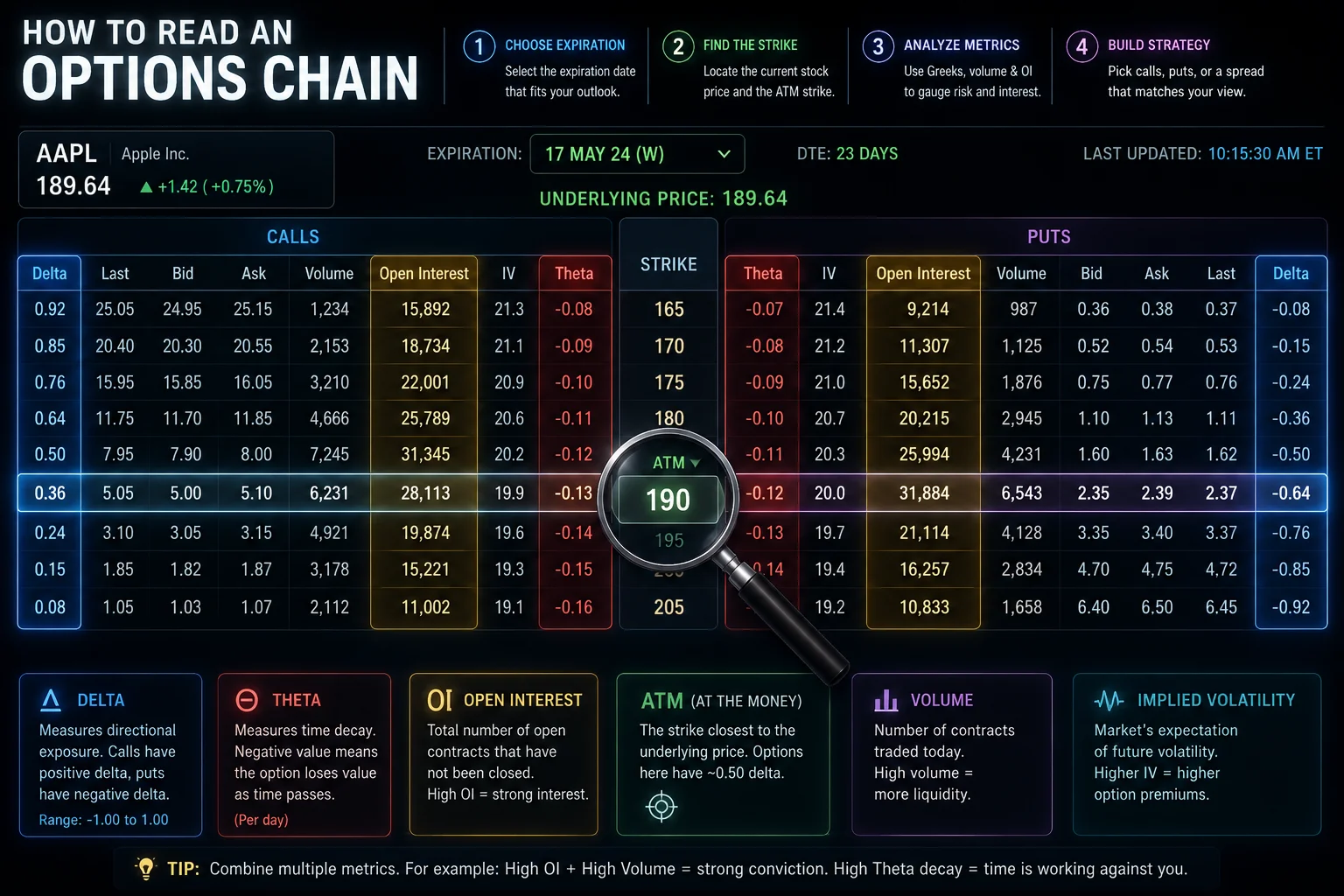
A Wall of Numbers That Actually Talks
Open an options chain on AAPL for the first time and you will see a grid of strikes, bids, asks, volumes, open interest, and Greeks — dozens of rows, all screaming for attention. Most beginners either ignore the chain entirely and trade blind, or freeze because they do not know where to look.
But the options chain is not noise. It is the single richest source of information a retail trader has. Read correctly, it tells you what the market expects, where smart money has parked its positions, which strikes are cheap versus expensive, and exactly which contract fits your strategy. This guide teaches you how to read an options chain step by step — column by column — so the wall of numbers starts working for you instead of against you.
TL;DR — Quick Summary
30-sec read- 1An options chain lists every strike and expiration for one underlying, with bid/ask, volume, open interest, IV, and Greeks
- 2Calls sit on the left, puts on the right; the at-the-money (ATM) strike sits in the middle near the current price
- 3Open interest reveals where the market has committed capital — high-OI strikes act as support and resistance
- 4Use Delta to pick strikes: ~0.30 for premium sellers, ~0.50-0.70 for directional buyers
- 5IV skew shows which side of the chain is expensive: OTM puts usually carry higher IV than OTM calls
Continue reading for the full guide with examples and strategies.
Key Takeaways
6 points- 1The options chain shows all available strikes, expirations, bids, asks, IV, and Greeks for one underlying asset
- 2Calls are on the left, puts on the right (or in separate tabs); the ATM strike is in the middle near spot price
- 3Open Interest = total outstanding contracts. High OI at a strike marks a key support or resistance level
- 4IV skew: OTM puts often carry higher IV than OTM calls ('put skew') — use it to find mispriced options
- 5Use Delta to find the right strike: ~0.30 Delta for sellers, ~0.50-0.70 Delta for directional buyers
- 6Always check the bid/ask spread before paying mid — a wide spread on an illiquid strike quietly eats your edge
What Is an Options Chain?
An options chain (also called an options matrix, option chain, or options table) displays every option contract available for a specific underlying asset — arranged by expiration date and strike price. So what is an options chain in practical terms? It is your primary interface for selecting and analyzing options before you trade. It shows every strike you could buy or sell, alongside its live price and its risk metrics.
Think of it as a menu. The rows are strike prices. The columns are the data you need to decide whether a given strike is worth trading: how much it costs, how liquid it is, how much the market expects the underlying to move, and how the option will behave as price, time, and volatility change. Once you understand the option chain analysis fundamentals, every strategy — from a simple long call to a multi-leg iron condor — becomes a matter of reading the right rows.
Updated for 2026
What is new in modern options chains
- • IV Rank and IV Percentile are now standard columns. Most retail platforms (Tastytrade, thinkorswim, Interactive Brokers) display IV Rank directly in the chain. IV Rank above 50 favors option sellers; IV Rank below 20 favors option buyers. Check it before picking a strategy, not after.
- • Daily and 0DTE expirations dominate volume. SPX, SPY, and QQQ now offer same-day expiry contracts. Open interest at near-the-money strikes on 0DTE chains is one of the loudest signals in the market — pin risk and gamma walls are real in the final hour of the session.
- • Gamma exposure (GEX) overlays. Several broker chains now show dealer gamma clusters. A large positive GEX cluster at a strike often acts as a magnet into expiry — context that raw open interest alone misses.
- • Liquidity warnings on weeklies. Friday weekly chains are flagged for thin liquidity outside the front few strikes. A quoted $0.50 mid can cost you $0.65-$0.70 in practice on an illiquid strike — always check the spread before paying mid.
The Anatomy of an Options Chain: Calls, Puts, and the Middle
Before the columns, understand the layout. On most platforms the chain is split down the middle by the strike price:
Calls (Left Side)
The right to buy the underlying at the strike. Calls gain value as the underlying rises. Below the current price they are in-the-money (ITM); above it they are out-of-the-money (OTM).
The ATM Strike (Middle)
The strike closest to the current underlying price is at-the-money. It carries the highest Gamma and Theta, and its price is almost entirely time value. This is your reference point.
Puts (Right Side)
The right to sell the underlying at the strike. Puts gain value as the underlying falls. Above the current price they are ITM; below it they are OTM.
At the top of the chain you also select an expiration date. Near-term expirations (weeklies, 0DTE) decay fast and swing hard; monthly and LEAPS expirations move slower. The same strike behaves completely differently depending on which expiration you are looking at, so always confirm the date before reading the row.
Options Chain Structure: Column by Column
Here is the complete option chain explained, one column at a time. Every serious options chain shows some version of these fields. Learn what each one means and, more importantly, how to act on it.
| Column | What It Means | How to Use It |
|---|---|---|
| Strike | Price at which you can buy (call) or sell (put) the underlying | Select based on your directional target and Delta |
| Bid / Ask | Best buy and sell prices in the market right now | Mid-price is fair value; a wide spread means illiquid — avoid |
| Last | Price of the most recent trade | Less reliable than bid/ask for thinly traded options |
| Volume | Contracts traded today | High volume signals active interest and better fills |
| Open Interest (OI) | Total outstanding contracts not yet closed | High OI marks a key strike; feeds the max pain calculation |
| IV (Implied Volatility) | Market's expected future volatility for this option | Compare to IV Rank to judge if it is rich or cheap |
| Delta | Price sensitivity to a $1 move in the underlying | ~0.30 for sellers; 0.50-0.70 for directional buyers |
| Theta | Daily time decay in dollars | Sellers want high Theta; buyers want low Theta |
| Gamma | Rate at which Delta itself changes | High near expiry equals risk; look for manageable Gamma |
| Vega | Sensitivity to a 1% change in IV | Check against IV Rank — are you trading at fair IV? |
Read the Greeks together, never alone
A strike with beautiful Theta but ugly Gamma can wipe out a week of decay in a single move. The Greeks describe one option from four angles at once, and they trade off against each other. If you are still shaky on what each Greek measures, read our beginner guide to the options Greeks before you rely on the chain's Greek columns.
How to Find the Right Strike Using Delta
If you are wondering how to select a strike price using Delta, it is your single most practical guide to strike selection. Delta doubles as a rough probability that the option finishes in-the-money, so it maps neatly to how aggressive or conservative a trade is. Our deep dive on understanding Delta covers the math; here is the shorthand you will actually use at the chain.
- 0.70-0.90 Delta calls: Deep ITM. High premium, moves almost like the stock itself. Used for stock-replacement strategies where you want leverage with fewer surprises.
- 0.45-0.55 Delta calls: ATM. Highest Gamma and Theta. Breakeven sits roughly at the current price. Best for directional bets that want maximum leverage per dollar.
- 0.25-0.35 Delta calls: Slightly OTM. The workhorse strike for sellers — covered calls and credit spreads. Wins roughly 70% of the time at expiry.
- 0.10-0.20 Delta calls: Far OTM. Cheap, high-leverage lottery tickets that rarely pay off. Avoid unless you have a specific catalyst thesis.
The same logic mirrors on the put side with negative Delta. A -0.30 Delta put is the classic strike for cash-secured puts and the short leg of put credit spreads. Once you have a target Delta, you have narrowed dozens of strikes down to one or two candidates.
Open Interest vs Volume: Where Smart Money Sits
If you have ever asked what open interest means in an options chain, it is simply the number of contracts that have not yet been closed. High OI at specific strikes reveals where the market has concentrated its positions — levels that often act as support and resistance. The difference between open interest vs volume is the key nuance most beginners miss: volume resets to zero every morning and measures today's activity, while open interest accumulates and measures lasting commitment.
| Metric | Volume | Open Interest |
|---|---|---|
| Resets | Every trading day | Accumulates over the life of the contract |
| Tells you | Today's activity and liquidity | Total standing commitment at a strike |
| Best for | Judging fill quality and intraday interest | Finding support/resistance and max pain |
The max pain theory says the underlying tends to gravitate toward the strike with the highest combined OI at expiration, because that is where the most option buyers expire worthless and sellers profit most. It is not a law of physics, but for weekly and 0DTE traders it is a useful reference point — especially when a single strike holds a wall of open interest far larger than its neighbors.
How to Find Support and Resistance From Open Interest
One of the most practical things the chain does is mark price levels where the market is likely to fight. The logic is simple: option sellers (writers) do not want the strikes they sold to go in-the-money, so they defend those levels. That turns high-OI strikes into magnets and barriers.
Highest Call OI = Resistance
The strike above the current price with the largest call open interest tends to act as a ceiling. Call writers there have an incentive to keep price below it, so rallies often stall near that level.
Highest Put OI = Support
The strike below the current price with the largest put open interest tends to act as a floor. Put writers defend it, so dips frequently find buyers near that level.
A quick checklist for mapping levels straight off the chain:
- Scan the OI column, not the price. Look for the two or three strikes whose open interest dwarfs their neighbours — those are the walls.
- Bracket the current price. The big call-OI strike above and the big put-OI strike below define the expected trading range into expiration.
- Watch the change in OI, not just the total. A strike where OI is building intraday is a fresh level; a stale wall from weeks ago matters less.
- Confirm with price. OI levels are context, not signals. Combine them with actual support and resistance on the chart before you act.
Put-Call Ratio (PCR): The Sentiment Gauge Inside the Chain
The put-call ratio compresses the whole chain into a single sentiment number. It is calculated by dividing total put open interest (or put volume) by total call open interest (or call volume). Because it is a crowd-positioning measure, experienced traders usually read it as a contrarian indicator — extreme readings often mark exhaustion rather than confirmation.
| PCR Reading | Surface Sentiment | Common Contrarian Read |
|---|---|---|
| Above ~1.2 | Heavy put positioning (bearish) | Crowd is hedged/fearful — often seen near short-term bottoms |
| ~0.8 to 1.2 | Balanced calls and puts | Neutral / range-bound expectations |
| Below ~0.7 | Heavy call positioning (bullish) | Crowd is greedy — can flag a short-term top |
Read PCR as context, not a trigger
The exact thresholds drift by ticker and market regime, so treat the bands above as rough zones rather than hard lines. PCR is most useful at extremes and always in combination with price action, the OI walls above, and IV Rank. On its own it is a mood ring, not a trade plan.
IV Skew: Reading Which Side Is Expensive
In most equity options chains, OTM puts carry higher IV than OTM calls — a pattern called "put skew." This reflects the reality that investors constantly pay up for downside protection, the way people pay for insurance. Reading the IV skew across an options chain tells you which side is rich and which is cheap, and you can exploit that:
- Selling put spreads: You are selling relatively overpriced OTM puts. The skew works in your favor as a premium seller.
- Buying call spreads: OTM calls are relatively cheaper than puts at the same Delta, so directional upside bets cost less to structure.
- Comparing strikes: The skew is a map of expensive versus cheap. Sell where IV is inflated, buy where it is depressed.
Skew steepens before events
Ahead of earnings, Fed meetings, or product launches, the entire IV surface lifts and the put skew often steepens. After the event, IV collapses — the dreaded IV crush that can leave a directionally correct long option in the red. Reading skew and IV Rank together at the chain is how you avoid buying overpriced premium right before it deflates.
Reading the Chain to Pick a Strike
Educational ExampleA step-by-step walk through an options chain to select one contract for a bullish swing trade.
Suppose XYZ trades at $100 and you are moderately bullish over the next 30 days. You open the monthly chain and read it in order:
- Expiration: You pick the monthly ~30 days out — enough time for the thesis to play out without paying for excessive premium.
- IV Rank: The chain shows IV Rank at 22 — relatively low. Options are cheap, which favors being a net buyer of premium. Good.
- Delta target: You want directional leverage without gambling, so you scan for a call near 0.55 Delta. That points you to the $100 (ATM) call.
- Liquidity check: The $100 call shows a bid of $3.40 and ask of $3.55 — a tight $0.15 spread with 4,200 volume and 18,000 open interest. Liquid enough to enter and exit cleanly.
- Greeks sanity check: Delta 0.55, Theta -$0.06/day, Gamma healthy, Vega modest. You accept the daily decay because you expect the move within two weeks.
The verdict
You buy the $100 call near the $3.50 mid. Breakeven is $103.50 at expiry. Max loss is the $350 premium per contract. Every one of those decisions came straight off the chain — no guesswork. Model the payoff first with the Options Profit Calculator.
This is a hypothetical scenario using historical market data for educational purposes only. Past performance does not guarantee future results.
How to Read an Options Chain for Day Trading
Day traders read the chain differently from swing traders. For intraday and 0DTE plays, focus on the front-expiry near-the-money strikes where volume and liquidity are deepest, and watch how open interest builds through the session to spot gamma walls and pin levels. Always confirm a tight bid/ask spread before entering — slippage on illiquid strikes destroys short-term edge faster than a wrong directional call.
Use IV Rank to decide whether you should be a net buyer or seller of premium that day, then size positions for the fast Theta and Gamma swings near expiry. Near-dated strikes have enormous Gamma, so Delta shifts violently on small moves — a contract that was 0.30 Delta at lunch can be 0.60 by the close. You can model these payoffs with our Options Profit Calculator before risking capital, and stress-test how a volatility shift changes them with the Volatility Impact Calculator.
Common Mistakes When Reading an Options Chain
Paying mid on an illiquid strike
A wide bid/ask means you may fill far from the quoted mid. Always check volume and the spread before assuming the mid is your price.
Trusting the "Last" price
On thin strikes the last trade could be hours old. Bid/ask reflects the live market; "Last" often does not.
Ignoring IV Rank
Buying premium at high IV Rank sets you up for IV crush. Read IV in context, not in isolation.
Confusing volume with open interest
High volume with tiny OI can mean a one-day rush that vanishes tomorrow. Use both together to judge conviction.
Turn the Chain into a Trade Plan
You have the strike, the Delta, and the IV read from the chain. Now pressure-test the trade before you risk a dollar. Look up the Greeks for any strike, then model the payoff and volatility impact.
Read the strike, Delta, and IV off the chain
Confirm the Greeks in the calculator
Model profit and volatility scenarios
Reading the chain: follow-up questions
How do you read an options chain step by step?
Start by choosing an expiration date. Then locate the ATM strike (closest to the current price) in the middle — calls to the left, puts to the right. For each candidate strike, read bid/ask (fair value and liquidity), volume and open interest (activity and commitment), IV and IV Rank (rich or cheap), and the Greeks (Delta, Theta, Gamma, Vega). Use Delta to match a strike to your strategy, then confirm the spread is tight before you trade.
What is the difference between open interest and volume?
Volume counts contracts traded today and resets to zero each morning — it measures short-term activity and liquidity. Open interest counts all contracts still outstanding and accumulates over the life of the option — it measures lasting commitment. High volume with low open interest can be a one-day rush; high open interest marks a strike where the market has parked real capital, often acting as support or resistance.
Which Delta should I use to pick a strike?
It depends on your strategy. Premium sellers typically use 0.25-0.35 Delta strikes (OTM, win roughly 70% of the time). Directional buyers use 0.45-0.55 Delta (ATM, highest leverage per dollar). Conservative buyers who want a higher probability of profit use 0.65-0.80 Delta (ITM, more expensive). Delta also approximates the probability the option finishes in-the-money.
What does IV skew tell you on an options chain?
IV skew shows how implied volatility differs across strikes. In equities, OTM puts usually carry higher IV than OTM calls ('put skew') because investors pay up for downside protection. This tells you which side of the chain is expensive versus cheap: selling puts collects that inflated premium, while call spreads are relatively cheaper to buy at the same Delta.
What is a good put-call ratio (PCR) reading?
There is no single 'good' number — PCR is best read at extremes and as a contrarian gauge. Roughly, a reading near 0.8 to 1.2 suggests balanced, range-bound sentiment. Above about 1.2 means the crowd is heavily hedged and can mark a short-term bottom, while below about 0.7 means the crowd is heavily bullish and can flag a top. Thresholds drift by ticker, so always confirm PCR with price action and open-interest levels.
How do you spot support and resistance on an options chain?
Look at the open interest column, not the price. The strike above the current price with the largest call open interest often acts as resistance because call writers defend it, and the strike below with the largest put open interest often acts as support because put writers defend it. These OI walls bracket the likely trading range into expiration, but treat them as context and confirm with the actual chart before trading.
Frequently Asked Questions
What is open interest in options?
Open Interest is the total number of outstanding option contracts that have not been closed or exercised. High open interest at specific strikes signals where market participants have concentrated positions — these levels often act as support and resistance, and they feed the max pain calculation for expiration.
How do I choose the right strike price using Delta?
For sellers: 0.25-0.35 Delta (OTM, win about 70% of the time). For directional buyers: 0.45-0.55 Delta (ATM, highest leverage). For conservative buyers: 0.65-0.80 Delta (ITM, more expensive but higher probability of profit). Delta also approximates the odds the option finishes in-the-money, so it doubles as a probability gauge.
Why does the bid/ask spread matter when reading a chain?
The spread is your real cost of entry and exit. A tight spread (a few cents) on a high-volume strike means you can fill near the mid and exit cleanly. A wide spread on a low-volume strike means you may pay well above mid to get in and receive well below mid to get out — quietly erasing your edge. Always check volume and the spread before assuming the mid-price is achievable.
What is max pain and should I trade around it?
Max pain is the strike where the largest dollar amount of options would expire worthless, calculated from open interest across all strikes. The theory says price tends to drift toward max pain into expiration because that is where option sellers profit most. It is a useful reference for weekly and 0DTE traders, but it is a tendency, not a guarantee — never trade it in isolation from your own thesis and risk plan.
Can the options chain predict which way a stock will move?
No. The chain shows expectations, positioning, and pricing — not direction. Heavy call buying or a wall of open interest tells you where capital sits, not where price must go. Use the chain to select the right contract and to read relative cost (IV skew, IV Rank), then combine it with your own directional thesis and strict risk management.
Investment Risk Disclaimer
This content is for educational purposes only and should not be considered financial advice. All investments carry risk, including the potential loss of principal. Past performance does not guarantee future results. Before making any investment decisions, please consult with a qualified financial advisor who understands your personal financial situation, risk tolerance, and investment goals.
Stock Averager provides tools and educational content but does not provide personalized investment advice or recommendations.
Explore this topic in depth
Options Greeks
The variables that price every option — direction, time, volatility — and how they fight each other.
- Options Greeks Explained Simply: The Secret Language of Pricing (main guide)Delta, gamma, theta, vega and rho — the vocabulary of every strategy.
- Understanding Delta: The Most Important Options GreekDirectional exposure and the probability reading that guides strike selection.
- Theta Decay: Why Your Options Lose Value Every DayHow time decay actually accrues, and the '80% expire worthless' myth.
- Gamma in Options: The Hidden Risk That Surprises TradersWhy delta itself moves, and the risk that spikes near expiry.
- Vega in Options: Why Your Option Lost Money Despite Being RightVolatility exposure, and being right on direction while still losing.
- IV Crush: Why Your Options Lost Money Despite Being RightThe post-earnings volatility collapse that ruins well-reasoned trades.
Options Strategies
Constructing positions: income, defined risk, direction-neutral structures, and portfolio protection.
- Covered Calls: Earn 1-3% Monthly on Stocks You Own (main guide)Income against shares you own, and the upside you genuinely give up.
- Cash-Secured Puts: Get Paid to Wait for Lower PricesBeing paid to wait for a lower entry, with the obligation spelled out.
- Credit Spreads: Limited Risk Options Strategy for Consistent IncomeDefined-risk premium selling and how the width sets your worst case.
- Iron Condor: Profit from Sideways MarketsProfiting from a range, plus the assignment and tail risks involved.
- Options Calendar Spreads: Income from Time DecaySelling near-dated time against a longer-dated holding.
- Delta Neutral Strategy: Profit Without Predicting DirectionRemoving directional exposure to isolate volatility and time.
- Hedging with Options: Protect Your Portfolio from CrashesProtective puts, collars and portfolio-level crash protection.
About Stock Averager Team
Expert financial analysts dedicated to simplifying complex investment strategies for everyone. We build tools that help you make better money decisions.