
Gamma in Options: The Hidden Risk That Surprises Traders
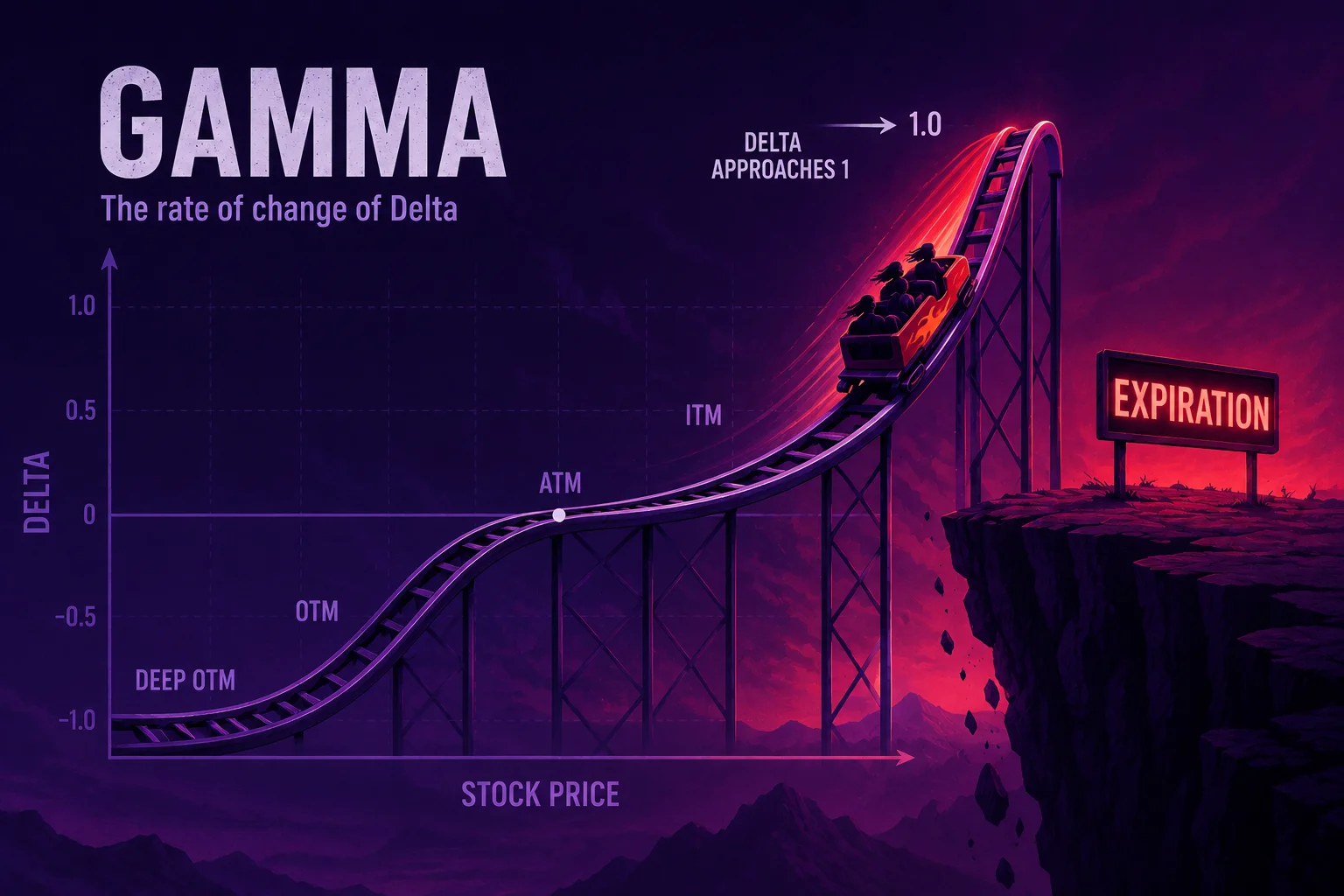
Speed vs Acceleration
Delta tells you where you are. Gamma tells you how fast you're moving. Ignoring Gamma in options trading is like driving a car while watching only your speedometer and never your accelerator — you'll be shocked by how quickly your risk changes when the road turns.
A short option that felt perfectly hedged on Monday can blow through your loss limit by Friday afternoon, even though nothing about the trade "changed." What changed was Gamma — the invisible force that quietly re-writes your Delta after every tick. This guide shows you where Gamma hides, why it explodes near expiration, and exactly how professionals keep it from wrecking their accounts.
TL;DR — Quick Summary
30-sec read- 1Gamma (Γ) measures how fast Delta changes per $1 move in the underlying — it's the acceleration behind your P&L.
- 2At-the-money options near expiration have the highest Gamma; deep ITM and deep OTM options have almost none.
- 3Buyers are long Gamma (big moves help them); sellers are short Gamma (big moves hurt them) in exchange for Theta.
- 40DTE and last-week options carry extreme Gamma risk — a position can flip from profit to max loss in minutes.
Continue reading for the full guide with examples and strategies.
Key Takeaways
6 points- 1Gamma measures how fast Delta changes per $1 move in the underlying stock.
- 2High Gamma = Delta changes rapidly = position gets riskier faster. Dangerous near expiry.
- 3ATM options have the highest Gamma. Deep ITM and OTM options have low Gamma.
- 4Short options positions have negative Gamma — you lose money if the stock moves sharply in either direction.
- 5Gamma risk is highest in the last 7-14 days before expiration (0DTE options are extreme Gamma risk).
- 6You cannot eliminate Gamma, but you can size, structure, and time trades to keep it manageable.
What Is Gamma in Options Trading?
If you have ever searched for what is Gamma in options trading for beginners, here is the simplest definition: Gamma (Γ) is the rate of change of an option's Delta. Where Delta measures how much the option price moves for a $1 move in the stock, Gamma measures how much Delta itself moves for that same $1. In calculus terms, Delta is the first derivative of the option price and Gamma is the second derivative. In driving terms, Delta is your speed and Gamma is your acceleration.
Example: a call option has Delta = 0.50 and Gamma = 0.05. If the stock rises $1, the new Delta is roughly 0.50 + 0.05 = 0.55. If it rises another dollar, Delta climbs to about 0.60. Your position is getting more sensitive to the stock with every move — that compounding sensitivity is Gamma at work. If you're still shaky on the underlying concept, start with our guide to understanding Delta and the broader options Greeks for beginners.
Key Relationship
New Delta ≈ Old Delta + (Gamma × Stock Price Change)This is an approximation — Gamma itself changes as the stock moves. But it's accurate for small price movements and is the single most useful equation for anticipating how your risk evolves.
Two properties make Gamma easy to reason about. First, long options (both calls and puts you buy) always have positive Gamma. Second, short options (calls and puts you sell) always have negative Gamma. The sign of your Gamma tells you instantly whether sharp moves are your friend or your enemy.
Which Options Have the Highest Gamma?
Knowing which options have the highest Gamma is the key to anticipating how quickly your risk can change. Gamma is not spread evenly across the options chain — it concentrates around the at-the-money (ATM) strike and intensifies as expiration approaches. The table below is a practical reference for how Gamma behaves across moneyness and time.
Illustrative Gamma by Moneyness and Days to Expiry
Example values for a $100 stock, 30% IV — for intuition, not exact quotes
| Strike / Moneyness | 45 DTE | 14 DTE | 2 DTE | Risk Level |
|---|---|---|---|---|
| $110 (Deep OTM) | 0.015 | 0.010 | ~0.00 | Low |
| $100 (ATM) | 0.040 | 0.075 | 0.200 | Highest near expiry |
| $90 (Deep ITM) | 0.015 | 0.010 | ~0.00 | Low |
💡 The Pattern to Memorize
Gamma peaks at the money and grows explosively as expiration nears. An ATM option with 45 days left has modest Gamma; the same strike with 2 days left can have four to five times more. Deep ITM options already have a Delta near 1.0 and deep OTM options a Delta near 0.0 — neither has much room for Delta to change, so their Gamma is small at every expiration.
Long Gamma vs Short Gamma: What's the Difference?
The difference between long Gamma and short Gamma comes down to whether you bought or sold the option, and it decides whether sharp moves help or hurt you.
Long Gamma (Buyers)
- • Big moves in either direction help you
- • Delta accelerates in your favor as the stock runs
- • Your winners grow faster; your losers slow down
- • The cost: you pay Theta every single day
Short Gamma (Sellers)
- • Big moves in either direction hurt you
- • Delta moves against you faster as the stock runs
- • Your losses accelerate; your gains flatten out
- • The reward: you collect Theta every single day
The Theta-Gamma Trade-Off
Option sellers profit from Theta (time decay) but suffer from Gamma (large moves). This is the core risk-reward of options selling. ATM options near expiry have the highest Theta AND the highest Gamma — maximum daily income but maximum risk if the stock moves sharply. Every premium seller is, in effect, being paid to accept negative Gamma. The skill is getting paid enough to justify it.
Why Is Gamma Risk Highest Near Expiration (0DTE)?
If you are wondering why Gamma risk is highest near expiration, zero-days-to-expiry (0DTE) options are the clearest example of an extreme Gamma environment. With almost no time value left, an option's Delta must resolve toward either 1.0 (finishing in-the-money) or 0.0 (finishing worthless) within hours. That forces Delta to swing violently around the strike — which is another way of saying Gamma is enormous.
In practice, a 0DTE ATM option can see its Delta lurch from 0.50 to 0.80 on a modest intraday move, then back again, several times before the close. For a seller, this means a position that shows a small profit at noon can hit maximum loss by 3:00 PM without any dramatic headline. 0DTE trading is popular with day traders precisely because of this leverage, but it is arguably the highest Gamma risk retail traders can take on.
⚠️ The Expiration-Week Trap
Traders who sell ATM premium in the final week often feel safe because Theta income looks juicy and the stock "hasn't moved much." But a single earnings leak, Fed surprise, or index rebalance can move the underlying enough that runaway Gamma turns a week of collected Theta into a one-day loss. Near expiry, Gamma — not direction — is usually the risk that ends the trade.
How a Short Call Gets Away From You
Educational ExampleA step-by-step look at negative Gamma turning a calm trade into a fast loss.
Suppose AAPL trades at $200 and you sell one 200-strike call expiring in 3 days for $2.50 ($250 credit). At entry the call's Delta is -0.50 (you're short, so you're short 50 deltas) and Gamma is 0.06.
- Day 1 — stock rises to $203: Gamma pushes the call's Delta up. Your short Delta grows from roughly -50 to about -68. You are now much more exposed to further upside than when you started — Gamma made the position more directional without you doing anything.
- Same day — stock jumps to $206 on news: Delta climbs toward -0.85. The call you sold for $2.50 is now worth about $6.80. Your $250 credit has become an unrealized loss of roughly $430.
- The Theta comfort was an illusion: You were collecting perhaps $40-$50 a day in time decay. A single $6 move — well within a normal AAPL day — erased more than a week of that income because negative Gamma accelerated your Delta against you.
The lesson: near expiration, the credit you collect is small relative to the Gamma risk you carry. Model the same trade in the Options Profit Calculator and watch how steeply the P&L curve bends once the stock clears your strike.
This is a hypothetical scenario using historical market data for educational purposes only. Past performance does not guarantee future results.
How to Manage Gamma Risk (and How to Trade Gamma)
You can't delete Gamma from an options position, but you can control how much of it you carry and when. These are the tactics professional sellers use to keep negative Gamma from ending their week.
- Use spreads instead of naked options. Buying a further-out strike against your short strike caps Gamma. A credit spread has far less net Gamma than a naked short option because the long leg's positive Gamma offsets the short leg's negative Gamma.
- Sell in the 30-45 DTE window, not expiration week. This is the zone where Theta is meaningful but Gamma is still tame. Selling ATM options with 2-5 days left is maximum Gamma risk for a shrinking reward.
- Close at 50% of max profit. Taking winners early removes the remaining Gamma risk before expiration week — where most short-premium blow-ups happen.
- Gamma scalp if you're long Gamma. Owning a straddle gives you positive Gamma; as the stock moves, you can trade shares against your growing Delta to lock in profit. This is the core of delta neutral trading.
- Check Gamma before every entry. High Theta with manageable Gamma is the seller's sweet spot. Use the Options Greeks Calculator to see the exact number, then pressure-test the trade in the Options Strategy Builder.
Gamma vs Delta: What's the Difference?
Beginners often ask about the difference between Gamma and Delta in options, and the distinction is simple once you frame it as motion. Delta tells you how much an option's price changes for a $1 move in the stock — it's your current speed. Gamma tells you how much that Delta itself changes for the same $1 move — it's your acceleration. A position can have a comfortable Delta today, but a high Gamma means that Delta (and your risk) can change dramatically after a single sharp move. That is why traders watch both numbers together rather than Delta alone. Gamma is also why static Delta hedges drift out of balance: as the stock moves, Gamma constantly re-writes your Delta, forcing you to re-hedge.
What Is a Gamma Squeeze?
A gamma squeeze is one of the most searched Gamma topics because it explains the explosive, seemingly irrational rallies you occasionally see in heavily shorted or meme stocks. It happens when a wave of call buying forces the options market makers who sold those calls to hedge — and that hedging itself pushes the stock higher, creating a self-reinforcing feedback loop.
Here is the mechanism step by step. When traders buy huge quantities of out-of-the-money calls, the dealers on the other side are left short those calls, which means they are short Gamma. To stay neutral, dealers buy shares of the underlying to hedge their growing short Delta. As the stock rises toward the popular strike, Gamma pushes the calls' Delta up fast, forcing dealers to buy even more shares. That buying lifts the price again, drags more strikes into the money, and pulls in fresh momentum buyers — the loop repeats until the strike cluster is fully in-the-money and hedging is complete.
Why a Gamma Squeeze Is Different From a Short Squeeze
A short squeeze is driven by short sellers of the stock buying to cover their losing positions. A gamma squeeze is driven by options dealers buying to hedge, not by anyone's directional bet. The two often occur together and amplify each other, but a gamma squeeze is a purely mechanical consequence of options hedging. It is also self-limiting: once expiration passes or the calls are fully hedged, the forced buying stops and the move frequently unwinds just as violently.
Gamma Exposure (GEX), the Gamma Flip, and Pinning
Zoom out from a single position and Gamma also describes how the entire options market can push a stock around. Gamma Exposure, or GEX, estimates how much stock dealers must mechanically buy or sell to stay hedged for each 1% move in the underlying. It is essentially the aggregate net Gamma of all outstanding options, and it tells you whether dealer hedging is likely to calm the market or accelerate it.
Positive GEX (dealers long Gamma)
- • Dealers sell into rallies and buy dips to stay hedged
- • That hedging damps volatility and can "pin" price near big strikes
- • Markets tend to feel calm and mean-reverting
Negative GEX (dealers short Gamma)
- • Dealers must buy as price rises and sell as it falls
- • That hedging amplifies moves instead of damping them
- • Markets tend to trend hard and gap — squeezes live here
The price where net dealer Gamma crosses from positive to negative is called the gamma flip or zero-gamma level. Above it, hedging tends to suppress volatility; below it, hedging tends to add fuel. This is also why you often see "pinning" — a stock drifting toward a strike with huge open interest on expiration day, because positive-Gamma dealer hedging quietly nudges it there. You do not need institutional GEX data to trade well, but knowing the concept explains why some expiration days feel eerily calm and others turn into trend days.
💡 Related Second-Order Greeks
Gamma is a second-order Greek (the rate of change of Delta). Two of its cousins are worth knowing by name: charm measures how Delta drifts simply as time passes, and color measures how Gamma itself changes over time. You do not need to compute these to trade, but they explain why a hedged position slowly goes off-balance overnight even when the stock never moves — the same reason short Gamma near expiry demands constant attention.
See Your Real Gamma Before You Trade
Don't guess how fast your Delta will move. Enter your strike, expiry, underlying price, and IV to get the exact Gamma — alongside Delta, Theta, and Vega — for any option in seconds.
Enter your option's strike and expiration
Read the Gamma value and Theta side by side
Confirm risk is manageable before entering
People Also Ask
What is Gamma in options trading?
Gamma measures how fast an option's Delta changes for each $1 move in the underlying stock. If Delta is your speed, Gamma is your acceleration. High Gamma means your Delta — and therefore your P&L sensitivity — changes rapidly with small moves. At-the-money options near expiration have the highest Gamma.
Why is Gamma highest near expiration?
Near expiration, small stock moves dramatically change whether an option finishes in-the-money or out-of-the-money. That forces Delta to swing toward 1.0 or 0.0 very quickly, which is exactly what high Gamma means. In the final 7-14 days — and especially on 0DTE options — Gamma becomes the dominant risk on ATM strikes.
Is long Gamma or short Gamma better?
Neither is universally better — they suit different goals. Long Gamma (option buyers) profits from large moves but pays Theta daily. Short Gamma (option sellers) collects Theta but loses on sharp moves. Buyers want volatility; sellers want the stock to sit still. Your market view decides which side you want.
How do you reduce Gamma risk?
Use defined-risk spreads instead of naked options, sell in the 30-45 DTE window rather than expiration week, close winning short trades at around 50% of max profit, and avoid selling ATM options with only a few days left. Checking Gamma on a Greeks calculator before entry keeps you from carrying more than you realize.
What is a gamma squeeze?
A gamma squeeze is a self-reinforcing rally caused by options hedging rather than fundamentals. Heavy call buying leaves dealers short Gamma, so they buy shares to hedge; that buying lifts the stock, which forces them to buy even more as the calls' Delta climbs. The loop feeds on itself until the calls are fully hedged or expire, at which point the move often unwinds sharply.
What is gamma exposure (GEX)?
GEX estimates how much stock dealers must mechanically buy or sell to stay hedged for each 1% move in the underlying — essentially the market's aggregate net Gamma. Positive GEX means dealer hedging damps volatility (selling rallies, buying dips), while negative GEX means hedging amplifies moves. The price where it flips sign is called the gamma flip or zero-gamma level.
Frequently Asked Questions
What is the difference between Gamma and Delta?
Delta measures how much an option's price changes for a $1 move in the stock (your speed). Gamma measures how much that Delta changes for the same $1 move (your acceleration). A low Delta can still be dangerous if Gamma is high, because a single sharp move can rapidly increase your Delta and your exposure. That's why experienced traders never look at Delta in isolation.
Do calls and puts have different Gamma?
No — at the same strike and expiration, a call and a put have the same Gamma. Gamma depends on moneyness, time to expiry, and volatility, not on whether the contract is a call or a put. What differs is the sign of your exposure: buying either gives you positive Gamma, while selling either gives you negative Gamma.
Why do 0DTE options move so violently?
0DTE (zero-days-to-expiry) options have almost no time value, so their Delta must resolve toward 1.0 or 0.0 within hours. That produces extreme Gamma around the ATM strike — Delta can swing from 0.5 to 0.8 and back on modest intraday moves. The result is huge P&L swings from small stock moves, which is why 0DTE selling is considered high-risk.
How does Gamma affect option sellers specifically?
Sellers are short Gamma, meaning their Delta moves against them as the stock runs. A short call's negative Delta grows as the stock rises, accelerating losses; a short put's positive Delta grows as the stock falls. Sellers accept this negative Gamma in exchange for Theta income, so the goal is to collect enough premium and close early enough that a sharp move can't overwhelm the Theta collected.
Can you make money trading Gamma directly?
Yes — this is called gamma scalping. A long-Gamma position (such as a long straddle) becomes more positively directional as the stock rises and more negatively directional as it falls. Traders repeatedly sell shares into rallies and buy them back in dips to harvest that drift, profiting from realized volatility. It requires active management and works best when actual movement exceeds what the option's implied volatility priced in.
Related Articles
Investment Risk Disclaimer
This content is for educational purposes only and should not be considered financial advice. All investments carry risk, including the potential loss of principal. Past performance does not guarantee future results. Before making any investment decisions, please consult with a qualified financial advisor who understands your personal financial situation, risk tolerance, and investment goals.
Stock Averager provides tools and educational content but does not provide personalized investment advice or recommendations.
Explore this topic in depth
Options Greeks
The variables that price every option — direction, time, volatility — and how they fight each other.
- Options Greeks Explained Simply: The Secret Language of Pricing (main guide)Delta, gamma, theta, vega and rho — the vocabulary of every strategy.
- Understanding Delta: The Most Important Options GreekDirectional exposure and the probability reading that guides strike selection.
- Theta Decay: Why Your Options Lose Value Every DayHow time decay actually accrues, and the '80% expire worthless' myth.
- Vega in Options: Why Your Option Lost Money Despite Being RightVolatility exposure, and being right on direction while still losing.
- IV Crush: Why Your Options Lost Money Despite Being RightThe post-earnings volatility collapse that ruins well-reasoned trades.
- How to Read an Options Chain: A Complete Step-by-Step GuideOpen interest, implied volatility and skew, read column by column.
About Stock Averager Team
Expert financial analysts dedicated to simplifying complex investment strategies for everyone. We build tools that help you make better money decisions.