
Averaging Down on Crypto: The Same Formula With Nothing Underneath It
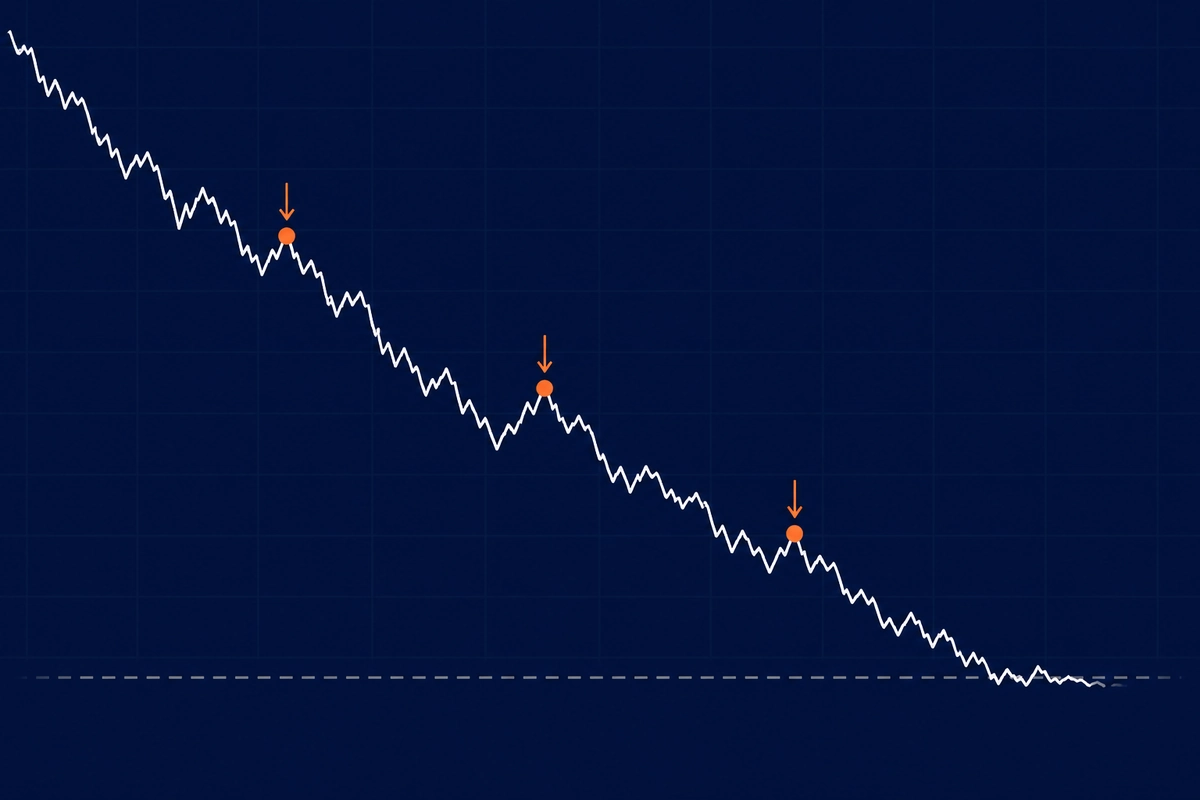
The Same Formula, With Nothing Underneath It
Averaging down on crypto uses exactly the same arithmetic as averaging down on a stock, and the average down calculator works identically for a token as for a share. What is missing is everything the stock version quietly relies on: earnings, a balance sheet, a valuation you can check your thesis against.
When someone averages down a stock they can at least ask whether the business is still worth what they thought. In crypto there is frequently no equivalent question to ask — which means the discipline has to come from position sizing and rules rather than from analysis.
TL;DR — Quick Summary
30-sec read- 1The maths is unchanged: your average cost falls the same way, and fractional units make the share count exact rather than rounded.
- 2What is missing is the anchor. Most tokens have no cash flows, so there is no valuation to say whether a 70% drawdown is a bargain or a warning.
- 3Drawdowns are far deeper and last far longer than in equities, so a plan sized for a 30% fall is not a plan.
- 4Bitcoin and Ethereum are a different risk category from small-cap tokens — the latter regularly do not recover at all.
- 5Position size is the only genuine protection. Set the maximum before the first purchase and treat it as permanent.
Continue reading for the full guide with examples and strategies.
Who This Is For
Intermediate LevelPerfect if you:
- You hold crypto that is well below your entry and are deciding whether to add
- You want to apply the averaging-down maths you already use for stocks
- You are running a scheduled crypto purchase and want to know if that is different
- You hold a small-cap token and are not sure the usual rules apply
You'll learn:
- What changes and what does not when the asset has no fundamentals
- Why crypto drawdown depth breaks plans built for equity volatility
- The difference between scheduled buying and reactive averaging down here
- Why fees and spreads matter more than most people account for
- A rules-based approach that does not require a valuation you cannot produce
What is identical
The cost basis calculation does not care what the asset is. Own 0.5 BTC at $60,000 and buy another 0.5 at $30,000, and your average is $45,000 — the same weighted average you would compute for shares. The formula for reaching a target average is unchanged:
Additional Units = (Owned × (Original − Target)) ÷ (Target − Current)One genuine convenience: crypto is divisible to many decimal places, so the rounding-down step that applies to whole shares does not apply here. If the calculation says 0.3847 ETH, you can buy 0.3847 ETH, and your average lands exactly where you intended rather than approximately.
The break-even mathematics is unchanged too, and it bites much harder here because the drawdowns are bigger. Recovering a loss of L still requires a gain of L ÷ (1 − L) — but where a bad equity drawdown is 40%, a routine crypto drawdown is 70% or more, and 70% down requires a 233% gain to get back to flat.
What is missing
Averaging down on a stock is defensible when you can argue that price has diverged from value. That argument needs a value — earnings, cash flows, assets, a multiple you can compare to peers. Most crypto assets do not have one, and the usual substitutes are weaker than they appear.
There are usually no cash flows
A stock at 8x earnings is cheap against something. A token at $4 that was $12 is cheap only against its own previous price, which is not a valuation — it is a chart. Staking yields are the nearest analogue, but a yield paid in the same token whose price you are worried about does not anchor that price.
Tokenomics can dilute you quietly
Many tokens have vesting schedules and emissions that increase supply for years after launch. The price can fall while adoption genuinely grows, simply because new supply arrives faster than demand. Averaging down into an unlock schedule means buying repeatedly into a known, ongoing seller.
Nothing forces a recovery
An index recovers because failing constituents get replaced. A good company recovers because it keeps earning. A token recovers only if enough people decide to buy it again — and a very large share of tokens from any given cycle never see their previous highs, on any timeframe.
The counterparty may not survive
Beyond the asset itself, exchange failure, bridge exploits and custody loss have permanently destroyed positions that were otherwise correct. This risk has no equivalent in a brokerage account holding ordinary shares, and adding to a position increases your exposure to it.
Drawdowns that break equity-sized plans
The single most common failure in crypto averaging down is a plan built for the wrong scale. A tranche ladder with steps at 15%, 25% and 35% below entry is a reasonable structure for a large-cap stock. In crypto it exhausts your entire budget inside the first leg of a decline that has 50% still to go.
| Drawdown | Gain needed to break even | Context |
|---|---|---|
| 30% | 42.9% | An ordinary equity correction |
| 50% | 100% | A severe equity bear market |
| 70% | 233% | A routine crypto cycle low |
| 85% | 567% | Common for major assets in a deep bear market |
| 95% | 1,900% | Frequent outcome for small-cap tokens |
Read the bottom two rows carefully, because they are the reason position sizing matters more here than anywhere else. At a 95% drawdown, averaging down does not meaningfully change your outcome — you need a twentyfold move regardless, and whether your average is $10 or $6 is a detail. By the time averaging down feels most compelling, it has largely stopped being the lever that matters.
A three-tranche plan sized for crypto rather than equities
Educational ExampleIllustrative only. The point is the spacing and the cap, not the specific numbers.
You decide a single crypto asset may occupy at most $6,000 — a number chosen because losing all of it would be survivable, not because of anything on the chart.
- Tranche 1 — $3,000 at entry. Half the budget goes in first, so a straight recovery is not wasted.
- Tranche 2 — $1,500 if the price falls 40%.
- Tranche 3 — $1,500 if the price falls 65%.
- Hard cap — $6,000. There is no fourth tranche at any price.
Note the spacing: 40% and 65%, not 15% and 25%. A plan whose triggers are all inside the first third of a typical crypto decline is a plan to be fully invested before the drawdown is half done. And note what the cap protects — not your average price, but your ability to be completely wrong about this asset and still be fine.
This is a hypothetical scenario using historical market data for educational purposes only. Past performance does not guarantee future results.
Scheduled buying is a different thing
Buying a fixed amount of Bitcoin every month and averaging down after a crash are frequently described with the same words, and they are not the same behaviour. The scheduled version makes no claim about price: it buys the same amount whether the asset is at a high or a low, and its discipline comes from being automatic. The reactive version is a decision, taken at the worst possible moment for decision-making, that this price is a bargain.
In an asset class with no valuation anchor, the scheduled approach is the more defensible of the two precisely because it does not require you to be right about the price. If your instinct in a crash is to deploy more than usual, the disciplined version of that instinct is to decide the extra amount and the dates in advance — turning a reaction into a plan. Averaging down vs dollar-cost averaging covers the distinction in full.
Fees, spreads and the cost of many small buys
Crypto trading costs are higher and less visible than equity commissions. Exchange fees commonly run 0.1% to 0.6% per trade depending on venue and tier, retail brokerage apps often bury a wider spread in the quoted price, and on-chain transactions add network fees that are unrelated to your order size.
This compounds badly with a many-tranche plan. Eight small purchases at an effective all-in cost of 0.5% each spend 4% of the deployed capital on execution — on a position you are entering because you think it is undervalued by rather more than 4%, but still. Because these fees are percentage-based, they behave like the percentage-commission case in the average down calculator: they raise the true cost of every unit you buy, which means a target average close to the current price can become genuinely unreachable.
Tax: one significant difference
In the US, digital assets are treated as property for tax purposes, so disposals produce capital gains and losses much as shares do, and holding period still separates short-term from long-term treatment. The notable difference concerns the wash sale rule.
The wash sale position is unsettled — do not rely on folklore
The wash sale rule in the US is written in terms of “stock or securities”, which is why it has widely been treated as not applying to crypto, and why tax-loss harvesting followed by an immediate repurchase became a common practice. This is an area that legislators have repeatedly proposed changing, and the treatment may well differ by the time you file. Other countries handle it entirely differently — the UK, for instance, applies same-day and 30-day matching rules to crypto disposals. Confirm the current position with a professional rather than repeating what was true in a previous tax year.
The record-keeping burden is also genuinely heavier. Every tranche is a separate lot with its own acquisition date and cost, exchanges vary in the quality of their reporting, and moving assets between wallets can obscure the trail. A plan of many small purchases produces many small lots, and reconstructing them at tax time is materially harder than reading a brokerage statement.
A rules-based approach when you cannot value the asset
The honest position is that in most crypto cases you cannot produce the valuation argument that justifies averaging down a stock. So the discipline has to be structural instead of analytical.
Defensible
- A total cap set before the first buy, sized so losing all of it changes nothing important.
- Tranches spaced for crypto-scale declines — 40%, 65% — not equity-scale ones.
- Sticking to assets with the longest history and deepest liquidity if you are going to add at all.
- A schedule rather than a reaction, so the decision is not made during the crash.
Not defensible
- Averaging down with borrowed money or on a leveraged position — liquidation removes the ability to wait.
- Adding to a small-cap token purely because it has fallen a long way.
- Buying into an active unlock or emissions schedule you have not checked.
- Increasing a position to a size where being wrong would genuinely hurt you.
Set the cap with the position size calculator before anything else, then use the average down calculator to see what each tranche actually does to your average — including the exchange fee, which on a percentage basis is larger than most equity commissions.
Key Takeaways
5 points- 1The arithmetic transfers from stocks unchanged; fractional units mean your average lands exactly where you planned.
- 2The valuation anchor does not transfer. Without cash flows there is no way to argue price has diverged from value.
- 3Crypto drawdowns of 70-85% are routine, so tranches spaced for equity declines exhaust the budget far too early.
- 4Percentage-based exchange fees and spreads make many-tranche plans expensive, and can put a target average out of reach.
- 5The cap on total position size is the only protection that works without requiring you to be right.
Related questions on averaging down crypto
Is averaging down on Bitcoin a good idea?
It is the most defensible case in the asset class, since Bitcoin has the longest history, the deepest liquidity and a fixed supply schedule, and it has recovered from 80%-plus drawdowns before. That is history rather than a guarantee, and the recoveries took years. If you do it, size it so that a permanent loss of the position would not change your circumstances, and space the tranches for declines far deeper than equity investors are used to.
Should I average down on altcoins?
The bar is much higher and most positions do not clear it. A large proportion of tokens from any given cycle never regain their previous highs, and many have ongoing token unlocks that add supply for years after launch. Averaging down into an emissions schedule means buying repeatedly from a seller who is not price-sensitive - check the tokenomics before deciding the chart is the whole story.
How is crypto DCA different from averaging down?
DCA buys a fixed amount on a fixed schedule regardless of price, so it makes no claim about whether the asset is cheap. Averaging down is a discretionary decision that this price is a bargain, taken during a decline. In an asset class with no valuation anchor to check that claim against, the scheduled version is the more defensible of the two.
Frequently Asked Questions
Does the average down calculator work for crypto?
Yes. The maths is identical, and because crypto is divisible to many decimal places, the answer is exact rather than rounded to whole units. Enter your existing holding, your average cost, the current price and the average you want, and add your exchange fee as a percentage - that last part matters more in crypto than in equities, where flat commissions are the norm.
How deep are crypto drawdowns compared with stocks?
Substantially deeper and longer. A severe equity bear market is a 50% decline; major crypto assets have repeatedly fallen 80% or more in cycle downturns, and small-cap tokens routinely fall 95% and stay there. Any tranche plan carried over unchanged from equity investing will be fully deployed long before a typical crypto decline has finished.
Should I average down on crypto with leverage?
No. Averaging down requires the ability to hold through a drawdown, and leverage is precisely what removes that ability - a liquidation converts a temporary decline into a permanent loss regardless of what the asset does afterwards. The two are structurally incompatible, and this is the single most reliable way people turn a survivable position into a total one.
What is the tax treatment of averaging down on crypto?
In the US, digital assets are treated as property, so disposals produce capital gains and losses and the holding period still separates short-term from long-term rates. The wash sale rule is written in terms of stock or securities, which is why it has widely been treated as not applying - but this has been the subject of repeated legislative proposals and rules differ by country. Check the current position rather than relying on what was true in an earlier year.
How much of my portfolio should be in one crypto asset?
Small enough that a permanent loss of the whole position would not change your plans - which for most people means a single-digit percentage of investable assets, and often much less. The number matters far more than your entry price, because it is the only variable that determines whether being completely wrong about the asset is survivable.
What does averaging down not fix?
It does not recover a loss - it lowers the price at which the loss disappears, while increasing the money exposed to the outcome. It cannot help with an asset that never recovers, and past a certain drawdown it stops mattering much at all: at 95% down you need a twentyfold move whether your average is $10 or $6. Averaging down changes the shape of a bet, not whether the bet was a good one.
Investment Risk Disclaimer
This content is for educational purposes only and should not be considered financial advice. All investments carry risk, including the potential loss of principal. Past performance does not guarantee future results. Before making any investment decisions, please consult with a qualified financial advisor who understands your personal financial situation, risk tolerance, and investment goals.
Stock Averager provides tools and educational content but does not provide personalized investment advice or recommendations.
Sources & Further Reading
Figures and rules cited in this article are drawn from the primary sources below. Tax and regulatory details change — always confirm against the current official guidance for your jurisdiction.
- 1Digital Assets — Internal Revenue ServiceUS treatment of digital assets as property, and the reporting obligations that follow from it.
- 2Publication 550: Investment Income and Expenses — Internal Revenue ServiceThe wash sale rule as written for stock and securities - the text underlying the unsettled question of how it applies to digital assets.
About Stock Averager Team
Expert financial analysts dedicated to simplifying complex investment strategies for everyone. We build tools that help you make better money decisions.