
Averaging Down on ETFs vs Individual Stocks: Same Maths, Different Bet
Identical Arithmetic, Opposite Risks
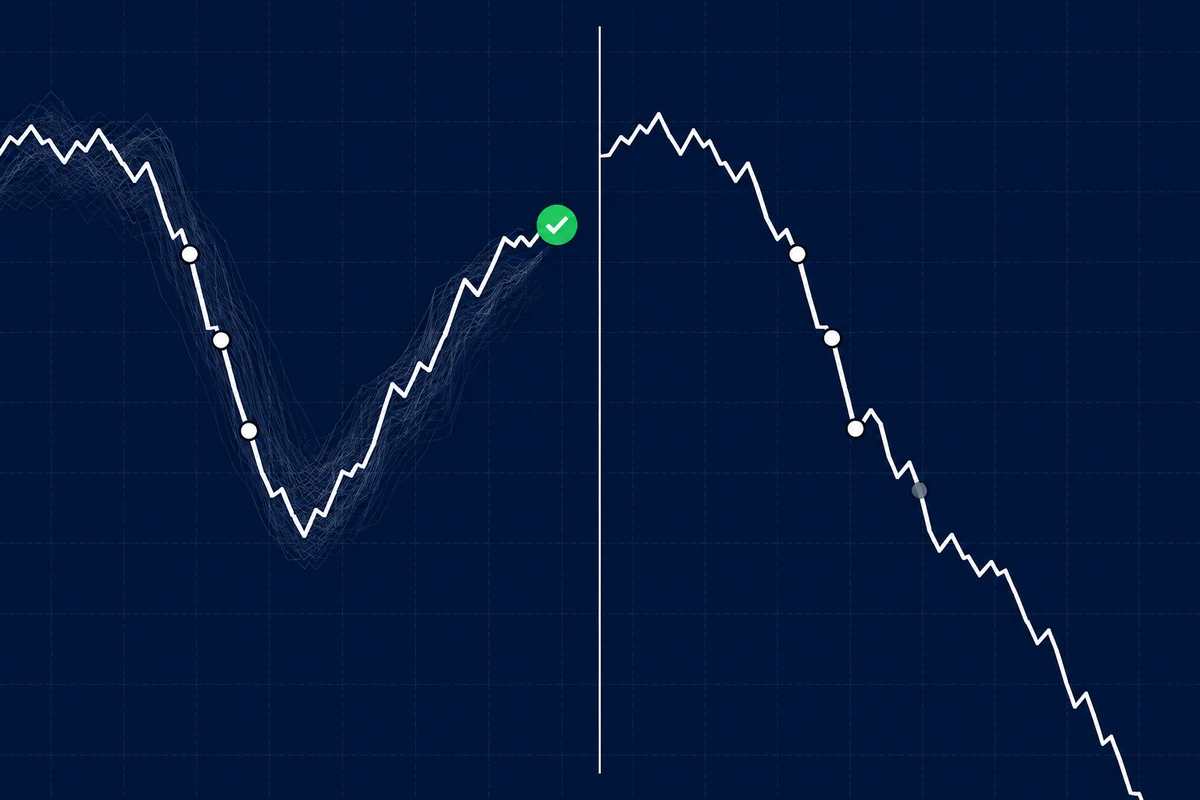
Buying more of a falling S&P 500 ETF and buying more of a falling single stock use exactly the same formula. Your average cost moves the same way, and the average down calculator gives the same answer for both. What differs is what you are betting on — and that difference is large enough that the two decisions deserve completely different levels of scrutiny.
One is a bet that the market as a whole recovers, which it always has. The other is a bet that this specific management team, in this specific industry, is going to be fine — which is true far less often than investors averaging into a loser tend to assume.
TL;DR — Quick Summary
30-sec read- 1The maths is identical. The risk is not: an index cannot go to zero the way one company can, because its failing components get replaced.
- 2Averaging down an ETF is closer to scheduled investing than to a decision — it needs a budget, not a thesis.
- 3Averaging down a single stock needs a reason you can state in one sentence, and a cap set before the first purchase.
- 4The concentration trap only exists on single stocks: the position that has fallen furthest becomes your largest holding precisely because it performed worst.
- 5Sector and thematic ETFs sit between the two. They diversify company risk but not the bet on the theme, and they are frequently averaged into as though they were broad index funds.
Continue reading for the full guide with examples and strategies.
Who This Is For
Intermediate LevelPerfect if you:
- You hold both index funds and individual stocks and want one rule for each
- A broad-market ETF is down and you are deciding whether to add
- A single position is down heavily and you are tempted to double it
- You bought a sector or thematic ETF and are not sure which category it belongs to
You'll learn:
- Why an index recovers structurally and a single stock does not
- The concentration trap that only affects single-stock averaging
- How to treat sector and thematic ETFs, which are neither one thing nor the other
- A worked comparison of the same drawdown on both
- Practical rules you can apply to each without re-deciding every time
The part that is identical
Cost basis arithmetic does not know what it is being applied to. Whether you own 200 shares of a broad index fund or 200 shares of one company, adding to the position at a lower price moves your average by the same weighted-average calculation, and the number of shares you need to reach a target average comes from the same formula:
Additional Shares = (Owned × (Original − Target)) ÷ (Target − Current)The break-even mathematics is also unchanged. A 40% drawdown needs a 66.7% recovery in both cases, and averaging your basis down halves that requirement in both cases. If the arithmetic were the whole story, the two decisions would be the same decision, and this article would not need to exist.
The part that is not
What differs is what has to happen for the trade to work. That is worth being precise about, because it is the entire basis for treating the two differently.
Broad index ETF
You are betting that the aggregate earnings of hundreds of companies recover. The index has a structural advantage that no single stock has: it is rebalanced. Failing constituents fall out and are replaced by whatever succeeded them, so the index survives the failure of its own components by design.
The realistic downside is a long, painful recovery — not a permanent zero.
Single stock
You are betting on one company, one management team, one balance sheet and one competitive position. There is no rebalancing mechanism to save you. If this business is permanently impaired, your average cost is irrelevant — you own more of something heading somewhere you do not want to go.
The realistic downside includes a permanent loss of the entire position.
This is the whole argument, and it is a structural one rather than a matter of opinion about volatility. Adding to a falling index is a bet on aggregate recovery, which has always eventually arrived. Adding to a falling company is a bet that this particular business is not one of the ones that does not come back — and the price falling is, at minimum, evidence that other people think it might be.
The same 40% drawdown, two different positions
Educational ExampleIllustrative figures. The arithmetic is identical; read what each result actually requires.
Position A — a broad-market ETF
100 units bought at $50, now $30. Adding 100 units at $30 takes your average to $40 for $3,000. For this to work, the market has to do what markets have done after every previous drawdown: recover. You do not need to be right about anything specific. You need the money to not be required for a few years.
Position B — a single stock
100 shares bought at $50, now $30. Identical additional purchase, identical $40 average, identical $3,000. But for this to work, a specific claim has to be true — the market has mispriced this company and its earnings power is intact. If that claim is wrong, you have converted a $2,000 paper loss into a $5,000 one and doubled your exposure to finding out.
Same numbers, different questions. Position A asks whether you can wait. Position B asks whether you are right. Only one of those has a reliable answer.
This is a hypothetical scenario using historical market data for educational purposes only. Past performance does not guarantee future results.
The concentration trap
There is a second asymmetry, and it is the one that does the most damage in practice. It applies to single stocks and barely applies to broad ETFs at all.
Every time you average down a single position, you increase both its size and its share of your portfolio. Do it three times and the holding you were least right about becomes the largest thing you own — because it performed worst. Nothing in that sequence involved a decision to concentrate. Each individual step looked reasonable; the cumulative effect is a portfolio quietly reorganised around your worst idea.
Why this barely applies to a broad ETF
Adding to an index fund increases your equity exposure, but it does not concentrate you in anything — the position is already spread across hundreds of companies, and it stays spread. You can end up over-allocated to stocks relative to your plan, which is a real risk worth watching, but you cannot accidentally end up with 40% of your net worth riding on one management team's next decision.
The defence against this is not willpower, it is arithmetic done in advance. Decide the maximum total position before the first purchase and treat it as a hard cap. The position size calculator sets that number from the loss you can actually afford, rather than from how cheap the stock happens to look on the day you are tempted.
Sector and thematic ETFs: neither one nor the other
The clean split above has an awkward middle. A semiconductor ETF, a clean-energy fund, a single-country fund, an ARK-style thematic product — these are diversified across companies but not across the thing that actually caused the drawdown.
If a sector fund has fallen 45%, it usually has not fallen because one company disappointed. It has fallen because the market repriced the entire theme — rates moved, subsidies changed, a cycle turned. Diversification across thirty companies inside that theme protects you from none of that. So the honest classification is: a sector ETF is a single bet wearing a diversified costume, and it should be averaged into with the discipline you would apply to a stock, not the automatic-pilot approach you would apply to a total-market fund.
| Instrument | What you are betting on | Approach |
|---|---|---|
| Total market / S&P 500 ETF | Aggregate corporate earnings recovering | Schedule it. No thesis needed, just a budget and time. |
| Sector or thematic ETF | One theme or cycle turning back up | Treat as a single bet. Needs a thesis and a hard cap. |
| Individual stock | This company specifically being fine | Highest bar. Thesis, cap, and a re-check at every tranche. |
Rules that survive contact with a falling market
The point of deciding this in advance is that a 40% drawdown is the worst possible moment to be forming a policy. Two sets of rules, one for each case.
For broad index ETFs
- Keep contributing on schedule. A falling market is when scheduled buying does its work.
- If you deploy extra cash, decide the amount in advance rather than in response to a headline.
- Watch total equity allocation, not the individual position — that is the risk that can actually drift.
- Do not attempt to time the bottom. The schedule exists precisely because nobody can.
For individual stocks
- State the thesis in one sentence before adding. If you cannot, that is the answer.
- Set the maximum total position first, and never exceed it however cheap the stock gets.
- Re-check the fundamentals at every tranche. A guidance cut invalidates the plan.
- Ask whether you would open this position today with fresh money and no history.
Two costs that differ between the two
Beyond the risk, two practical frictions land differently and are worth knowing before you plan a series of purchases.
Expense ratios. An ETF charges an annual fee on the whole position, so averaging down increases the assets that fee applies to. On a broad index fund at three to ten basis points this is negligible. On a thematic fund at 0.75% it is a real, permanent drag on a position you are deliberately making larger.
Commission per tranche. If your broker charges per order, every tranche pays again. A plan of four small purchases at $9.95 each spends $40 on execution, which on a $2,000 total position is 2% gone before the thesis gets a chance. This applies to both instruments equally, and it is the reason the average down calculator takes commission as an input rather than assuming trades are free.
One tax difference worth knowing
In the US, the average cost basis method — the blended number most investors think in — is permitted for mutual fund shares and certain dividend reinvestment plans, but not for individual stocks or, generally, for ETF shares held directly. Stock and ETF lots default to FIFO unless you identify specific lots at the time of sale.
The practical consequence for anyone averaging down: selling part of an averaged position may draw from your oldest and most expensive lots rather than from the blended average you have been tracking, which changes the gain or loss you report. Separately, the wash sale rule applies to both instruments — if you sell at a loss within 30 days either side of buying substantially identical shares, that loss is deferred rather than allowed. Tax implications of averaging down covers the detail, and IRS Publication 550 is the primary source.
Key Takeaways
5 points- 1The formula is identical for ETFs and stocks; what differs is whether a specific claim has to be true for the trade to work.
- 2An index recovers structurally because failing constituents are replaced. A single company has no such mechanism.
- 3Averaging down a broad ETF needs a budget and time. Averaging down a stock needs a thesis and a hard cap.
- 4Sector and thematic ETFs are single bets in diversified packaging — apply the stock rules to them.
- 5The concentration trap is single-stock-specific: repeated additions make your worst idea your largest position.
Related questions on averaging into funds and stocks
Is it safer to average down on an ETF than a stock?
Structurally, yes. A broad index fund cannot go to zero the way one company can, because its failing constituents get removed and replaced. That does not make an ETF safe — a long drawdown is still painful and recovery can take years — but the permanent-loss scenario that exists for a single stock does not exist in the same way for a diversified index.
Should I average down on a sector ETF the same way?
No. A sector fund diversifies company risk but not the bet on the sector itself, and a sector-wide drawdown usually reflects the theme being repriced rather than one company disappointing. Treat it with the discipline you would apply to an individual stock: a stated thesis and a total position cap set in advance.
How often should I average down into an index fund?
On a schedule rather than on a trigger. Scheduled investing works because it removes the timing decision, and a falling market is exactly when the schedule earns its keep. If you deploy extra cash during a drawdown, decide the amount and the dates in advance rather than reacting to how frightening the news feels.
Frequently Asked Questions
Does averaging down work the same way for ETFs and stocks?
The arithmetic is identical - the same weighted-average formula gives the same new average cost for both. What differs is the risk you are taking. Adding to a broad index fund is a bet that the market recovers, which historically it has. Adding to a single stock is a bet that one specific business is fine, which is true far less reliably.
Can an ETF go to zero like a stock can?
A broad index ETF effectively cannot, because it is rebalanced: constituents that fail are dropped and replaced, so the index survives the failure of its own components. Narrow, leveraged and single-commodity ETFs are a different matter - leveraged products in particular can decay toward zero through daily rebalancing even when the underlying eventually recovers.
What is the concentration trap in averaging down?
It is the pattern where repeated additions to a falling single stock make it your largest holding precisely because it has performed worst. No individual step looks unreasonable, which is what makes it dangerous. Setting a hard cap on the total position before the first purchase is the only reliable defence.
Do expense ratios matter when averaging down an ETF?
They matter more as the position grows, since the fee applies to the whole holding annually. At three to ten basis points on a broad index fund the effect is negligible. On a thematic fund charging 0.75% or more, deliberately increasing the position also permanently increases the drag on it, which is worth factoring into the decision.
Should I average down on a leveraged ETF?
Generally no. Leveraged and inverse ETFs reset their exposure daily, so in a volatile market they can lose value even when the underlying index ends up flat. They are built as short-term trading instruments, and averaging down is a strategy that requires holding through a drawdown - the two are fundamentally mismatched.
Which should I average down first if both are underwater?
The index fund, in most cases, because it requires no judgement about a specific business and no thesis that could turn out to be wrong. Adding to a losing individual position should clear a much higher bar, and if capital is limited, the trade that does not require you to be right about anything specific is usually the better use of it.
Investment Risk Disclaimer
This content is for educational purposes only and should not be considered financial advice. All investments carry risk, including the potential loss of principal. Past performance does not guarantee future results. Before making any investment decisions, please consult with a qualified financial advisor who understands your personal financial situation, risk tolerance, and investment goals.
Stock Averager provides tools and educational content but does not provide personalized investment advice or recommendations.
Sources & Further Reading
Figures and rules cited in this article are drawn from the primary sources below. Tax and regulatory details change — always confirm against the current official guidance for your jurisdiction.
- 1Publication 550: Investment Income and Expenses — Internal Revenue ServiceCost basis methods available for stock, ETF and mutual fund shares, and the wash sale rule that applies to all three.
- 2Dollar Cost Averaging — U.S. Securities and Exchange Commission (Investor.gov)The regulator's definition of scheduled investing, the approach recommended here for broad index funds.
About Stock Averager Team
Expert financial analysts dedicated to simplifying complex investment strategies for everyone. We build tools that help you make better money decisions.